
C57BL/6-Agttm2(AGT)Bcgen Ren1tm2(REN)Bcgen/Bcgen • 113705


Gene targeting strategy for B-hAGT/hREN mice.
The exons 1-5 of mouse Agt gene that encode the whole molecule were replaced by human counterparts in B-hAGT mice. The promoter, 5’UTR and 3’UTR region of the mouse gene were replaced by human counterparts.
The exons 1-9 of mouse Ren1 gene that encode the whole molecule were replaced by human counterparts in B-hREN mice. The promoter, 5’UTR and 3’UTR region of the mouse gene were replaced by human counterparts.
B-hAGT/hREN mice is obtained by crossing B-hAGT mice (113362) with B-hREN mice (113397).

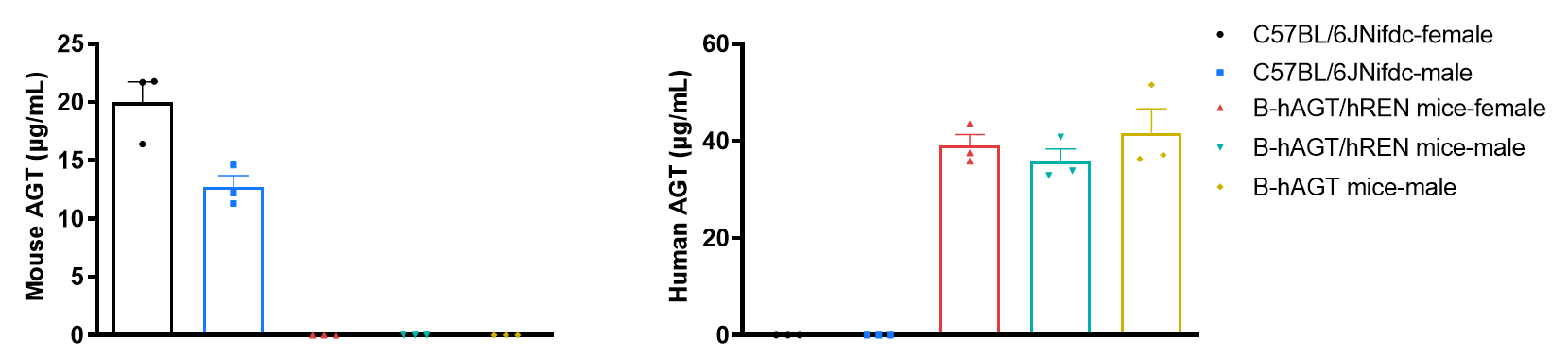
Strain specific AGT expression analysis in wild-type C57BL/6JNifdc, homozygous humanized B-hAGT mice and homozygous humanized B-hAGT/hREN mice by ELISA. Serum was collected from wild-type C57BL/6JNifdc (+/+) (male and female, n=3, 7-week-old), homozygous B-hAGT mice (H/H) (male, n=3, 7-week-old) and homozygous B-hAGT/hREN mice (H/H;H/H) (male and female, n=3, 7-week-old). Expression level of mouse and human AGT were analyzed by ELISA (mouse AGT ELISA kit: Abcam, ab245718; human AGT ELISA kit: Abcam, ab287170). Mouse AGT was exclusively detectable in wild-type C57BL/6JNifdc. Human AGT was exclusively detectable in homozygous B-hAGT mice and homozygous B-hAGT/hREN mice. Values are expressed as mean ± SEM.
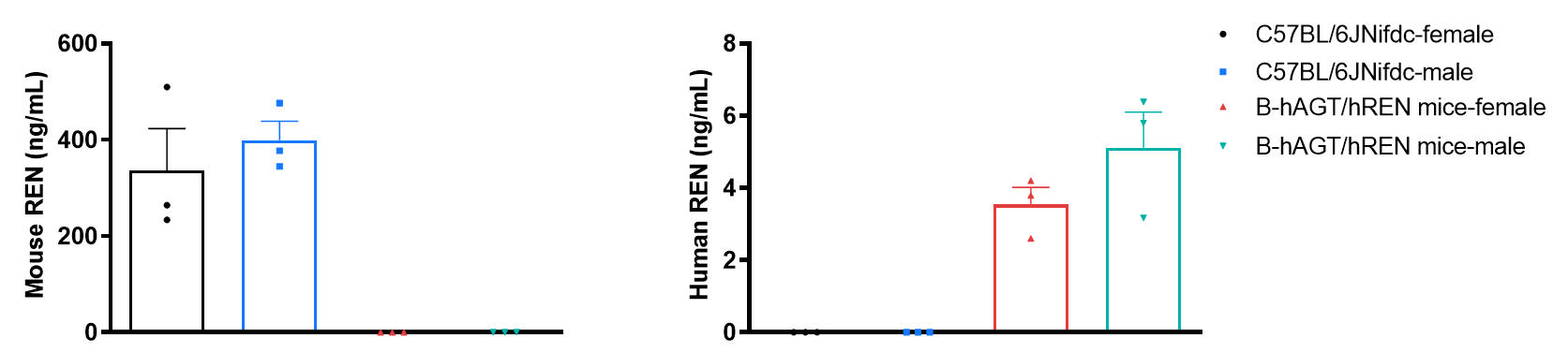
Strain specific REN expression analysis in wild-type C57BL/6JNifdc and homozygous humanized B-hAGT/hREN mice by ELISA. Serum was collected from wild-type C57BL/6JNifdc (+/+) (male and female, n=3, 7-week-old) and homozygous B-hAGT/hREN mice (H/H;H/H) (male and female, n=3, 7-week-old). Expression level of mouse and human REN were analyzed by ELISA (mouse REN ELISA kit: Thermo Fisher, EMREN1; human REN ELISA kit: RD, DREN00). Mouse REN was exclusively detectable in wild-type C57BL/6JNifdc. Human REN was exclusively detectable in homozygous B-hAGT/hREN mice. Values are expressed as mean ± SEM.

Strain specific analysis of AGT gene expression in wild-type C57BL/6JNifdc mice and B-hAGT/hREN mice by RT-qPCR. Liver RNA were isolated from wild-type C57BL/6JNifdc mice (+/+) (male and female, n=3, 7-week-old) and homozygous B-hAGT/hREN mice (H/H;H/H) (male and female, n=3, 7-week-old). Expression level of mouse and human AGT were analyzed by qPCR. Mouse Agt was exclusively detectable in wild-type C57BL/6JNifdc. Human AGT was exclusively detectable in homozygous B-hAGT/hREN mice. Values are expressed as mean ± SEM.


The inhibitory efficiency of the AGT-targeted nucleic acid drugs in homozygous B-hAGT/hREN mice. B-hAGT/hREN mice were randomly divided into four groups (6-8 weeks old, female and male). The human AGT targeted nucleic acid drugs (Zilebesiran-analog) and PBS were administered to the mice individually. Zilebesiran-analog was administered in the form of PBS aqueous solution. The mice were sacrificed on day 7, and the liver tissue was collected to detect the expression level of human AGT protein by ELISA and human AGT mRNA by qPCR. (A) The schematic diagram of experimental processing. (B) The expression of human AGT protein and human AGT mRNA in the liver after treatment. The human AGT in the treatment group was reduced compared to the control group, demonstrating that B-hAGT/hREN mice provide a powerful preclinical model for in vivo evaluation of human AGT-targeted nucleic acid drugs. Values are expressed as mean ± SEM.