C57BL/6-Il4tm2(IL4)Bcgen Il4ratm1(IL4RA)Bcgen Il13tm1(IL13)Bcgen Il13ra1tm1(IL13RA1)Bcgen Tnfrsf4tm1(TNFRSF4)Bcgen Tnfsf4tm1(TNFSF4)Bcgen/Bcgen • 113595
| Product name | B-hIL4/hIL4RA/hIL13/hIL13RA1/hOX40/hOX40L mice |
|---|---|
| Catalog number | 113595 |
| Strain name | C57BL/6-Il4tm2(IL4)Bcgen Il4ratm1(IL4RA)Bcgen Il13tm1(IL13)Bcgen Il13ra1tm1(IL13RA1)Bcgen Tnfrsf4tm1(TNFRSF4)Bcgen Tnfsf4tm1(TNFSF4)Bcgen/Bcgen |
| Strain background | C57BL/6 |
| NCBI gene ID | 3565,3566,3596,3597,7293,7292 (Human) |
| Aliases | BSF1; IL-4; BCGF1; BSF-1; BCGF-1; CD124; IL4RA; IL-4RA; P600; IL-13; NR4; CT19; CD213A1; IL-13Ra; OX40; ACT35; CD134; IMD16; TXGP1L; GP34; CD252; OX4OL; TXGP1; CD134L; OX-40L; TNLG2B |

Gene targeting strategy for B-hIL4/hIL4RA/hIL13/hIL13RA1/hOX40/hOX40L mice.
The exons 1-4 of mouse Il4 gene that encode the full length coding sequence were replaced by human IL4 exons 1-4 in B-hIL4/hIL4RA/hIL13/hIL13RA1/hOX40/hOX40L mice. The exons 4-7 of mouse Il4ra gene that encode the extracellular region coding sequences were replaced by human IL4RA exons 4-7 in B-hIL4/hIL4RA/hIL13/hIL13RA1/hOX40/hOX40L mice. The exons 1-4 of mouse Il13 gene that encode the full length coding sequence were replaced by human IL13 exons 1-4 in B-hIL4/hIL4RA/hIL13/hIL13RA1/hOX40/hOX40L mice. The exons 2-9 of mouse Il13ra1 gene that encode the extracellular protein were replaced by human IL13RA1 exons 2-9 in B-hIL4/hIL4RA/hIL13/hIL13RA1/hOX40/hOX40L mice. The exons 1-5 of mouse OX40 gene that encode the extracellular domain were replaced by human OX40 exons 1-5 in B-hIL4/hIL4RA/hIL13/hIL13RA1/hOX40/hOX40L mice. The exons 2-3 of mouse Ox40l gene that encode the extracellular region were replaced by human OX40L exons 2-3 in B-hIL4/hIL4RA/hIL13/hIL13RA1/hOX40/hOX40L mice.
The B-hIL4/hIL4RA/hIL13/hIL13RA1/hOX40/hOX40L mice were obtained by breeding B-hIL4/hIL4RA/hIL13/hIL13RA1 mice with B-hOX40/hOX40L mice.


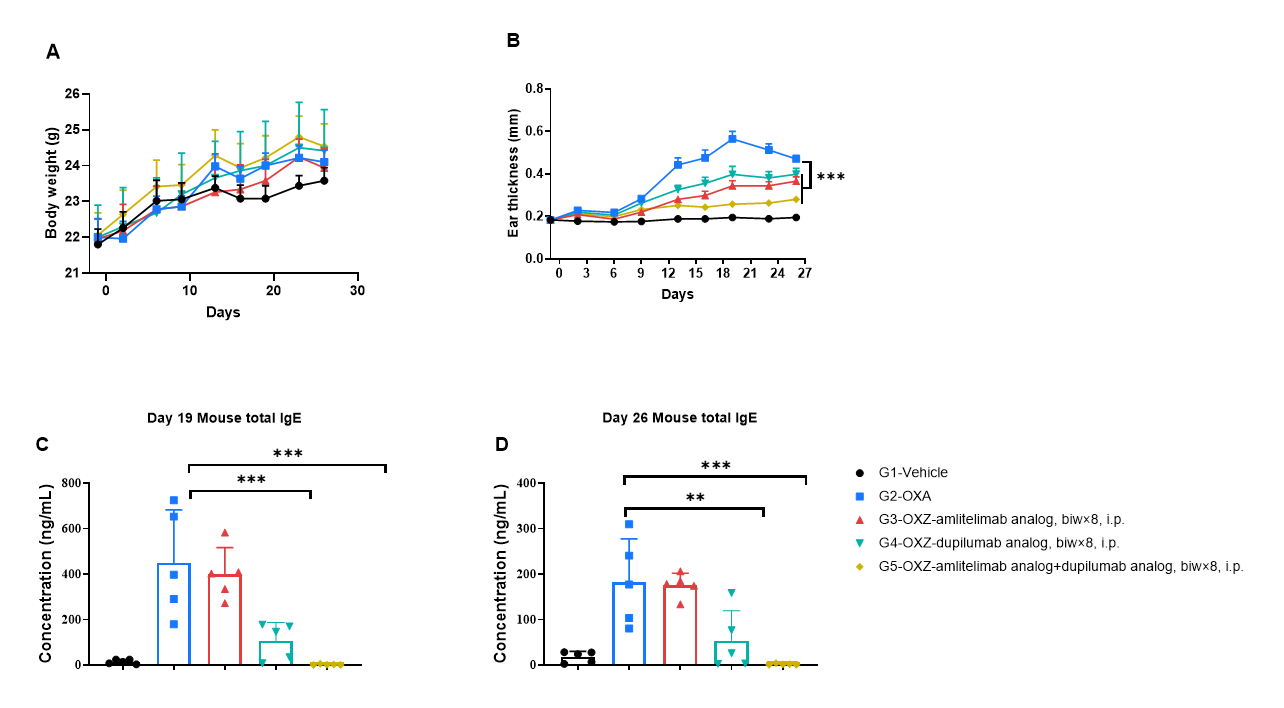
Efficacy of anti-human OX40L antibody amlitelimab analog and anti-human IL4RA antibody dupilumab analog in B-hIL4/hIL4RA/hIL13/hIL13RA1/hOX40/hOX40L mice. (A&B) Ear thickness and body weight changes during the treatment. (C&D) Total IgE levels in serum. The results showed that compared to the untreated group (G2), the group of mice treated with amlitelimab analog (provided by a client) or dupilumab analog (provided by a client) showed a significant reduction in ear thickness. Serum was collected at the study endpoint. IgE level was analyzed by ELISA. The results showed that the levels of total IgE in mice treated with amlitelimab analog or dupilumab analog was lower than that in untreated mice. Values are expressed as mean ± SEM. Significance was determined by two-way ANOVA test. *P < 0.05, **P < 0.01, ***P < 0.001.

H&E staining of AD model in B-hIL4/hIL4RA/hIL13/hIL13RA1/hOX40/hOX40L mice. Ear tissues were collected at the study endpoint and analyzed with H&E staining. The results showed that compared to the untreated group (G2), the group of mice treated with amlitelimab analog or dupilumab analog showed a significant reduction in epidermal thickness and pathological score of ear skin. Values are expressed as mean ± SEM. Significance was determined by two-way ANOVA test. *P < 0.05, **P < 0.01, ***P < 0.001, ****P < 0.0001. AD: Atopic dermatitis.
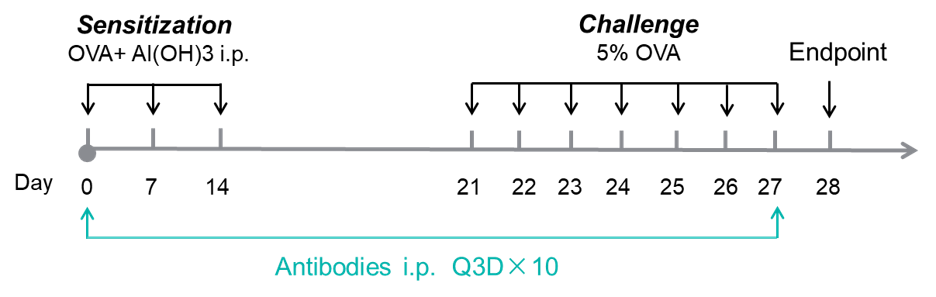
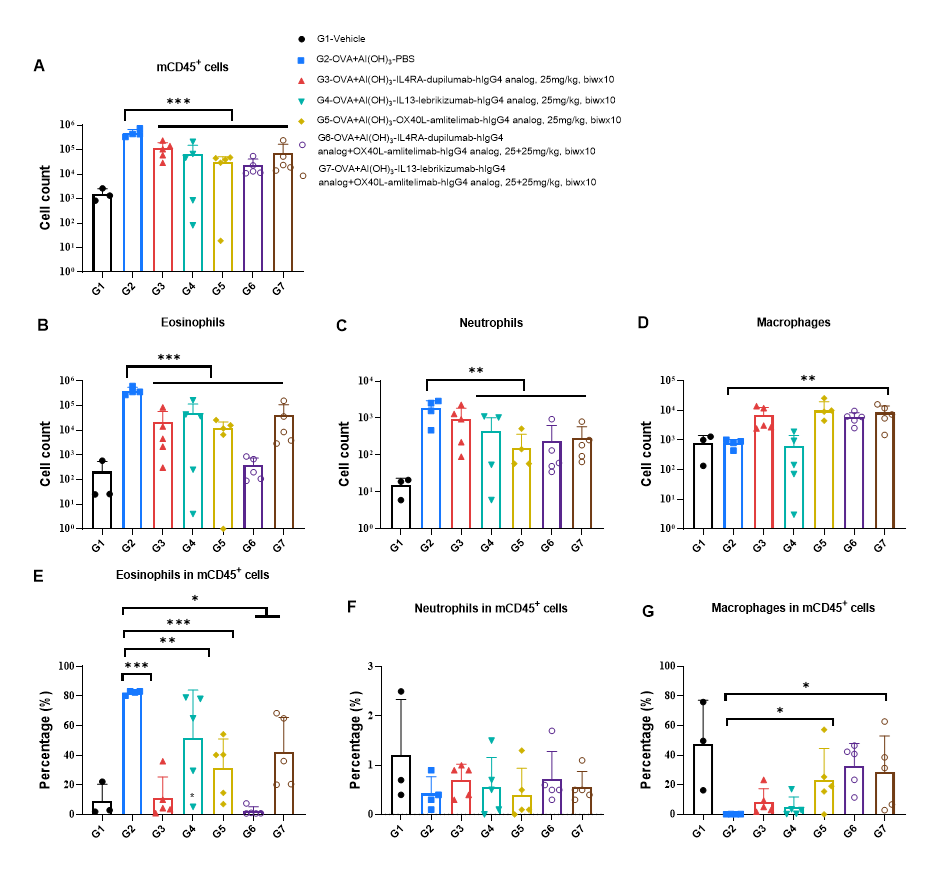
Analysis of immune cells in BALF (Bronchoalveolar fluid) by flow cytometry. B-hIL4/hIL4RA/hIL13/hIL13RA1/hOX40/hOX40L mice (female, 15-week-old, n=5) were immunized with OVA to induce asthma. Anti-human IL4RA antibody (IL4RA-dupliumab-hIgG4 analog, synthesized in-house), anti-human IL13 antibody (IL13-lebrikizumab-hIgG4 analog, synthesized in-house) and anti-human OX40L antibody (OX40L-amlitelimab-hIgG4 analog, synthesized in-house) were intraperitoneally injected from day 0 to day 27. BALF was collected at the end of the experiment to detect inflammatory cell infiltration in lung tissue. The results showed that the number of CD45+ cells and eosinophils of BALF in the antibodies treated group decreased significantly compared with the OVA-induced untreated group (G2). Data indicated that anti-human IL4RA antibody, anti-human IL13 antibody and anti-human OX40L antibody or a combination of both could effectively reduce the number and proportion of eosinophils in B-hIL4/hIL4RA/hIL13/hIL13RA1/hOX40/hOX40L mice induced with OVA. Values are expressed as mean ± SEM. Significance was determined by two-way ANOVA test. *P < 0.05, **P < 0.01, ***P < 0.001, ****P < 0.0001.
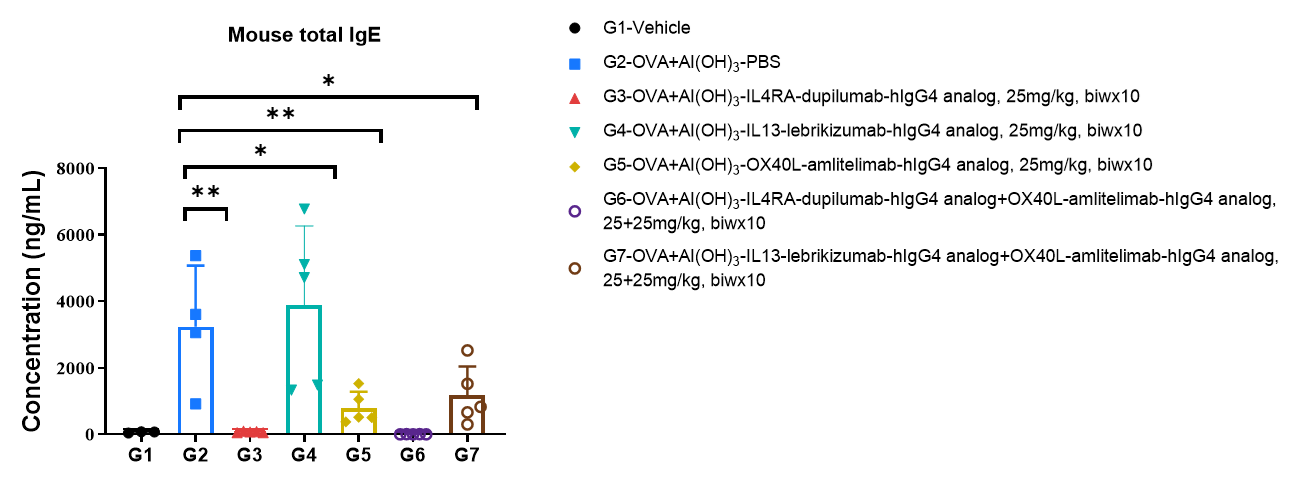
Mouse total IgE in serum were reduced in the mouse asthma model treated with anti-human IL4RA antibody, anti-human IL13 antibody and anti-human OX40L antibody. Serum was collected at the study endpoint. IgE level was analyzed by ELISA. The results showed that the level of total IgE in mice treated with anti-human IL4RA antibody, anti-human IL13 antibody and anti-human OX40L antibody or a combination of both were lower than that in untreated mice. Values are expressed as mean ± SEM. Significance was determined by unpaired t-test. *P < 0.05, **P < 0.01, ***P < 0.001.
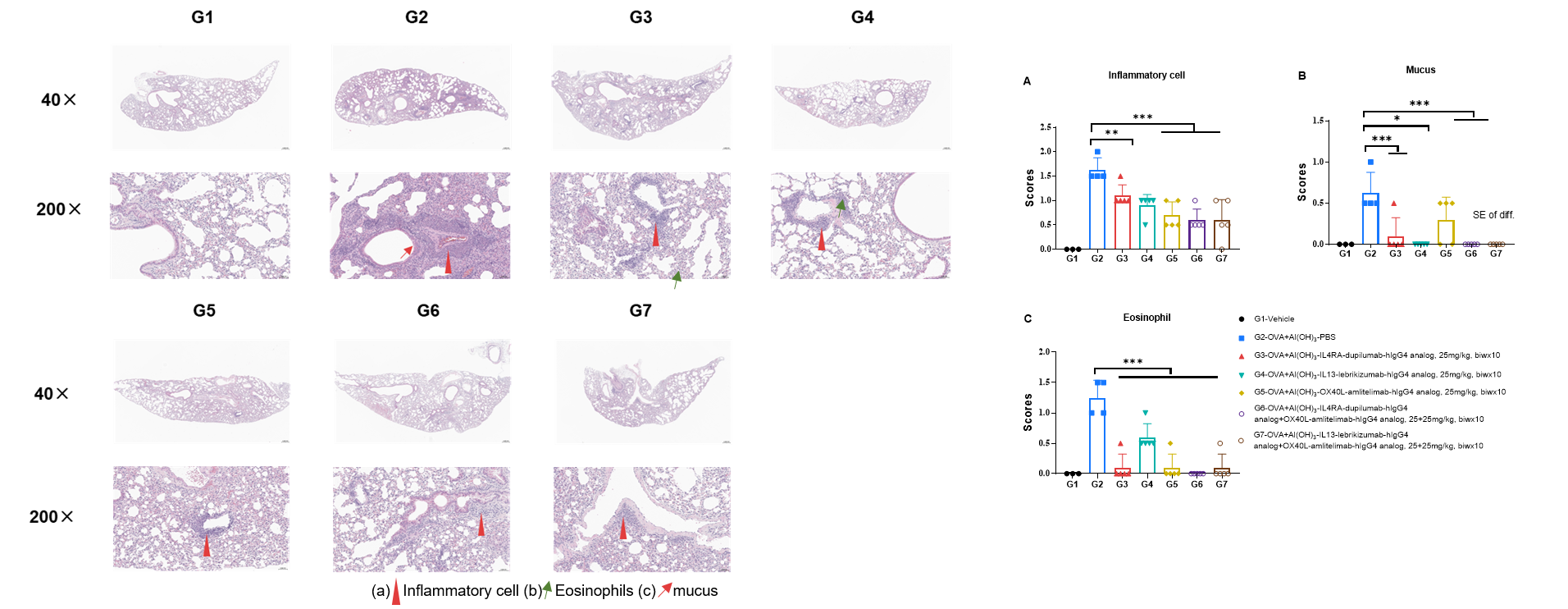
H&E staining of asthma-like model in B-hIL4/hIL4RA/hIL13/hIL13RA1/hOX40/hOX40L mice. Lung tissues were collected at the study endpoint and analyzed with H&E staining. The results showed that compared to the untreated group (G2), the group of mice treated with antibodies showed a significant reduction in inflammatory infiltration and mucus secretion in lung tissue, indicating that B-hIL4/hIL4RA/hIL13/hIL13RA1/hOX40/hOX40L mice provide a powerful preclinical model for in vivo evaluation of anti-human IL4RA antibody, anti-human IL13 antibody and anti-human OX40L antibody or a combination of both. Values are expressed as mean ± SEM. Significance was determined by unpaired t-test. *P < 0.05, **P < 0.01, ***P < 0.001.