Description
- CD96, also known as TACTILE, is a member of the immunoglobulin gene superfamily and is an inhibitory immune receptor expressed on T cells and resting NK cells. It competes with DNAM-1 for binding to Nectin and Nectin-like ligands, inhibiting NK cell activity and promoting tumor growth. In mouse tumor models, CD96 blocking antibodies can enhance NK cell production of IFN-γ and improve cancer control. Anti-CD96 antibodies can promote the antitumor metastatic activity of NK cells.
- TIGIT (T cell immunoreceptor with Ig and ITIM domains), a member of the immunoglobulin superfamily, binds to its ligand CD155 (PVR) with high affinity to mediate immunosuppressive signals. Intracellularly, it recruits phosphatases like SHIP1 via phosphorylation, inhibiting TCR and NK cell signaling pathways and reducing IFN-γ secretion. By competitively blocking CD226 (DNAM-1) binding to CD155, it suppresses co-stimulatory signals while enhancing regulatory T cell (Treg) activity to maintain immune homeostasis. TIGIT is expressed on activated CD8+ T cells, CD4+ T cells, NK cells, and Tregs. Overexpressed in solid tumors like NSCLC, breast cancer, and melanoma, often co-expressed with PD-1/PD-L1, TIGIT upregulation correlates with tumor progression. Combined PD-1/PD-L1 blockade enhances anti-tumor immunity by reversing TIGIT-mediated immune suppression.
- The exons 1-14 of mouse Cd96 gene that encode signal peptide and extracellular domain are replaced by human counterparts in B-hCD96/hTIGIT mice. The genomic region of mouse Cd96 gene that encodes transmembrane domain and cytoplasmic portion are retained. The promoter, 5’UTR and 3’UTR region of the mouse gene are retained. The chimeric CD96 expression is driven by endogenous mouse Cd96 promoter, while mouse Cd96 gene transcription and translation will be disrupted.
- The exon 2 of mouse Tigit gene that encode the extracellular domain is replaced by exon 2 of human TIGIT gene in B-hCD96/hTIGIT mice.
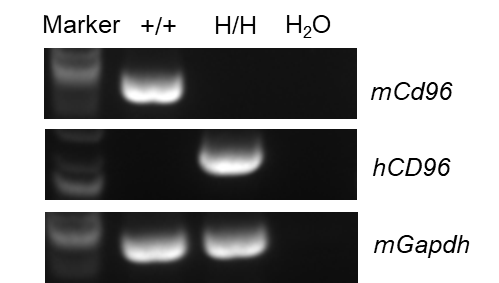
- Mouse Cd96 mRNA was detectable only wildtype C57BL/6 mice. Human CD96 mRNA was detectable only homozygous B-hCD96/hTIGIT mice but not in wild-type mice.
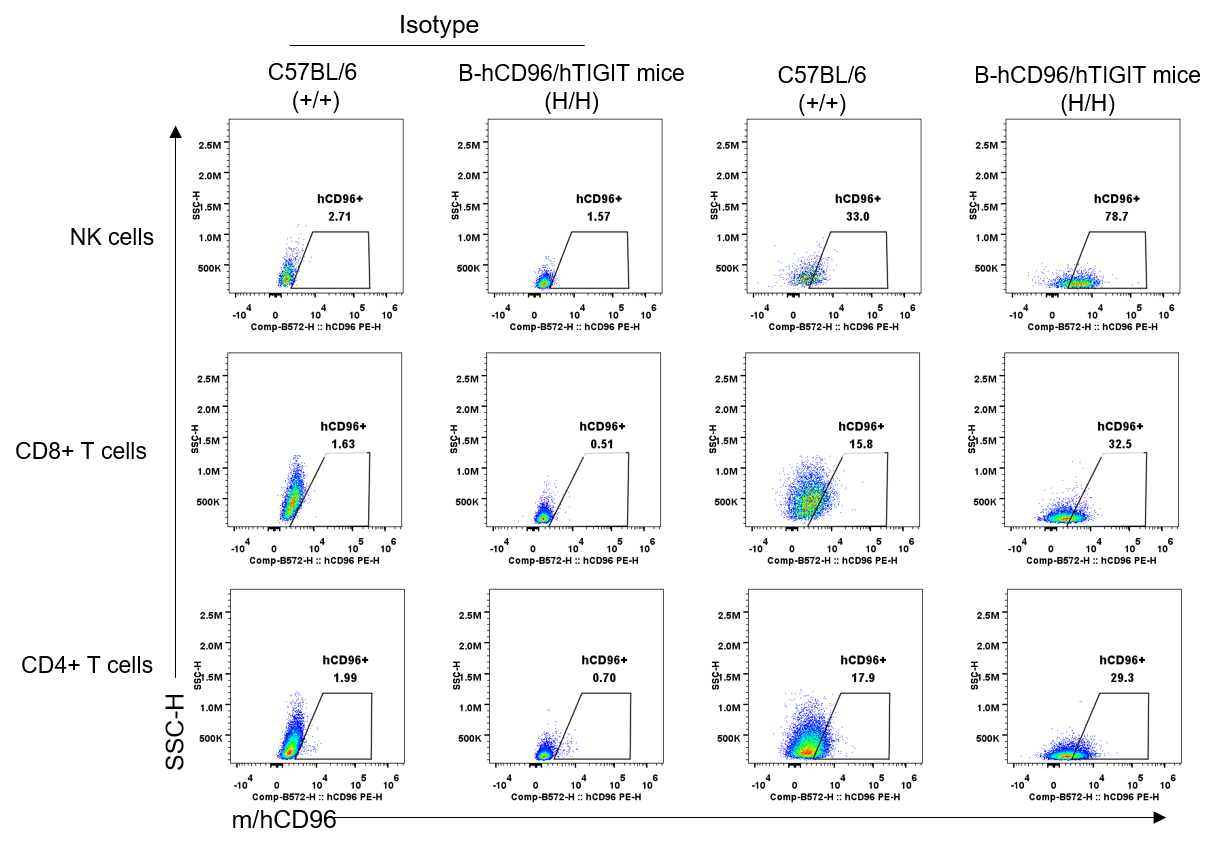
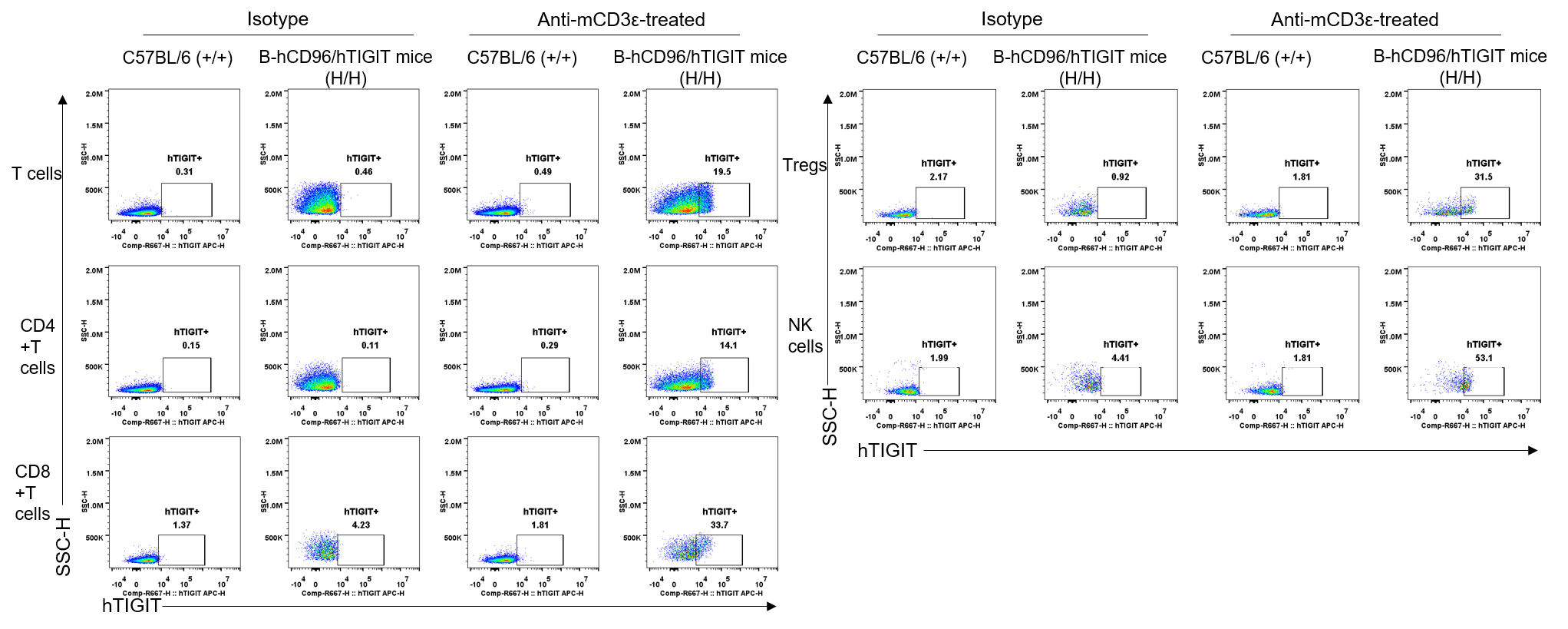
- CD96 protein was detectable in NK cells, CD8+ T cells and CD4+ T cells of homozygous B-hCD96/hTIGIT mice. The antibody was cross-reactive between human and mouse. TIGIT protein was detectable in T cells, CD8+ T cells, CD4+ T cells, NK cells and Tregs cells of homozygous B-hCD96/hTIGIT mice.
- B-hCD96/hTIGIT mice can be used to study the in vivo efficacy and safety evaluation of Bispecific antibody drug conjugates.
Targeting strategy
Gene targeting strategy for B-hCD96/hTIGIT mice.
- The exons 1-14 of mouse Cd96 gene that encode signal peptide and extracellular domain are replaced by human counterparts in B-hCD96/hTIGIT mice. The genomic region of mouse Cd96 gene that encodes transmembrane domain and cytoplasmic portion is retained. The promoter, 5’UTR and 3’UTR region of the mouse gene are retained. The chimeric CD96 expression is driven by endogenous mouse Cd96 promoter, while mouse Cd96 gene transcription and translation will be disrupted.
- The exon 2 of mouse Tigit gene that encode the extracellular domain is replaced by exon 2 of human TIGIT gene in B-hCD96/hTIGIT mice.
Protein expression analysis
Strain specific CD96 expression analysis in homozygous B-hCD96/hTIGIT mice by flow cytometry. Splenocytes cells were collected from wild-type mice (+/+) and homozygous B-hCD96/hTIGIT mice (H/H), analyzed by flow cytometry with anti-CD96 antibody (Biolegend, 338405). CD96 protein was detectable in NK cells, CD8+ T cells and CD4+ T cells of wild-type mice and homozygous B-hCD96/hTIGIT mice. The antibody was cross-reactive between human and mouse.
mRNA expression analysis
Strain specific analysis of CD96 mRNA expression in wild-type C57BL/6 mice and B-hCD96/hTIGIT mice by RT-PCR. Spleen RNA were isolated from wild-type C57BL/6 mice (+/+) and homozygous B-hCD96/hTIGIT mice (H/H, H/H), then cDNA libraries were synthesized by reverse transcription, followed by PCR with mouse and human CD96 primers. Mouse Cd96 mRNA was detectable only in wild-type C57BL/6 mice. Human CD96 mRNA was detectable only homozygous B-hCD96/hTIGIT mice but not in wild-type mice.
Protein expression analysis
Strain specific TIGIT expression analysis in homozygous B-hCD96/hTIGIT mice by flow cytometry. Splenocytes were collected from wild-type C57BL/6 mice (+/+) and homozygous B-hCD96/hTIGIT mice (H/H) stimulated with anti-CD3ε in vivo, analyzed by flow cytometry with TIGIT positive drugs (in house). TIGIT protein was detectable in T cells, CD8+ T cells, CD4+ T cells, NK cells and Tregs cells of homozygous B-hCD96/hTIGIT mice.
Frequency of leukocyte subpopulations in spleen
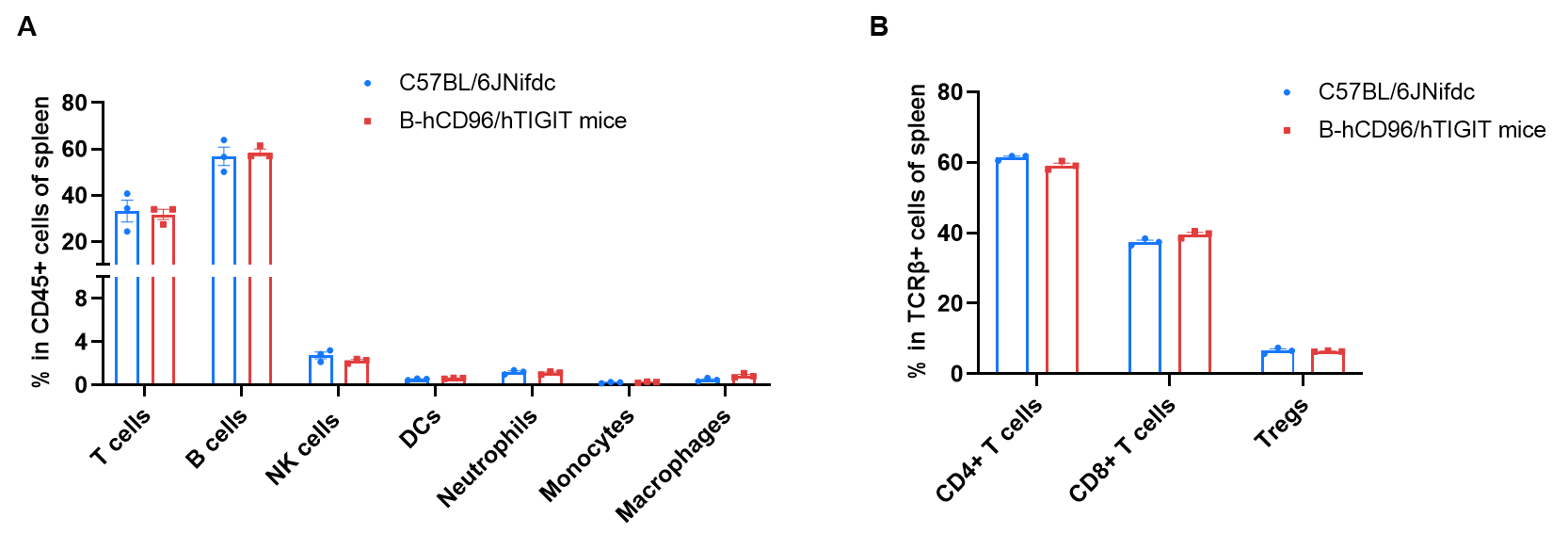
Frequency of leukocyte subpopulations in spleen by flow cytometry. Splenocytes were isolated from wild-type C57BL/6JNifdc mice (female, n=3, 8-week-old), homozygous B-hCD96/hTIGIT mice (female, n=3, 8-week-old). A. Flow cytometry analysis of the splenocytes was performed to assess the frequency of leukocyte subpopulations. B. Frequency of T cell subpopulations. Percentages of T cells, B cells, NK cells, dendritic cells, neutrophils, monocytes, macrophages, CD4+ T cells, CD8+ T cells and Tregs in B-hCD96/hTIGIT mice were similar to those in C57BL/6JNifdc. Values are expressed as mean ± SEM. Significance was determined by two-way ANOVA test. *P < 0.05, **P < 0.01, ***p < 0.001.
* When publishing results obtained using this animal model, please acknowledge the source as follows: The animal model [B-hCD96/hTIGIT mice] (Cat# 114024) was purchased from Biocytogen.