Description
- Background: The ERVW-1–encoded protein Syncytin-1 has been found to be highly expressed in patients with multiple sclerosis (MS). Its overexpression can induce neuroinflammation and cytotoxicity, and the potential mechanisms include:(1) increasing nitric oxide (NO) production in glial cells;(2) activating the TLR4/CD14 and TLR3 signaling pathways;(3) inducing the activation of cytotoxic T lymphocytes (CTLs).Therefore, Syncytin-1 represents a potential therapeutic target for neurological diseases.
- Application:Efficacy validation of multiple sclerosis diseases.
- Targeting strategy: The full coding sequences of human ERVW-1 gene that is driven by human ERVW-1 promoter are inserted into mouse Gt(ROSA)26Sor locus in B-hERVW-1 mice.
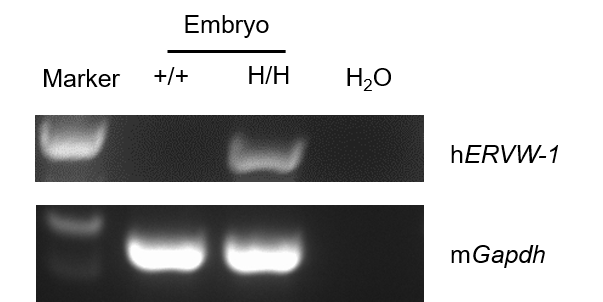
- Validation: Human ERVW-1 mRNA was exclusively detectable in homozygous B-hERVW-1 mice.
Targeting strategy
Gene targeting strategy for B-hERVW-1 mice. The full coding sequences of human ERVW-1 gene that is driven by human ERVW-1 promoter are inserted into mouse Gt(ROSA)26Sor locus in B-hERVW-1 mice.
mRNA expression analysis
Strain specific analysis of ERVW-1 mRNA expression in wild-type C57BL/6JNifdc and B-hERVW-1 mice by RT-PCR. Embryo RNA were isolated from wild-type C57BL/6JNifdc (+/+) and homozygous B-hERVW-1 mice (H/H), then cDNA libraries were synthesized by reverse transcription, followed by PCR with human ERVW-1 primers. Human ERVW-1 mRNA was exclusively detectable in homozygous B-hERVW-1 mice.
* When publishing results obtained using this animal model, please acknowledge the source as follows: The animal model [B-hERVW-1 mice] (Cat# 114420) was purchased from Biocytogen.