Background
Mesothelin (MSLN) and P-cadherin (CDH3) are cell-surface proteins and co-expressed in multiple solid tumor types (e.g., ovarian, pancreatic) with restricted normal-tissue accessibility, supporting their selection for targeted therapeutics. Their co-expression or spatial complementarity of MSLN and CDH3 in solid tumors provides a mechanistic basis to mitigate antigen escape and enhance internalization-driven delivery. Recent advances suggest that bispecific ADCs (bsADCs) can improve internalization and payload delivery in co-expressing tumors.
Method
We developed a fully human anti-human MSLN×CDH3 bsAb using our proprietary common light chain RenLite® mouse platform. Our bsADC employs a monovalent “1+1” architecture with two linker–payload options: monomethyl auristatin E (MMAE), a clinically validated microtubule inhibitor, and BLD1102, a newly developed DNA topoisomerase inhibitor.
Results
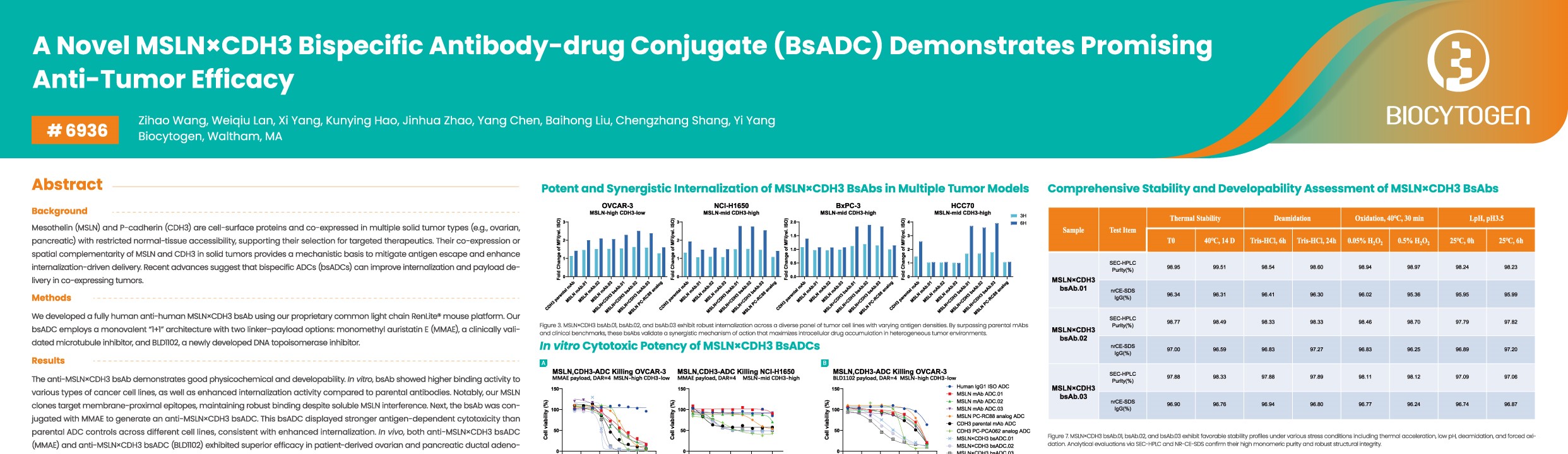
The anti-MSLN×CDH3 bsAb demonstrates good physicochemical and developability. In vitro, bsAb showed higher binding activity to various types of cancer cell lines, as well as enhanced internalization activity compared to parental antibodies. Next, the bsAb was conjugated with MMAE to generate an anti-MSLN×CDH3 bsADC. This bsADC displayed stronger antigen-dependent cytotoxicity than parental ADC controls across different cell lines, consistent with enhanced internalization. In vivo, we also tested the efficacy of the MSLN×CDH3 bsAb conjugated to BLD1102. Both anti-MSLN×CDH3 bsADC (MMAE) and anti-MSLN×CDH3 bsADC (BLD1102) exhibited superior efficacy in patient-derived ovarian and pancreatic ductal adenocarcinoma xenograft models.
Conclusion
Together, these results suggest that anti-MSLN×CDH3 bsADC has the potential to be a novel therapeutic alternative for MSLN and CDH3-expressing tumors.