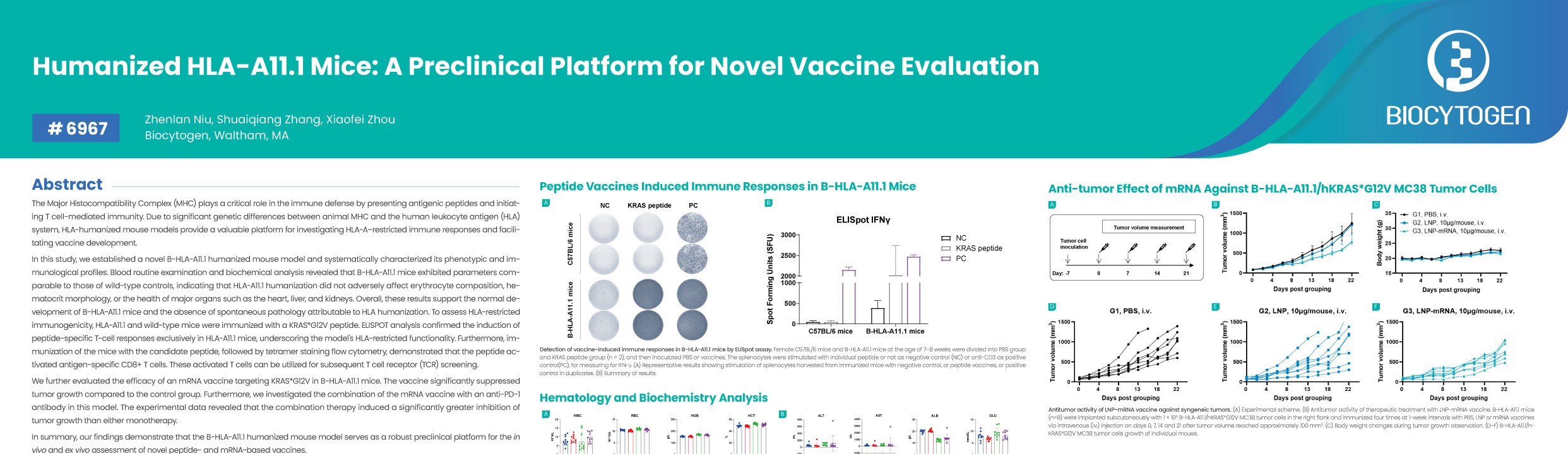
The Major Histocompatibility Complex (MHC) plays a critical role in the immune defense by presenting antigenic peptides and initiating T cell-mediated immunity. Due to significant genetic differences between animal MHC and the human leukocyte antigen (HLA) system, HLA-humanized mouse models provide a valuable platform for investigating HLA-A–restricted immune responses and facilitating vaccine development.
In this study, we established a novel B-HLA-A11.1 humanized mouse model and systematically characterized its phenotypic and immunological profiles. Blood routine examination and biochemical analysis revealed that B-HLA-A11.1 mice exhibited parameters comparable to those of wild-type controls, indicating that HLA-A11.1 humanization did not adversely affect erythrocyte composition, hematocrit morphology, or the health of major organs such as the heart, liver, and kidneys. Overall, these results support the normal development of B-HLA-A11.1 mice and the absence of spontaneous pathology attributable to HLA humanization. To assess HLA-restricted immunogenicity, HLA-A11.1 and wild-type mice were immunized with a KRAS*G12V peptide. ELISPOT analysis confirmed the induction of peptide-specific T-cell responses exclusively in HLA-A11.1 mice, underscoring the model's HLA-restricted functionality. Furthermore, immunization of the mice with the candidate peptide, followed by tetramer staining flow cytometry, demonstrated that the peptide activated antigen-specific CD8+ T cells. These activated T cells can be utilized for subsequent T cell receptor (TCR) screening.
We further evaluated the efficacy of an mRNA vaccine targeting KRAS*G12V in B-HLA-A11.1 mice. The vaccine significantly suppressed tumor growth compared to the control group. Furthermore, we investigated the combination of the mRNA vaccine with an anti-PD-1 antibody in this model. The experimental data revealed that the combination therapy induced a significantly greater inhibition of tumor growth than either monotherapy.
In summary, our findings demonstrate that the B-HLA-A11.1 humanized mouse model serves as a robust preclinical platform for the in vivo and ex vivo assessment of novel peptide- and mRNA-based vaccines.