


B-hB7-H3 B16-F10

NA • 322437

B-hB7-H3 B16-F10

Product nameB-hB7-H3 B16-F10
Catalog number322437
Strain nameNA
NCBI gene ID102657 (Human)
Chromosome9
AliasesB7h3; B7-H3; B7RP-2; 6030411F23Rik
TissueSkin
DiseaseMelanoma

在此页面上

  • Description
  • Phenotypic analysis
  • Tumorigenicity

海报

查看全部

    发表文章

      Description
      • Origin: The B16-F10 cell line is derived from C57BL/6J murine skin cells. The cell line is a commonly used murine model for melanoma.
      • Background Information: B7-H3 (CD276), a key immune checkpoint molecule, belongs to the B7 family of immunoregulatory proteins. In various solid tumors, such as non-small cell lung cancer, prostate cancer, and pancreatic cancer, overexpression of B7-H3 inhibits T cell activation and cytokine release, weakening the anti-tumor immune response and thereby promoting tumor immune evasion. Within the tumor microenvironment, B7-H3 is not only expressed on the surface of tumor cells but also present on tumor-associated endothelial cells and stromal cells, where it further participates in recruiting myeloid-derived suppressor cells (MDSCs) and polarizing M2-type macrophages, thereby fostering an immunosuppressive microenvironment. Additionally, B7-H3 has been found to exhibit non-immune functions, including promoting tumor cell migration, invasion, and angiogenesis, thereby driving tumor progression and metastasis. Targeted therapeutic strategies against B7-H3, such as antibody-drug conjugates, bispecific antibodies, and CAR-T cell therapies, have demonstrated promising anti-tumor potential in preclinical and early clinical studies, offering new directions for the treatment of advanced refractory tumors.
      • Gene targeting strategy: The exogenous promoter and the full-length of B7-H3 coding sequences were inserted to replace part of exon 3 and the full-length of exon 4 of murine B7-H3 gene. The insertion disrupts the endogenous murine B7-H3 gene, resulting in a non-functional transcript.
      • Tumorigenicity: Confirmed in wild-type C57BL/6JNifdc mice and B-hB7-H3 mice.
      • Application: The B-hB7-H3 B16-F10 tumor models can be used for preclinical evaluation of drugs targeting human B7-H3.
      Protein Expression Analysis

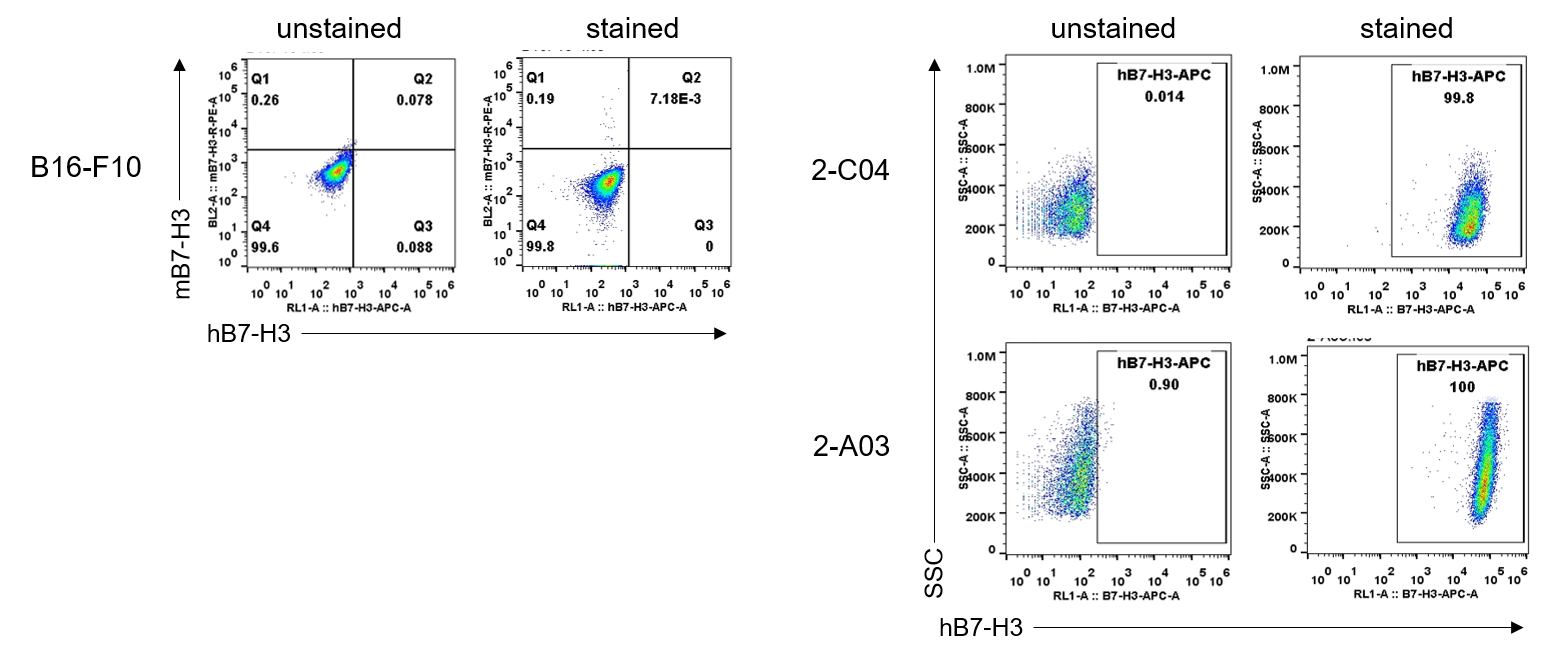
      B7-H3 expression analysis in B-hB7-H3 B16-F10 cells by flow cytometry. Single cell suspensions from wild-type B16-F10 cells and B-hB7-H3 B16-F10 #2-C04, #2-A03 were stained with species-specific anti-mouse B7-H3 antibody (Biolegend, 124508) and anti-human B7-H3 antibody (Biolegend, 351006). Human B7-H3 was detectable on the surface of B-hB7-H3 B16-F10 cells but not on the wild-type B16-F10 cells. Mouse B7-H3 was not detectable on the wild-type B16-F10 cells.

      Tumor Growth Curve & Body Weight Changes

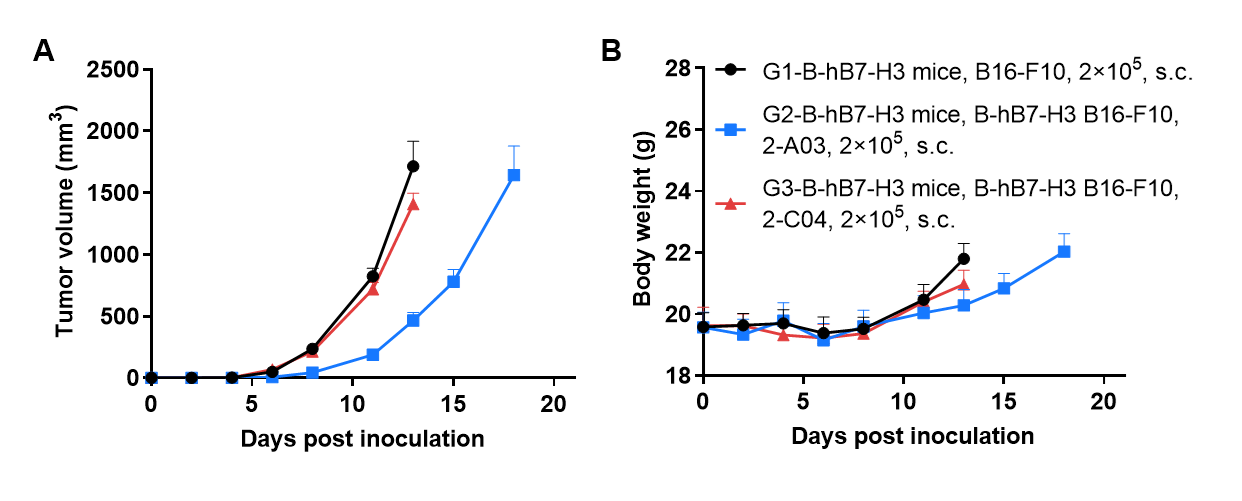
      Subcutaneous tumor growth of B-hB7-H3 B16-F10 cells. B-hB7-H3 B16-F10 cells (2×10⁵) and wild-type B16-F10 cells (2×10⁵) were subcutaneously implanted into B-hB7-H3 mice (female, 7-week-old, n=6). Tumor volume and body weight were measured twice a week. (A) Average tumor volume. (B) Body weight. Volume was expressed in mm3 using the formula: V=0.5 × long diameter × short diameter2. As shown in panel A, B-hB7-H3 B16-F10 cells were able to establish tumors in vivo and can be used for efficacy studies.

      Subcutaneous tumor growth of B-hB7-H3 B16-F10 cells. B-hB7-H3 B16-F10 cells and wild-type B16-F10 cells were subcutaneously implanted into wild-type C57BL/6JNifd mice (female, 6-week-old, n=6). Tumor volume and body weight were measured twice a week. (A) Average tumor volume. (B) Body weight. Volume was expressed in mm3 using the formula: V=0.5 × long diameter × short diameter2. As shown in panel A, B-hB7-H3 B16-F10 cells were able to establish tumors in vivo and can be used for efficacy studies.
      Protein Expression Analysis of Tumor Tissue

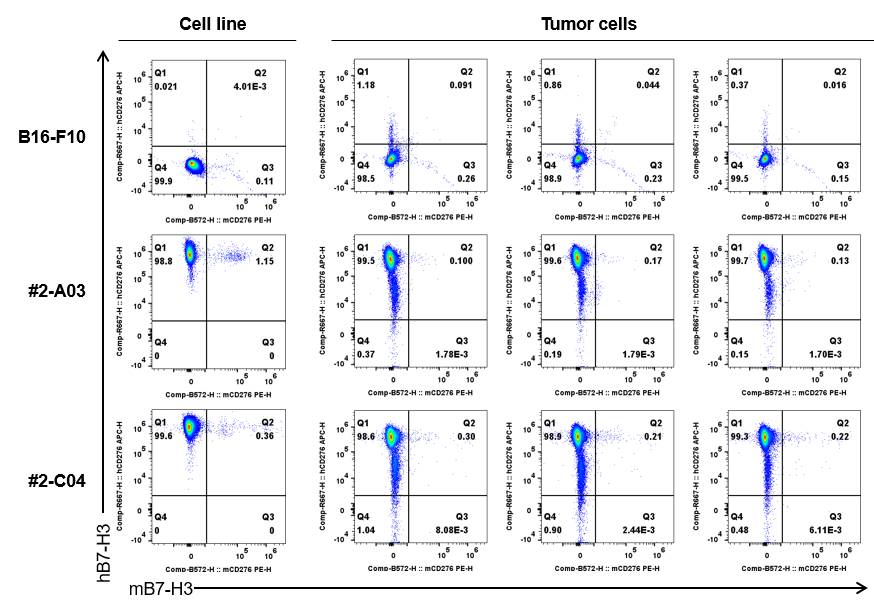
      Human B7-H3 expression evaluated in B-hB7-H3 B16-F10 cells by flow cytometry. B-hB7-H3  B16-F10 cells were subcutaneously transplanted into wild-type C57BL/6JNifdc mice (female, 6-week-old, n=6. Tumor cells were harvested and analyzed for mouse B7-H3 (Biolegend, 135605) and human B7-H3 (Biolegend, 351006) expression by flow cytometry. Human B7-H3 was only detectable in B-hB7-H3 B16-F10 cells and tumor cells. Mouse B7-H3 was not detectable in wild-type B16-F10 cells or B-hB7-H3 B16-F10 cells and tumor cells.