Description
- Background: Lysophosphatidic acid receptor 1 (LPAR1), a Gαi/o/q/12/13-coupled GPCR, is a compelling therapeutic target due to its central role in driving fibrosis, inflammation, and tumor progression. Its pathophysiological relevance stems from its high expression in disease-relevant cells and robust induction under stress. LPAR1 is activated by lysophosphatidic acid (LPA), a lipid mediator whose levels are elevated in patients with idiopathic pulmonary fibrosis (IPF) and cancer. Upon LPA binding, LPAR1 triggers downstream cascades, including Rho/ROCK, PLC/PKC, and PI3K/Akt, which promote fibroblast proliferation/migration, extracellular matrix (ECM) deposition, vascular leak, and cancer cell invasion/metastasis. Genetic ablation or pharmacological blockade of LPAR1 ameliorates fibrosis in animal models, and selective antagonists (e.g., BMS‑986278) have advanced to Phase II trials for IPF, validating its clinical potential. Beyond fibrosis, LPAR1 signaling modulates antiviral immunity and cancer immune exclusion, positioning it as a multifaceted target for diverse diseases.
- Targeting strategy: The exons 2-4 of mouse Lpar1 gene that encode the whole protein domain are replaced by human counterparts in B-hLPAR1 mice. The 3’UTR regions are also replaced with human LPAR1 3’UTR. The promoter and 5’UTR regions of the mouse gene are retained.
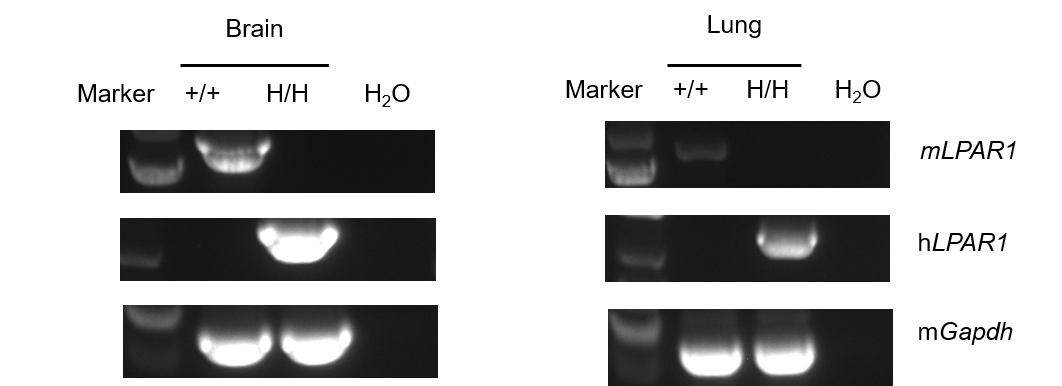
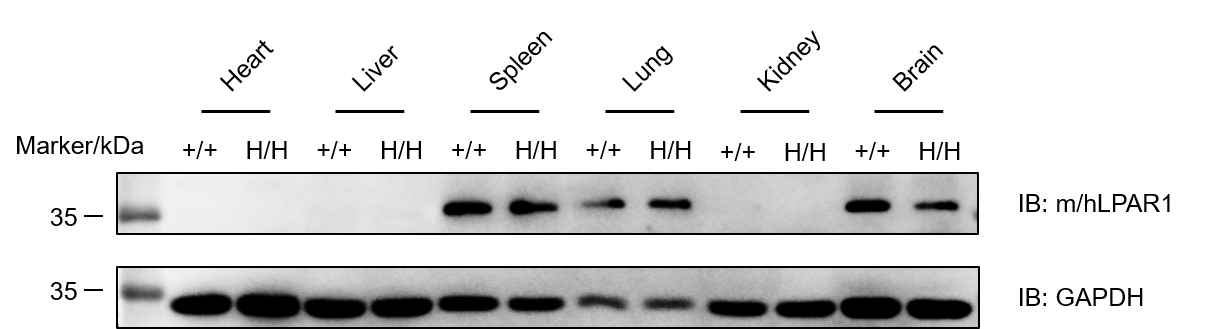
- Validation: Human LPAR1 mRNA was exclusively detectable in homozygous B-hLPAR1 mice but not in wild-type mice. Sequences were confirmed by Sanger Sequencing. LPAR1 protein was detected in spleen, lung and brain of both homozygous mice and wild-type mice, as the antibody was cross-reactive between human and mouse.
- Application: Humanized B-hLPAR1 mice can serve as valuable tools for preclinical efficacy testing and safety assessment of novel therapeutics for pulmonary fibrosis.
Targeting strategy
Gene targeting strategy for B-hLPAR1 mice. The exons 2-4 of mouse Lpar1 gene that encode the whole protein domain are replaced by human counterparts in B-hLPAR1 mice. The 3’UTR regions are also replaced with human LPAR1 3’UTR. The promoter and 5’UTR regions of the mouse gene are retained. The human LPAR1 expression is driven by endogenous mouse Lpar1 promoter, while mouse Lpar1 gene transcription and translation will be disrupted.
mRNA expression analysis
Strain specific analysis of LPAR1 mRNA expression in wild-type C57BL/6JNifdc and B-hLPAR1 mice by RT-PCR. Brain and lung RNA were isolated from wild-type C57BL/6JNifdc (+/+) and homozygous B-hLPAR1 mice (H/H), then cDNA libraries were synthesized by reverse transcription, followed by PCR with mouse or human LPAR1 primers. Mouse Lpar1 mRNA was only detectable in wild-type mice. Human LPAR1 mRNA was exclusively detectable in homozygous B-hLPAR1 mice but not in wild-type mice. Sequences were confirmed by Sanger Sequencing.
Protein expression analysis
Western blot analysis of LPAR1 protein expression in homozygous B-hLPAR1 mice. Various tissue lysates were collected from wild-type C57BL/6JNifdc (+/+) and homozygous B-hLPAR1 mice (H/H), and then analyzed by western blot with cross-reactive anti-LPAR1 antibody (Abcam, ab23698). 40 μg total protein were loaded for western blotting analysis. LPAR1 was detected in spleen, lung and brain of both homozygous mice and wild-type mice, as the antibody was cross-reactive between human and mouse.
* When publishing results obtained using this animal model, please acknowledge the source as follows: The animal model [B-hLPAR1 mice] (Cat# 113371) was purchased from Biocytogen.