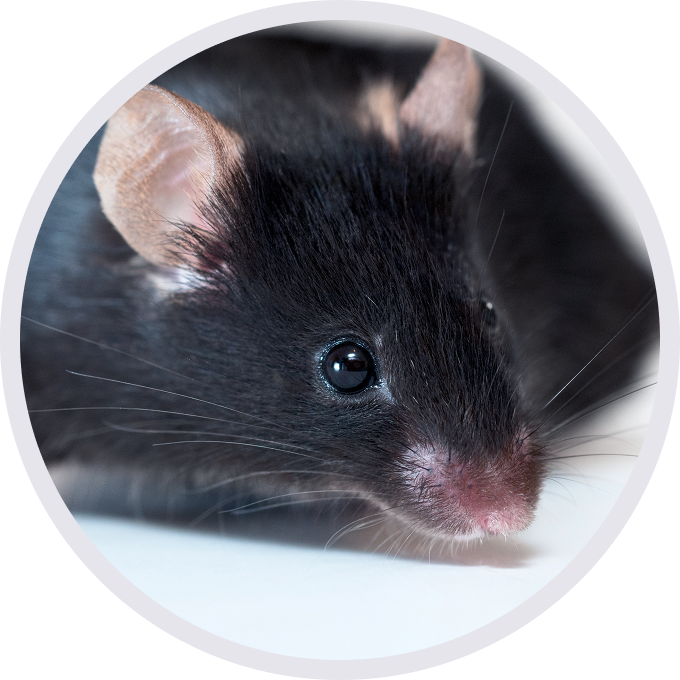
C57BL/6N-Pahtm1Bcgen/Bcgen • 113306


Gene targeting strategy for B-Pah KO mice. The exons 2-5 of mouse Pah gene that encode part of the protein were knocked out in B-Pah KO mice.

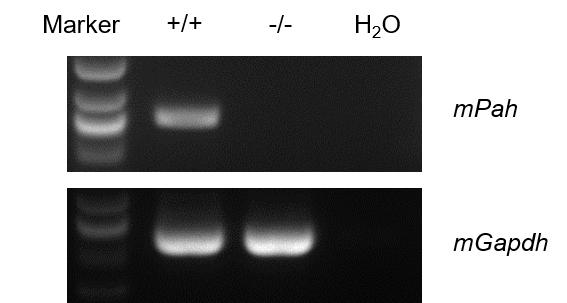
Strain specific analysis of PAH mRNA expression in wild-type C57BL/6 mice and B-Pah KO mice by RT-PCR. Liver RNA were isolated from wild-type C57BL/6 mice (+/+) and homozygous B-Pah KO mice (-/-), then cDNA libraries were synthesized by reverse transcription, followed by PCR with mouse Pah primers. Mouse Pah mRNA was exclusively detectable in wild-type mice but not in homozygous B-Pah KO mice.
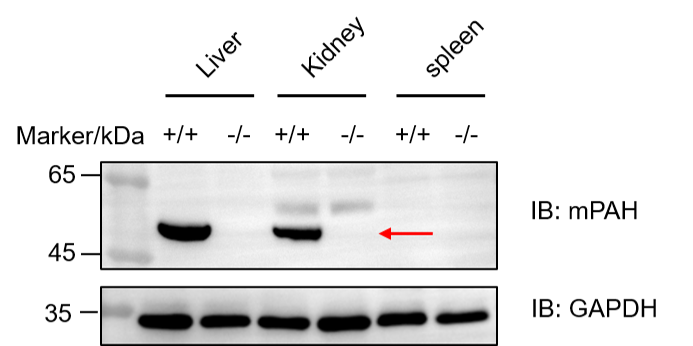
Western blot analysis of PAH protein expression in homozygous B-Pah KO mice. Various tissue lysates were collected from wild-type C57BL/6 mice (+/+) and homozygous B-Pah KO mice (-/-), and then analyzed by western blot with anti-PAH antibody (abcam, ab178430). 40 μg total proteins were loaded for western blotting analysis. PAH protein expression was only detected in the liver and kidney of wild-type mice but not in the homozygous B-Pah KO mice.
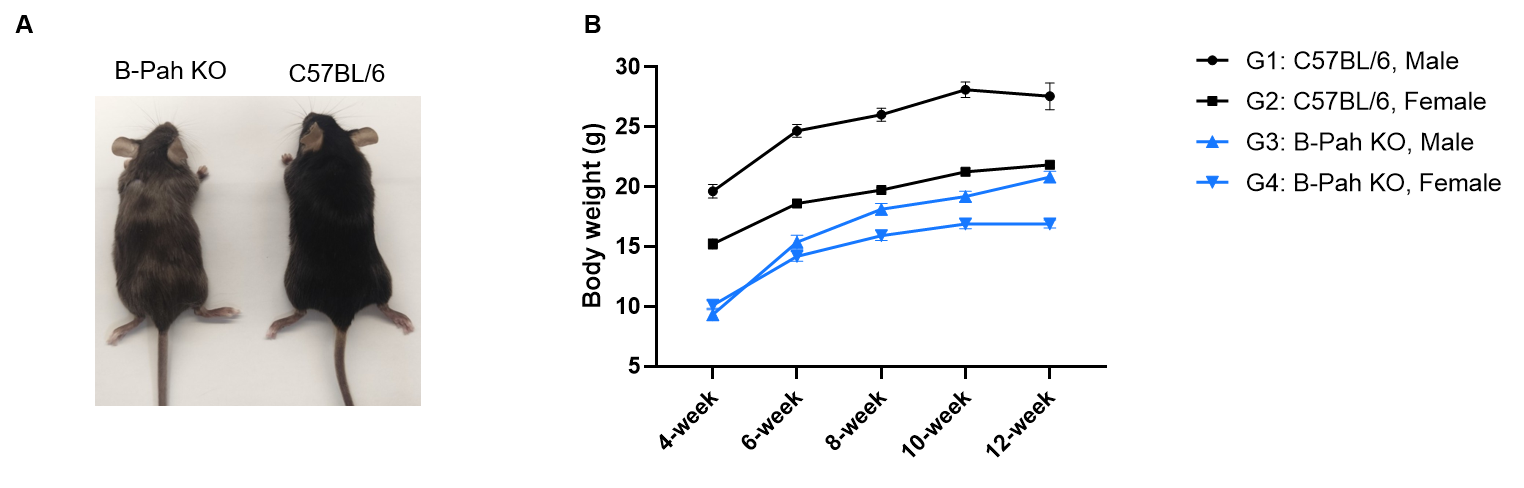
Hair coat color and body weight in homozygous B-Pah KO mice. (A) When compared to wild-type C57BL/6 mice (+/+, male, 7-week-old), homozygous B-Pah KO mice (-/-, male, 7-week-old) exhibit gray fur. (B) Body weight of homozygous B-Pah KO mice was lower than that of wild-type control mice at 4 to12 weeks of age. Values are expressed as mean ± SEM.

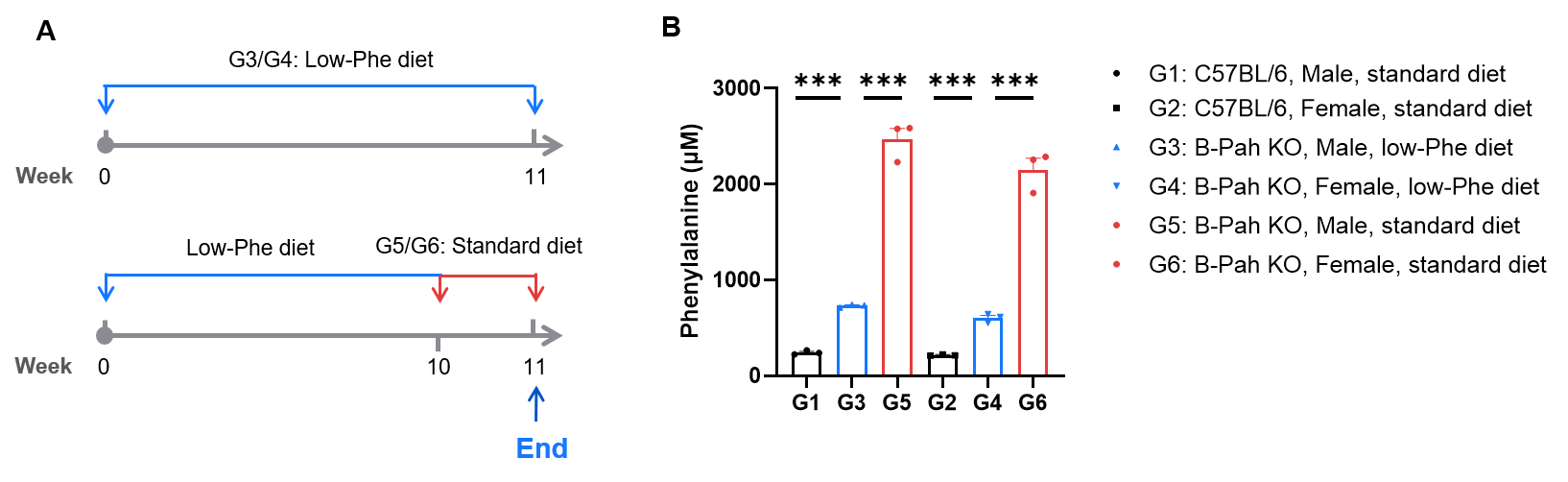
Phenylalanine concentration analysis in homozygous B-Pah KO mice. (A). At 10 weeks of age, three male and three female homozygous B-Pah KO mice were switched from a low-phenylalanine (low-Phe) diet to standard chow for one week, while an additional three male and three female KO mice remained on the low-Phe diet throughout the study. Wild-type control mice were maintained on standard chow continuously. (B). Serum phenylalanine (Phe) concentration was measured using phenylalanine assay kit (abcam, ab241000). The serum Phe concentration in homozygous B-Pah KO mice was higher than those in wild-type mice, additionally, Phe levels were further elevated in B-Pah KO mice fed with a standard chow (~2300 μM) compared to those maintained on the low-Phe diet. Values are expressed as mean ± SEM. Significance was determined by unpaired t test. *P < 0.05, **P < 0.01, ***P < 0.001.