
B-hHER2/hHER3 MC38

NA • 322535

B-hHER2/hHER3 MC38

Product nameB-hHER2/hHER3 MC38
Catalog number322535
Strain nameNA
Strain backgroundC57BL/6
AliasesErbb-2, HER-2, HER2, Neu, c-erbB2, c-neu, l11Jus8, mKIAA3023; Erbb-3r, Her3, Erbb3

在此页面上

  • Description
  • Phenotypic analysis
  • Tumorigenicity

海报

查看全部

    发表文章

      Description
      • Origin: The MC38 cell line is derived from C57BL6 murine colon adenocarcinoma cells. The cell line is a commonly used murine model for colorectal carcinoma.
      • Background Information: HER2, a receptor tyrosine kinase encoded by the ERBB2 gene, lacks ligand-binding ability but forms heterodimers with other ERBB receptors to activate intracellular signaling pathways via tyrosine phosphorylation. It is overexpressed in various cancers, including breast cancer, where amplification occurs in 25-30% of cases and correlates with poor prognosis. Several targeted therapies, such as trastuzumab, pertuzumab, and T-DM1, have been approved for HER2-positive tumors. HER3 (ERBB3) is a member of the EGFR/ERBB receptor family involved in regulating cell growth and survival. Although HER3 has weak kinase activity, it forms heterodimers, especially with HER2, to activate the PI3K/AKT signaling pathway. HER3 dysregulation is associated with tumor progression and drug resistance in multiple cancers, making it an important therapeutic target.
      • Gene targeting strategy: By using the unique gene editing technology of Biocytogen, the exogenous promoter, human HER2 coding sequence, and terminator sequence were modified into B-hHER2/hHER3 MC38 cell lines. The mouse Her3 gene was replaced by human HER3 coding sequence in B-hHER2/hHER3 MC38 cells.
      • Tumorigenicity: Confirmed in B-hHER2 mice.
      • Application: The B-hHER2/hHER3 MC38 tumor models can be used for preclinical evaluation of bispecific antibody drugs targeting human HER2 and HER3.
      • Notes:

      Inoculated cell lines can be suspended with DMEM stock solution.

      Before implementing the project, it is recommended to perform tumor growth experiments. The recommended cell inoculation amount is between 5E5~1E6.

      In the experiment, it is necessary to ensure that the number of animals inoculated subcutaneously is at least 1.6 times the actual grouping number.

      Protein Expression Analysis
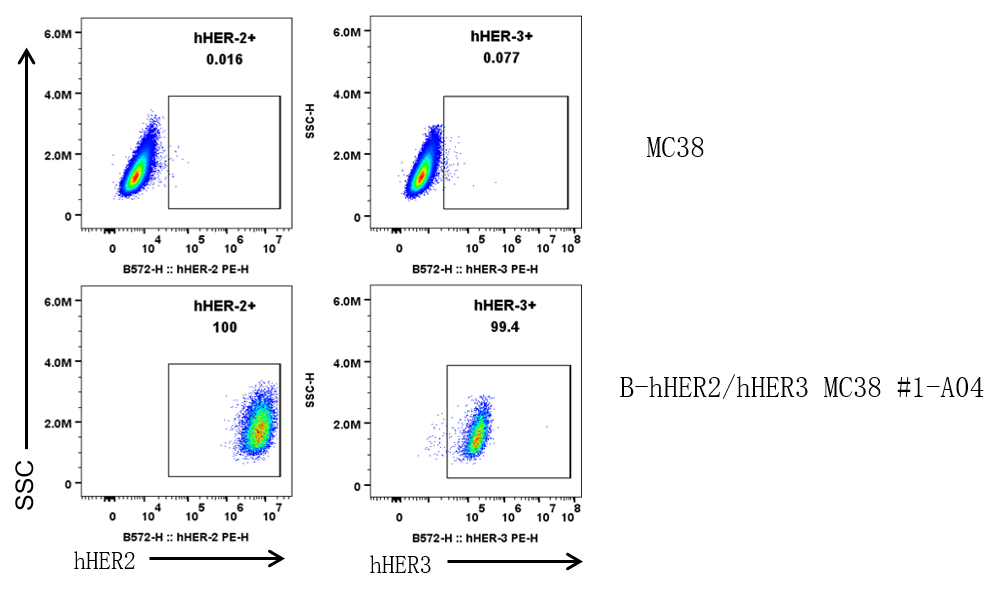
      • Human HER2 and HER3 were detected on the surface of B-hHER2/hHER3 MC38 but not wild-type MC38 cells.

      HER2 and HER3 expression analysis in B-hHER2/hHER3 MC38 by flow cytometry. Single cell suspensions from wild-type MC38 and B-hHER2/hHER3 MC38 #1-A04 cultures were stained with anti-human HER2 antibody (Biolegend, 324406) and anti-human HER3  antibody (Biolegend, 324706).

      Tumor Growth curve & Body Weight Changes

      Subcutaneous tumor growth of B-hHER2/hHER3 MC38 cells. B-hHER2/hHER3 MC38 (5×10⁵) and wild-type MC38 cells (5×10⁵) were subcutaneously implanted into B-hHER2 mice (female, 9-week-old, n=6). Tumor volume and body weight were measured twice a week. (A) Average tumor volume. (B) Body weight. Volume was expressed in mm3 using the formula: V=0.5 × long diameter × short diameter2. Results indicate that B-hHER2/hHER3 MC38 cells were able to establish tumors in vivo and can be used for efficacy studies. Values are expressed as mean ± SEM.

      HER2 and HER3 Protein Expression Analysis of Tumor Tissue
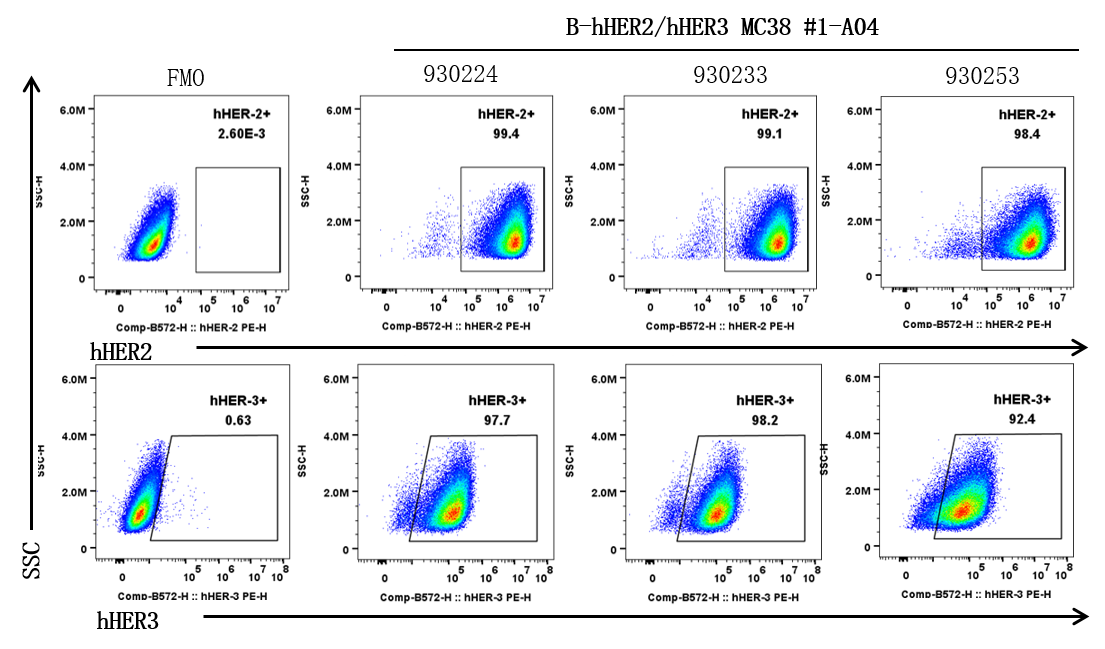
      • Human HER2 and HER3 were detected on the surface of B-hHER2/hHER3 MC38 tumors but not wild-type MC38 cells.

      HER2 and HER3 expression was evaluated​​ on B-hHER2/hHER3 MC38​​ by flow cytometry. ​​These cells​​ were subcutaneously transplanted into B-hHER2 mice (n=6). At the end of the experiment, tumor cells were harvested and ​​analyzed for both human HER2 and HER3 expression​​ by flow cytometry. ​​