


B-hCAIX MC38

NA • 322538

B-hCAIX MC38

Product nameB-hCAIX MC38
Catalog number322538
Strain nameNA
Strain backgroundC57BL/6
NCBI gene ID230099 (Human)
AliasesCa9; CAIX; MN/CA9

在此页面上

  • Description
  • Phenotypic analysis
  • Tumorigenicity

海报

查看全部

    发表文章

      Description
      • Origin: The MC38 cell line is derived from C57BL6 murine colon adenocarcinoma cells. The cell line is a commonly used murine model for colorectal carcinoma.
      • Background Information: Carbonic Anhydrase IX (CA9), also known as CAIX, is a transmembrane enzyme belonging to the carbonic anhydrase family. It plays a pivotal role in maintaining the pH balance within the tumor microenvironment. Under hypoxic conditions, which are common in solid tumors, the expression of CAIX is significantly upregulated via the HIF-1α signaling pathway. The primary function of CAIX is to catalyze the reversible hydration of carbon dioxide to bicarbonate and protons. This enzymatic activity helps to neutralize the acidic extracellular environment caused by tumor cell metabolism (such as the Warburg effect), thereby facilitating cancer cell survival, invasion, and metastasis. Due to its limited expression in normal tissues (primarily restricted to specific epithelial cells) and its high prevalence in various solid tumors—including clear cell renal cell carcinoma (ccRCC), cervical cancer, and breast cancer—CAIX has emerged as a prominent biomarker for hypoxia and a promising therapeutic target in oncology.
      • Gene targeting strategy: An exogenous promoter and a chimeric CAIX coding sequence—comprising murine signal peptide, human extracellular domain, and murine transmembrane and cytoplasmic domains—were inserted to replace murine exons 4 (partial), 11 (partial), and the entirety of exons 5-10.The insertion disrupts the endogenous murine CAIX gene, resulting in a non-functional transcript.
      • Tumorigenicity: Confirmed in B-hCAIX mice.
      • Application: The B-hCAIX MC38 tumor models can be used for preclinical evaluation of antibody drugs targeting human CAIX.
      • Notes:

      Inoculated cell lines can be suspended with DMEM stock solution.

      In the experiment, it is necessary to ensure that the number of animals inoculated subcutaneously is at least 1.6 times the actual grouping number.

      Protein expression analysis

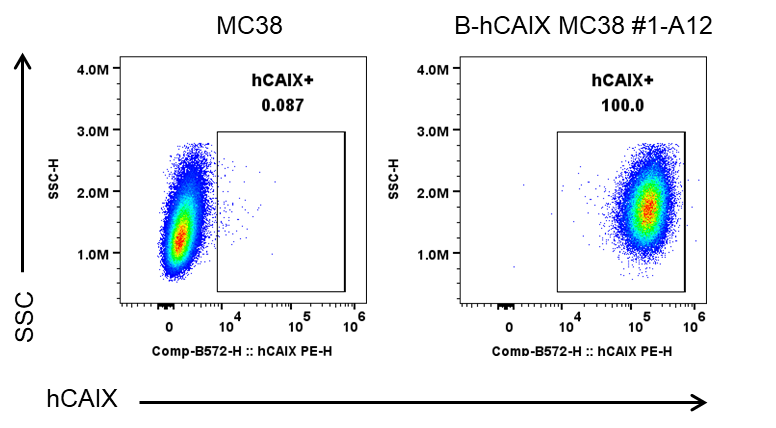
      CAIX expression analysis in B-hCAIX MC38 cells by flow cytometry. Single cell suspensions from wild-type MC38 and B-hCAIX MC38 #1-A12 were stained with anti-human CAIX antibody (R&D, FAB2188P). Human CAIX were detected on the surface of B-hCAIX MC38 cells but not wild-type MC38 cells.

      Tumor growth curve & body weight changes

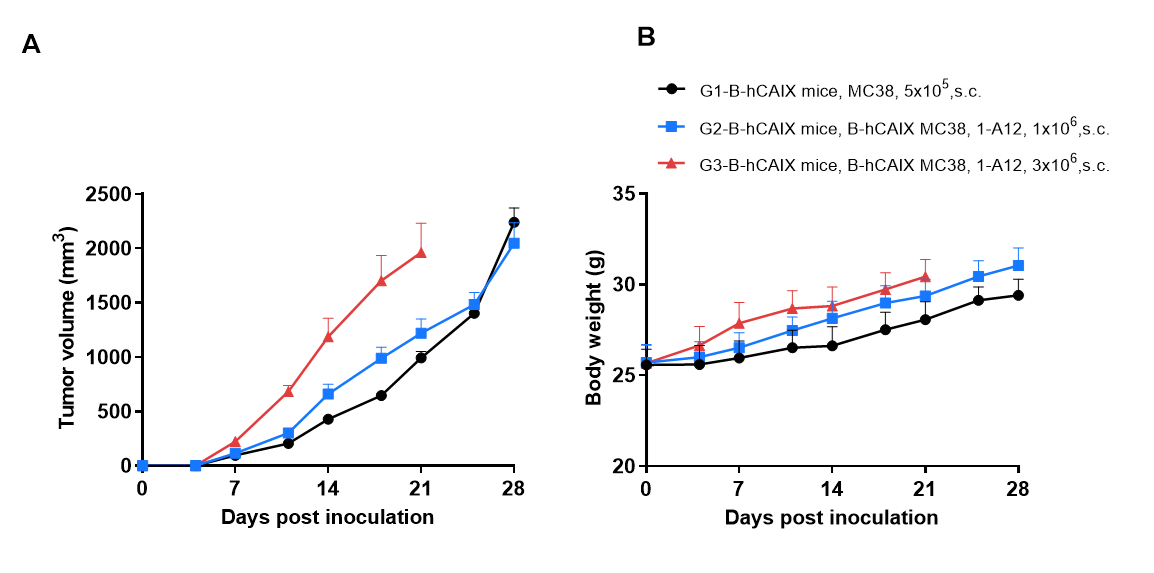
      Subcutaneous tumor growth of B-hCAIX MC38 cells. B-hCAIX MC38 cells (1×10⁶, 3×10⁶) and wild-type MC38 cells (5×10⁵) were subcutaneously implanted into B-hCAIX mice (Female, 6 to 9 weeks old, n=6). Tumor volume and body weight were measured twice a week. (A) Average tumor volume. (B) Body weight. Volume was expressed in mm3 using the formula: V=0.5 × long diameter × short diameter2. Results indicate that B-hCAIX MC38 cells were able to establish tumors in vivo and can be used for efficacy studies. Values are expressed as mean ± SEM.

      Protein expression analysis of tumor tissue

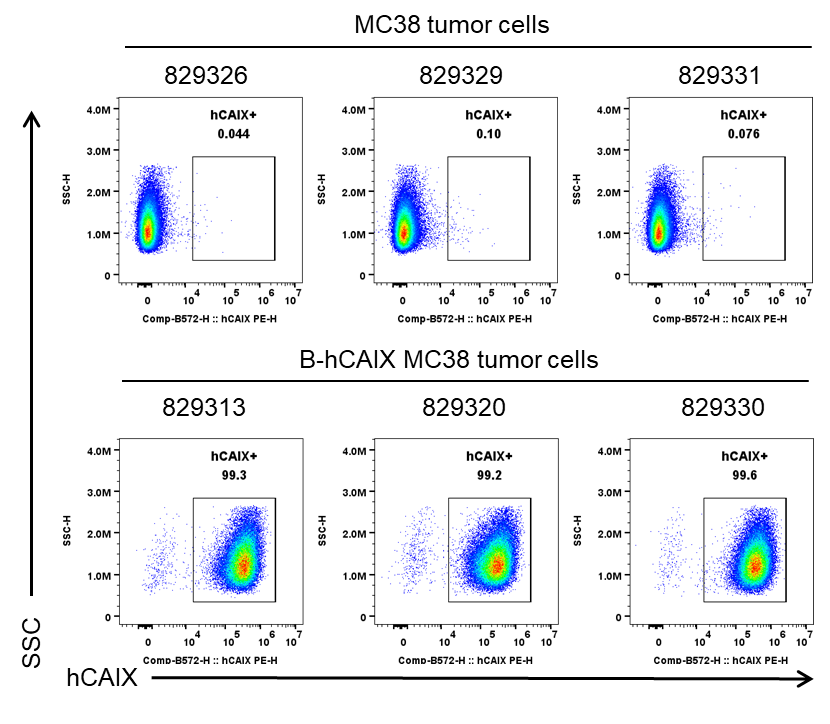
      CAIX expression evaluated on B-hCAIX MC38 tumor cells by flow cytometry. B-hCAIX MC38 cells were subcutaneously transplanted into B-hCAIX mice (n=6). Upon conclusion of the experiment, tumor cells were harvested and assessed for CAIX (R&D, FAB2188P) expression by flow cytometry. As shown, human CAIX were highly expressed on the surface of tumor cells. Therefore, B-hCAIX MC38 cells can be used for in vivo efficacy studies evaluating novel CAIX therapeutics.