ITGB6 × B7-H3 Dual-Payload Bispecific ADC (BCG048)

Asset ID: BCG048
Targets: ITGB6 × B7-H3
  • Aliases:
  • ITGB6: integrin β6, integrin beta-6, AI1H; B7-H3: CD276, 4Ig-B7-H3, B7H3, B7RP-2
  • Modality:
  • Dual-payload bispecific ADC (BsAD2C)
  • Payload Design:
  • Dual-payload design with vcMMAE and BLD1102 linker–payload system containing BCPT02
  • Development Stage:
  • Preclinical
  • Indications:
  • Non-small cell lung cancer (NSCLC), pancreatic, triple-negative breast cancer (TNBC), colorectal, gastric cancers
  • Key Differentiation:
  • Designed for dual-target recognition, enhanced internalization, dual-payload delivery, and antitumor efficacy in PDX models
  • Partnership Opportunity:
  • Available for licensing and co-development
ITGB6 × B7-H3 Dual-Payload Bispecific ADC (BCG048) banner

在此页面上

  • BCG048 Asset Highlights
  • Preclinical Data
  • Partnership Opportunities
  • FAQs

海报

查看全部

    BCG048: Next-Generation Bispecific Dual-Payload ADC Targeting ITGB6 and B7-H3

    ITGB6 × B7-H3 Dual-Target ADC Strategy

    • Tumor-selective target profile: Integrin β6 (ITGB6) and B7-H3 (CD276) are overexpressed in multiple solid tumors with limited expression in normal tissues, offering excellent therapeutic window for ADC development.
    • Broad solid tumor relevance: ITGB6 and B7-H3 are co-expressed across multiple solid tumor types, including esophageal carcinoma, head and neck squamous cell carcinoma, bladder carcinoma, non-small cell lung cancer (NSCLC), and pancreatic adenocarcinoma.
    • Complementary mechanisms: ITGB6 promotes tumor invasion and immune exclusion, while B7-H3 mediates immune suppression— attacking two distinct but cooperative tumor survival pathways allows efficient dual strike.
    • Improved binding and payload delivery: Both antigens enable specific antibody binding. ITGB6 exhibits efficient internalization, while B7-H3 provides clinically validated ADC tractability for payload delivery.
    • Overcoming tumor heterogeneity: By targeting both ITGB6 and B7-H3, BCG048 is designed to address antigen heterogeneity, broaden tumor cell coverage, and support a differentiated dual-target ADC strategy.
    • Competitive differentiation: While B7-H3 is an established and competitive ADC target, integrating ITGB6 introduces mechanistic depth and strategic differentiation.

    RenLite® Fully Human Common Light Chain Antibody Backbone

    Built on the RenLite® platform, BCG048 utilizes common light chain technology to eliminate heavy/light chain mispairing, ensure seamless assembly, simplify manufacturing, and provide a developable antibody backbone for the ITGB6 × B7-H3 dual-target ADC design.

    Dual-Payload ADC Design with vcMMAE and BLD1102

    BCG048 integrates vcMMAE (DAR=2) with our proprietary BLD1102 linker–payload system (BCPT02, DAR=4)—a highly potent topoisomerase I (TOP1) inhibitor with greater cytotoxic activity than DXd, addressing the limitations of single-payload ADCs.
    • Resistance mitigation: By combining distinct cytotoxic mechanisms—tubulin polymerization inhibition (vcMMAE) and TOP1-mediated DNA damage (BLD1102)—this dual-payload pairing may help mitigate single-payload resistance, particularly the MDR1-mediated efflux typically associated with MMAE.
    • Synergistic potency: The vcMMAE and BLD1102 pairing is designed to support broader tumor cell killing through complementary payload activity. The hydrophilic properties of BLD1102 may help improve solubility and reduce aggregation risk, supporting the developability of the BCG048 dual-payload ADC format.

    Robust Antitumor Efficacy Profile

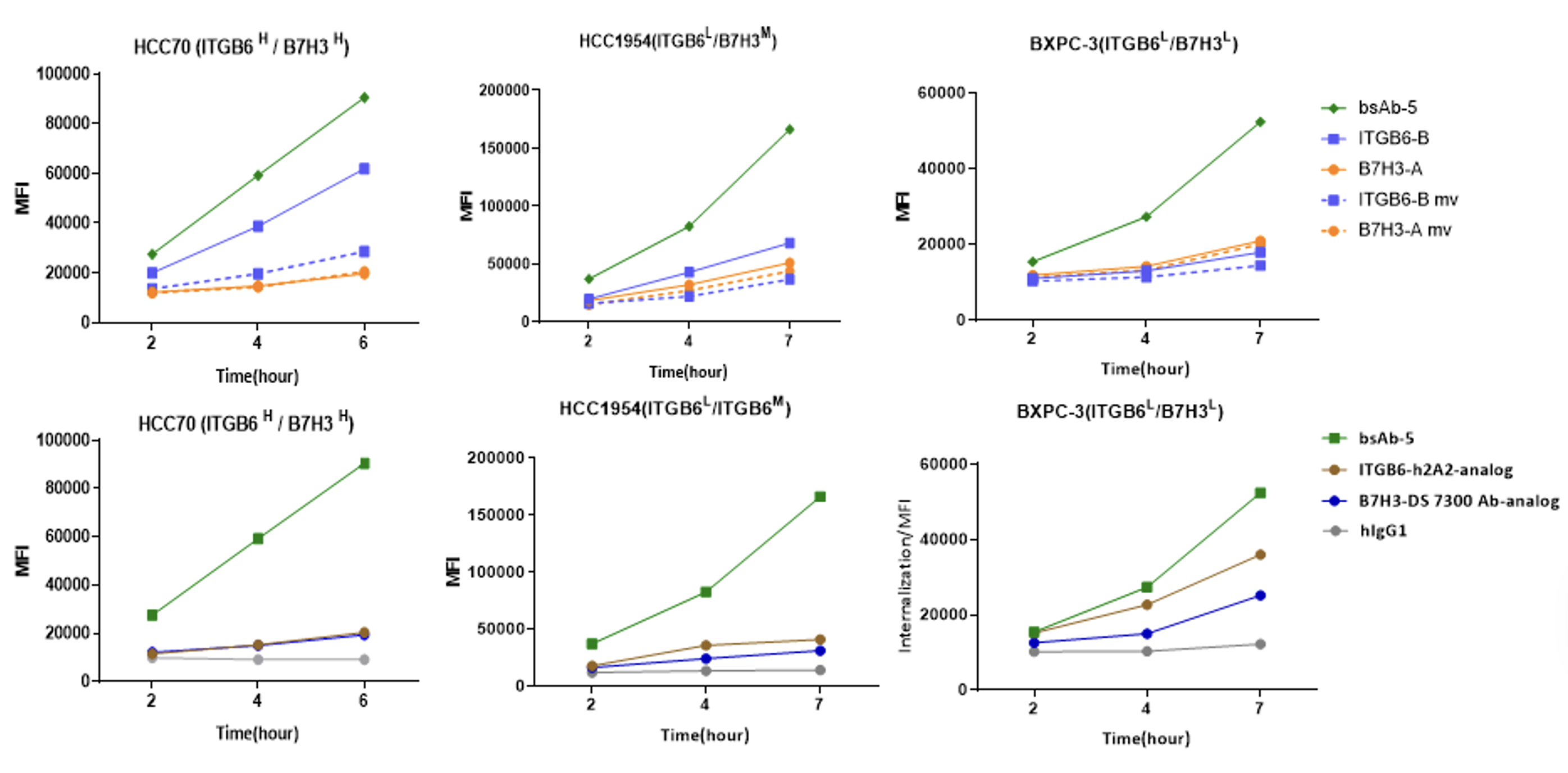
    • The ITGB6 × B7-H3 bsAb (unconjugated) shows enhanced internalization in dual-positive tumor cells (Figure 4).
    • The ITGB6 × B7-H3 bsAb (vcMMAE-conjugated) demonstrated improved efficacy in CDX models as proof of concept for dual targeting.
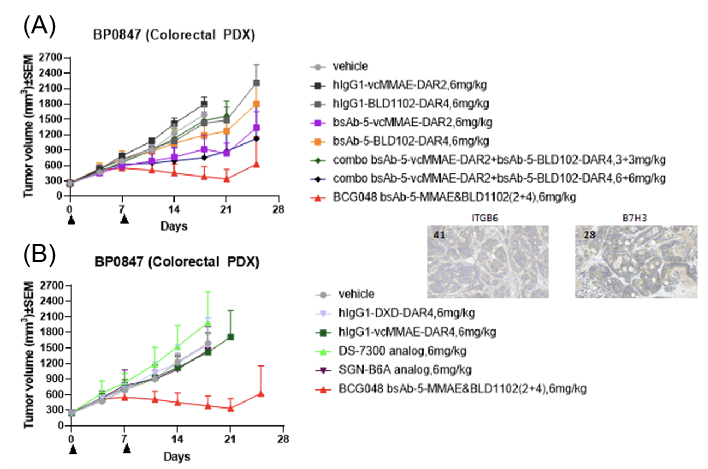
    • BCG048 (dual-payload) shows synergistic effects over single-payload ADCs and outperforms benchmark ADC comparators in vivo (Figure 5).

    IP Status and Potential Indications

    • A PCT patent application has been filed.
    • BCG048 is being evaluated for ITGB6/B7-H3-expressing solid tumors, with potential indications including NSCLC, pancreatic, TNBC, colorectal, gastric cancers.

    Preclinical Data Highlights Supporting BCG048 ITGB6 × B7-H3 Dual-Payload Bispecific ADC

    The preclinical data supporting BCG048 include target co-expression analysis, dual-payload conjugation feasibility, dual-payload pharmacokinetics, bispecific antibody backbone internalization, and antitumor efficacy in a colorectal PDX model, supporting the development of BCG048 as an ITGB6 × B7-H3 dual-payload bispecific ADC for broad potential solid tumor indications.

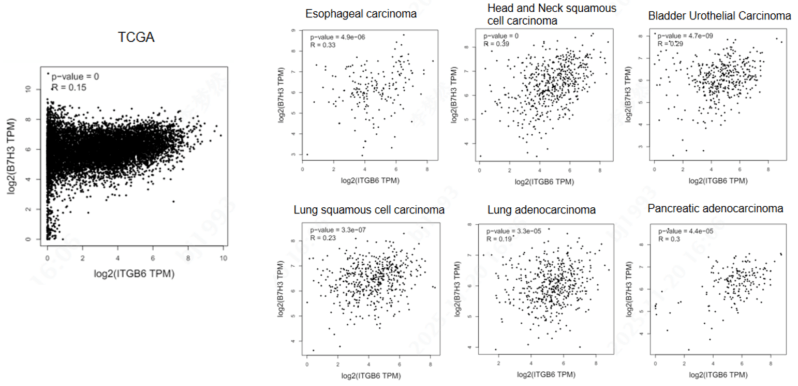
    ITGB6 and B7-H3 Are Co-expressed Across Multiple Solid Tumor Types

    Scatter plots showing the transcriptomic co-expression of ITGB6 and B7-H3 across multiple TCGA solid tumor types.
    Figure 1. Co-expression analysis of ITGB6 and B7-H3 in solid tumors based on TCGA transcriptomic data. Expression levels of ITGB6 and B7-H3 were evaluated using log2-transformed TPM values from the TCGA database. These data demonstrate a positive correlation between the two targets, supporting the rationale for evaluating ITGB6 × B7-H3 dual-targeting strategies in selected solid tumors, including esophageal carcinoma (ESCA), head and neck squamous cell carcinoma (HNSC), bladder urothelial carcinoma (BLCA), lung squamous cell carcinoma (LUSC), lung adenocarcinoma (LUAD), and pancreatic adenocarcinoma (PAAD).

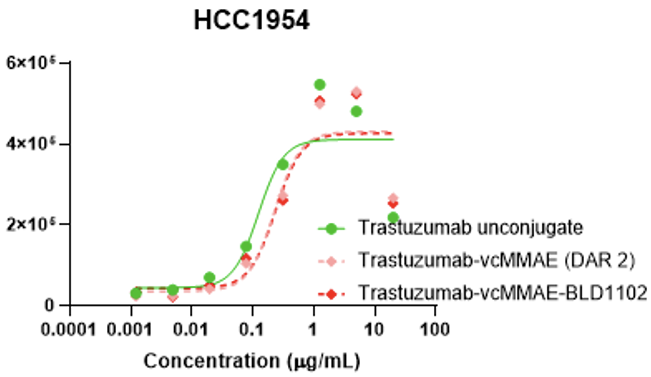
    Dual-Payload Conjugation Maintains Antigen Binding Activity

    Binding curves demonstrating that a trastuzumab-based dual-payload ADC retains robust HER2 antigen binding activity comparable to unconjugated antibody, validating the BCG048 conjugation platform.
    Figure 2. Antigen binding analysis of a trastuzumab-based dual-payload ADC in HCC1954 cells. The trastuzumab-vcMMAE-BLD1102 ADC (red line) retained HER2 binding activity comparable to both unconjugated trastuzumab and the single-payload trastuzumab-vcMMAE ADC, confirming that dual-payload conjugation does not compromise antigen affinity.

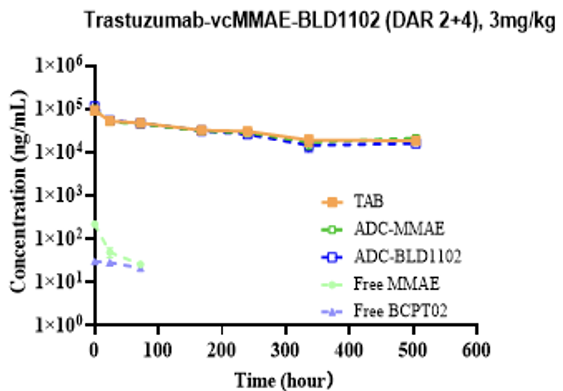
    Dual-Payload ADC Shows a Favorable Pharmacokinetic Profile

    A linear graph displaying the pharmacokinetic curves of a dual-payload ADC compared to single-payload controls and free payloads over time.
    Figure 3. Pharmacokinetic (PK) profile of a vcMMAE and BLD1102 dual-payload ADC. Following a single intravenous administration at 3 mg/kg, plasma concentrations of the dual-payload ADC, single-payload controls, and free payloads were quantified over time. The dual-payload ADC (yellow line) exhibited a PK profile comparable to that of the single-payload controls, confirming sustained systemic ADC exposure after dual-payload conjugation with vcMMAE and BLD1102.

    BCG048 Bispecific Antibody Backbone Shows Enhanced Internalization

    Kinetic curves displaying the time-dependent internalization of BCG048 bispecific antibody clone 5 versus single-target controls across HCC70, HCC1954, and BxPC-3 tumor cell lines.
    Figure 4. Internalization kinetics of the BCG048 ITGB6 × B7-H3 bispecific antibody backbone in tumor cells. Internalization was evaluated across HCC70, HCC1954, and BXPC-3 cells with different ITGB6 and B7-H3 expression levels. The BCG048 bsAb-5 clone (green line) demonstrated rapid, progressive internalization over time, outperforming single-target ITGB6 or B7-H3 parental antibody analogs and mutant controls, confirming enhanced internalization driven by the ITGB6 × B7-H3 bispecific antibody design.

    BCG048 Demonstrates Antitumor Efficacy in a Colorectal PDX Model

    Tumor volume growth curves demonstrating the superior in vivo antitumor efficacy of BCG048 dual-payload ADC compared with single-payload and benchmark ADCs in the BP0847 colorectal PDX model.
    Figure 5. Antitumor efficacy of BCG048 dual-payload ADC in the BP0847 colorectal PDX model. BCG048 (red line) showed superior antitumor efficacy compared with single-payload ADCs (A) and benchmark ADCs (B), supporting the antitumor potential of the ITGB6 × B7-H3 dual-targeting and dual-payload ADC design in this preclinical model.

    Explore BCG048 Partnership Opportunities

    Biocytogen welcomes partnership discussions to further evaluate the development potential of BCG048.

    Frequently Asked Questions (FAQs) About BCG048 and ITGB6 × B7-H3 Dual-Payload Bispecific ADC

    1. What makes the BCG048 bsAD2C different from standard single-payload ADCs?

    BCG048 is designed as a first-in-class dual-payload bispecific ADC (bsAD2C) asset. While clinical evidence shows that single-payload ADCs often fail to eliminate all tumor clones, BCG048 addresses tumor heterogeneity by simultaneously targeting two overexpressed solid tumor antigens: ITGB6 and B7-H3. Furthermore, it delivers two complementary cytotoxic payloads to provide a multi-dimensional attack, allowing it to outperform benchmark ADC comparators in vivo.

    2. How does a dual-payload ADC overcome treatment resistance?

    A dual-payload ADC overcomes treatment resistance through a "Dual-Strike Strategy" that conjugates two complementary toxins onto a single antibody to deliver a multi-dimensional attack. This design ensures that even if some cells are naturally resistant to one toxin, the second "mechanistically distinct" toxin can still kill them. Additionally, it prevents resistance by maintaining antitumor activity even if the tumor becomes resistant to one of the payload mechanisms, ultimately delivering synergistic potency and higher efficacy than co-administering separate treatments.

    3. Why does BCG048 target both ITGB6 and B7-H3 in solid tumors?

    Targeting both ITGB6 and B7-H3 provides a strategic advantage through complementary biology, pairing ITGB6's role in tumor invasion and immune exclusion with B7-H3's immune checkpoint suppression. This dual targeting reduces antigen escape to cover tumor heterogeneity and offers enhanced selectivity since both targets show low expression in normal tissues. Additionally, while B7-H3 is a highly competitive target in the industry, adding ITGB6 provides mechanistic uniqueness and a strong positioning advantage.

    4. What unique payloads are utilized in the BCG048 bsAD2C?

    The BCG048 bsAD2C utilizes a unique combination of two distinct payloads to enable complementary mechanisms of action. It pairs vcMMAE, a validated microtubule inhibitor with DAR=2, with the proprietary BLD1102 linker-payload system, which delivers the novel TOP1 inhibitor payload BCPT02 with DAR=4. Notably, this proprietary BCPT02 payload is highly potent and demonstrates greater cytotoxic activity than standard DXd (an exatecan derivative).

    5. How does the RenLite® platform improve the manufacturing of bispecific ADCs?

    A major challenge in developing bispecific antibodies is the complex manufacturing process. The RenLite® platform significantly improves bispecific ADC manufacturing by utilizing a fully human common light chain backbone. This innovative structural design effectively eliminates chain mispairing, which ensures seamless assembly and greatly simplifies the overall manufacturing process.

    6. Which solid tumor indications may be relevant for BCG048 development?

    BCG048 is being evaluated as a next-generation bispecific ADC for ITGB6/B7-H3-expressing solid tumors. Potential development areas include non-small cell lung cancer (NSCLC), pancreatic, triple-negative breast cancer (TNBC), colorectal, gastric cancers, where dual targeting may help improve tumor coverage and ADC payload delivery.