
B-hALK7 mice

C57BL/6JNifdc-Acvr1ctm2(ACVR1C)Bcgen/Bcgen • 114181

B-hALK7 mice

Product nameB-hALK7 mice
Catalog number114181
Strain nameC57BL/6JNifdc-Acvr1ctm2(ACVR1C)Bcgen/Bcgen
Strain backgroundC57BL/6JNifdc
NCBI gene ID130399 (Human)
AliasesALK7; ACVRLK7

在此页面上

  • Description
  • Targeting strategy
  • Phenotypic analysis
  • Efficacy
  • FAQ section

海报

查看全部

    发表文章

      Description

      Description

      • ACVR1C, also known as Activin receptor-like kinase 7 (ALK7), is a type I receptor within the TGF-β superfamily. Activin E functions as its endogenous ligands and activates the Smad2/3 signaling pathway, thereby regulating transcriptional programs associated with lipid metabolism and energy homeostasis. ALK7 plays an important role in adipose tissue biology by suppressing lipolysis and promoting fat accumulation.
      • Genetic studies, including rare variant analyses from the UK Biobank, have reported that loss-of-function variants in ALK7 are associated with favorable lipid profiles and fat distribution patterns, highlighting ALK7 as a promising therapeutic target for obesity and metabolic disorders.
      • ALK7-targeted drug development has highlighted nucleic acid therapeutics, including siRNA-based approaches designed to suppress human ACVR1C/ALK7 expression in adipose tissues.
      • ALK7 humanized mice were generated by replacing part of exon 2 through exon 9 of the endogenous mouse Alk7 gene, including the 3′ UTR region, with P2A and the full-length human ALK7 coding sequence and human ALK7 3′ UTR. The endogenous mouse promoter and 5′ UTR regions were retained to preserve physiological regulation of gene expression. Human ALK7 expression is driven by the endogenous mouse Alk7 promoter, while endogenous mouse Alk7 transcription and translation are disrupted.

      • This model enables translational evaluation of human ALK7-targeting therapeutics and provides a robust platform for obesity research, adipose metabolism studies, and preclinical siRNA drug development.

      Key Advantages

      • Physiological expression of human ALK7 driven by the endogenous mouse Alk7 promoter
      • Disruption of endogenous mouse Alk7 expression
      • Human ALK7 expression validated across multiple adipose tissues
      • Suitable for obesity and metabolic disease research
      • Enables in vivo efficacy testing of ALK7-targeted siRNA therapeutics
      • Translational platform for nucleic acid drug development targeting ACVR1C/ALK7

      Validation

      • Molecular Validation: Mouse Alk7 mRNA was detectable in wild-type C57BL/6JNifdc mice, whereas human ALK7 mRNA was detectable in homozygous ALK7 humanized mice. Human ALK7 transcript identity was further confirmed by Sanger sequencing.
      • Expression Validation: Human ALK7 mRNA expression was detected across multiple adipose depots, including perigonadal fat, inguinal subcutaneous fat, brown fat, and perirenal fat in ALK7 humanized mice, supporting adipose tissue expression of human ALK7 in the humanized model.
      • Functional Validation: Administration of human ALK7-targeted nucleic acid drug significantly reduced human ALK7 mRNA expression in adipose tissues of ALK7 humanized mice, confirming in vivo target-specific knockdown.
      • Translational Value: ALK7 humanized mice support preclinical evaluation of siRNA and other nucleic acid metabolic disease and obesity research.

      Applications

      • Obesity and metabolic disease research
      • siRNA and nucleic acid drug evaluation
      • Adipose tissue biology and lipolysis studies
      • Smad2/3 signaling pathway research
      • Preclinical efficacy evaluation of ALK7-targeted therapeutics
      • Safety and pharmacodynamic assessment of metabolic disease therapeutics
      Targeting Strategy

      The region spanning exon 2 through exon 9 of the endogenous mouse Alk7 gene, including the 3′ UTR region, was replaced with P2A and the full-length human ALK7 coding sequence (CDS), including the human ALK7 3′  UTR, in ALK7 humanized mice.

      The endogenous mouse Alk7 promoter and 5′ UTR regions were retained to preserve physiological transcriptional regulation. Human ALK7 expression is driven by the endogenous mouse Alk7 promoter, while endogenous mouse Alk7 transcription and translation are disrupted.

      Human ALK7 mRNA Expression in ALK7 Humanized Mice

      Strain-specific analysis of ALK7 mRNA expression in wild-type C57BL/6JNifdc mice and ALK7 humanized mice was performed by RT-PCR. Subcutaneous fat RNA was isolated from wild-type C57BL/6JNifdc mice (+/+) and homozygous ALK7 humanized mice (H/H). cDNA libraries were synthesized by reverse transcription, followed by RT-qPCR using human ALK7-specific primers. Human ALK7 mRNA was detectable in ALK7 humanized mice but not in wild-type mice. Human sequences were further confirmed by Sanger sequencing.
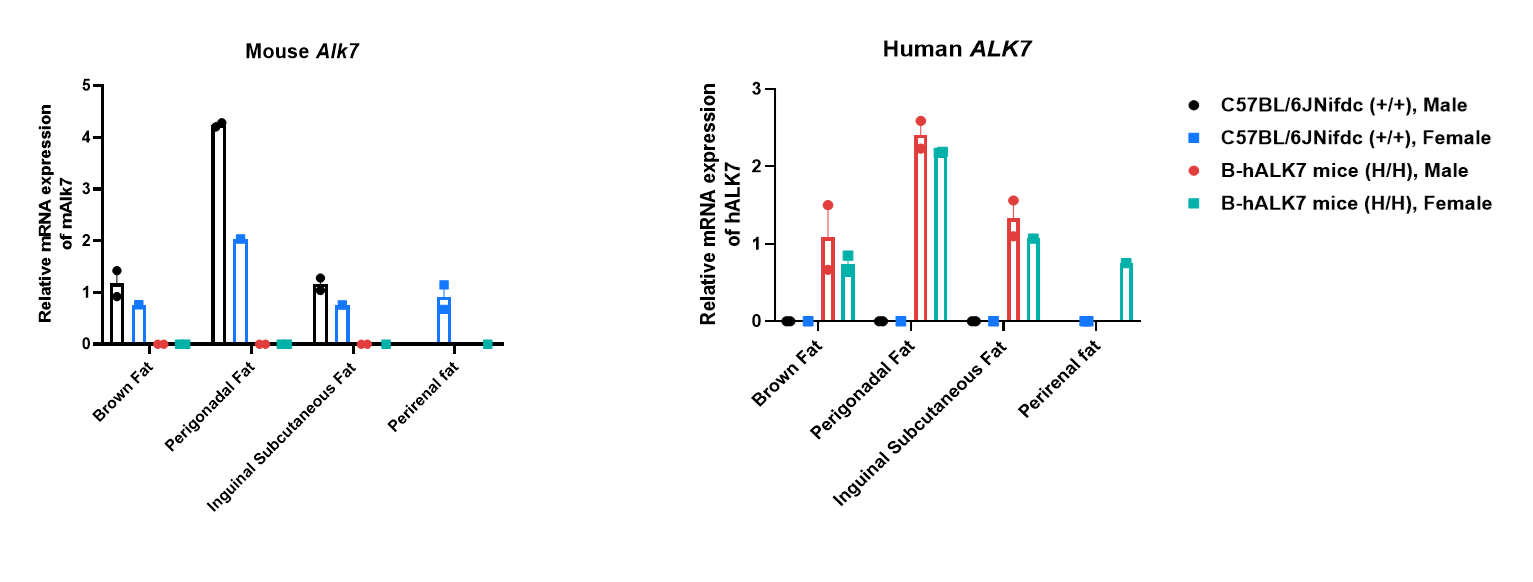
      Strain-specific analysis of human ALK7 mRNA expression in wild-type C57BL/6JNifdc mice and ALK7 humanized mice was performed by RT-qPCR. RNA was isolated from perirenal fat, perigonadal fat, inguinal subcutaneous fat, and brown fat of wild-type C57BL/6JNifdc mice (+/+) and homozygous ALK7 humanized mice (H/H). cDNA libraries were synthesized by reverse transcription, followed by RT-qPCR using mouse- or human-specific ALK7 primers. Human ALK7 mRNA was detectable in ALK7 humanized mice but not in wild-type mice.
      Note: Male perirenal fat samples were not collected.

      Inhibitory Efficiency of Nucleic Acid Drug Against Human ALK7 in ALK7 Humanized Mice

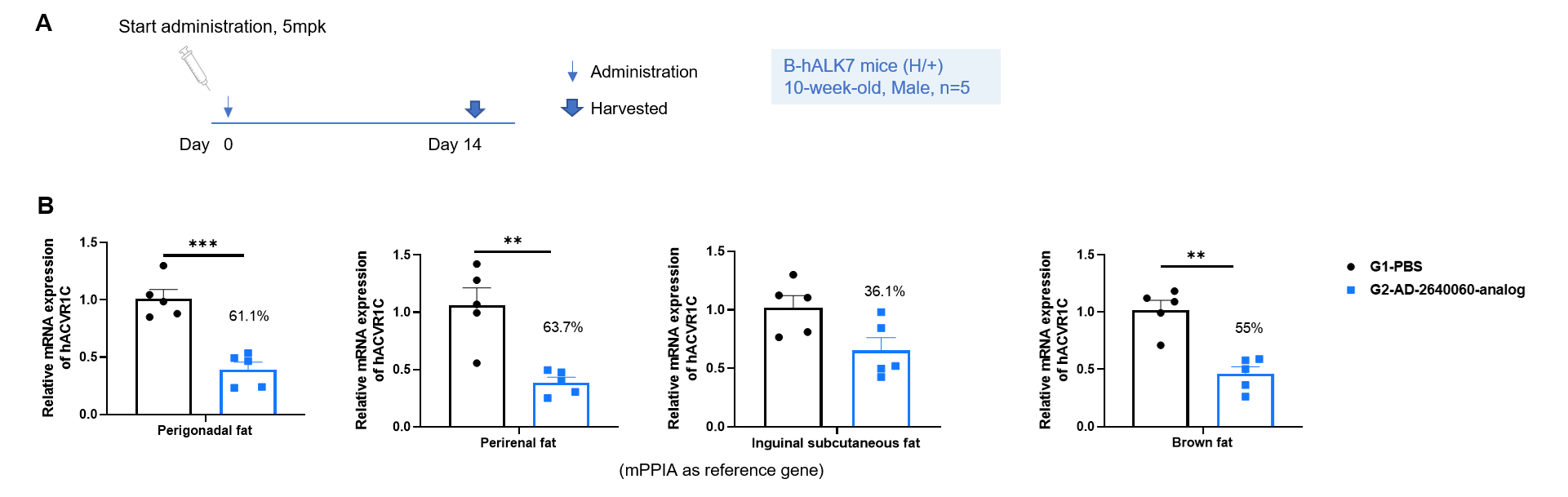
      The inhibitory efficiency of nucleic acid drug against human ALK7 was evaluated in heterozygous ALK7 humanized mice. Heterozygous ALK7 humanized mice (H/+) were randomly divided into two groups (male, 10 weeks old, n=5). Human ALK7-targeted nucleic acid drug synthesized according to patented sequences and PBS control were individually administered to mice in the form of aqueous PBS solutions.

      Mice were sacrificed on Day 14, and adipose tissues were collected for analysis of human ALK7 mRNA expression by qPCR.

      (A) Schematic diagram of experimental design
      (B) Human ALK7 mRNA expression levels in adipose tissues

      Human ALK7 expression in the siRNA-treated group was significantly reduced compared with the PBS control group. Significance was determined by a t-test. *P<0.05, **P<0.01, ***P<0.001. Values are expressed as mean ± SEM.

      Frequently Asked Questions (FAQs) About ALK7 Humanized Mice

      Q1: What are ALK7 humanized mice?

      A1: ALK7 humanized mice are genetically engineered mice expressing human ACVR1C/ALK7 under the endogenous mouse Alk7 promoter, enabling translational metabolic disease and obesity research.

      Q2: Why is ALK7 considered an important therapeutic target?

      A2: ALK7 regulates adipose metabolism and lipolysis. Human genetic studies have linked ALK7 loss-of-function variants with favorable lipid metabolism and reduced obesity risk.

      Q3: Can ALK7 humanized mice be used for siRNA drug evaluation?

      A3: Yes. This model is specifically designed for preclinical evaluation of human ALK7-targeted nucleic acid therapeutics, including siRNA drugs.

      Q4: Does the model express endogenous mouse Alk7?

      A4: No. Endogenous mouse Alk7 transcription and translation are disrupted, while human ALK7 is expressed under physiological regulatory control.

      Q5: What tissues express human ALK7 in this model?

      A5: Human ALK7 expression has been validated in multiple adipose tissues, including subcutaneous fat, perigonadal fat, brown fat, and perirenal fat.

      * When publishing results obtained using this animal model, please acknowledge the source as follows: The animal model [B-hALK7 mice] (Cat# 114181) was purchased from Biocytogen.