
CB17/lcr-Prkdcscid Fcgrttm1(FCGRT)Bcgen/Bcgen • 113781


Gene targeting strategy for B-hFcRn mice(CB-17 SCID). The CDS that encodes full-length human FCGRT, followed by the mouse 3’UTR-STOP, is inserted right after the mouse Fcgrt ATG to replace the exons 2-4 of the mouse Fcgrt gene. The FcRn protein expression will be driven by the endogenous mouse Fcgrt promoter, while the mouse Fcgrt gene transcription and translation will be disrupted.

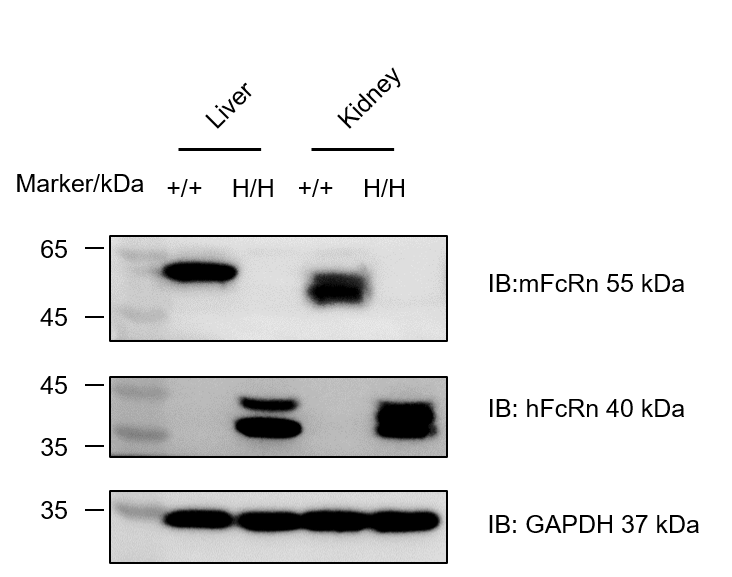
Western blot analysis of FcRn protein expression in homozygous B-hFcRn mice(CB-17 SCID). Various tissue lysates were collected from wild-type CB-17 SCID mice (+/+) and homozygous B-hFcRn mice(CB-17 SCID) (H/H), and then analyzed by western blot with species-specific anti-mouse FcRn antibody (R&D, AF6775) and anti-human FcRn antibody (Novus Biologicals, NBP1-89128). 40 μg total proteins were loaded for western blotting analysis. Mouse FcRn was only detectable in wild-type CB-17 SCID mice. Human FcRn was exclusively detectable in liver and kidney of homozygous B-hFcRn mice(CB-17 SCID).


Pharmacokinetics of huEM164-analog and huEM164YTE-analog in B-hFcRn mice(CB-17 SCID).
SCID/Nifdc, and B-hFcRn mice(CB-17 SCID) were intravenously injected with huEM164-analog (in-house) and huEM164YTE-analog (in-house), and serum was collected for pharmacokinetic (PK) analysis (n=6). A. Design of blood collection timepoints. B. The PK curve in each group. C. The PK parameters. Data are shown in mean ± SEM.
B-hFcRn mice(CB-17 SCID) lack T and B cells, preventing the production of anti-drug antibodies (ADA), making them suitable for pharmacokinetic (PK) evaluation of antibodies that induce severe ADA responses in mice.