B-hIL31/hIL31RA/hOSMR mice

C57BL/6-Il31tm1(IL31)BcgenIl31ratm1(IL31RA)BcgenOsmrtm1(OSMR)Bcgen/Bcgen • 130746

B-hIL31/hIL31RA/hOSMR mice

Catalog Number: 130746
Strain Name: C57BL/6-Il31tm1(IL31)BcgenIl31ratm1(IL31RA)BcgenOsmrtm1(OSMR)Bcgen/Bcgen
Strain Background: C57BL/6
NCBI gene ID: 9180,133396,386653 (Human)
Aliases: OSMRB; PLCA1; IL-31RB; OSMRbeta; IL-31R-beta; CRL; GPL; CRL3; GLMR; GLM-R; PLCA2; hGLM-R; IL-31RA; PRO21384; zcytoR17; IL-31
---
可提供授权方案
B-hIL31/hIL31RA/hOSMR mice

在此页面上

  • Description
  • Targeting strategy
  • Phenotypic analysis
  • Efficacy

海报

查看全部

    发表文章

      Description

      IL31: A key cytokine in inflammation and its therapeutic intervention

      • Gene Information: Interleukin 31 (IL31) is a protein-coding gene located on chromosome 12q24.31. IL-31 belongs to the family of IL-6-derived cytokines. IL31 encodes a cytokine that is primarily secreted by activated T cells and functions in pro-inflammatory signaling through the IL31RA/OSMR receptor complex.
      • Protein Expression: IL31 is a pro-inflammatory cytokine linked to various disorders, such as AD, asthma, and inflammatory bowel disease. Produced chiefly by TH2 cells and immature dendritic cells (iDCs).
      • Signaling Pathway: IL31 binds to the IL31RA/OSMR receptor complex on keratinocytes and dorsal root ganglia (DRG) neurons. Through this pathway, IL-31 acts as a pivotal mediator linking immune cells to both the epithelium and the neuronal network.
      • Therapeutic Inhibition: IL-31 is a neuroimmune cytokine that induces itch, inflammation, keratinocyte differentiation and fibroblast activation in chronic pruritic skin diseases. Nemolizumab (Mitchga Syringes) was approved in Japan on 28 March 2022 for use in adults and children over the age of 13 years for the treatment of itch associated with AD (only when existing treatment is insufficiently effective).
      Targeting strategy

      IL31

      • The mouse Il31 gene that encode the full-length protein was replaced by human IL31 counterpart gene sequences in B-hIL31/hIL31RA/hOSMR mice.

      IL31RA

      • The coding sequences including human IL31RA extracellular region and mouse Il31ra intracellular region were inserted into mouse IL31RA gene in B-hIL31/hIL31RA/hOSMR mice.

      OSMR

      • The coding sequences including human IL31RA extracellular region and mouse Il31ra intracellular region were inserted into mouse IL31RA gene in B-hIL31/hIL31RA/hOSMR mice.

      Note: The mice was obtained by B-hIL31/hIL31RA mice cross breeding with B-hOSMR mice.

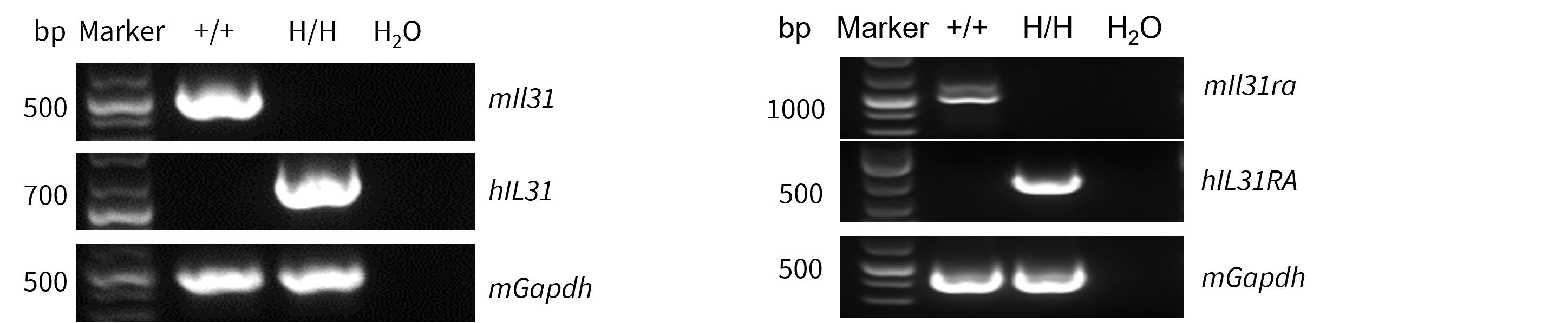
      Human IL31 and IL31RA mRNA Expression by RT-PCR
      • Human IL31 and IL31RA mRNA are specifically and correctly expressed in B-hIL31/hIL31RA mice.

      Strain specific analysis of IL31 and IL31RA gene expression in wild-type mice and homozygous B-hIL31/hIL31RA mice by RT-PCR. Testis was collect from wild-type C57BL/6 mice (+/+) and B-hIL31/hIL31RA mice (H/H). Mouse Il31 and Il31ra mRNA were exclusively detectable in wild-type mice. Human IL31 and IL31RA mRNA were exclusively detectable in homozygous B-hIL31/hIL31RA mice, but not in wild-type mice.
      Human OSMR Expression by RT-PCR/WB
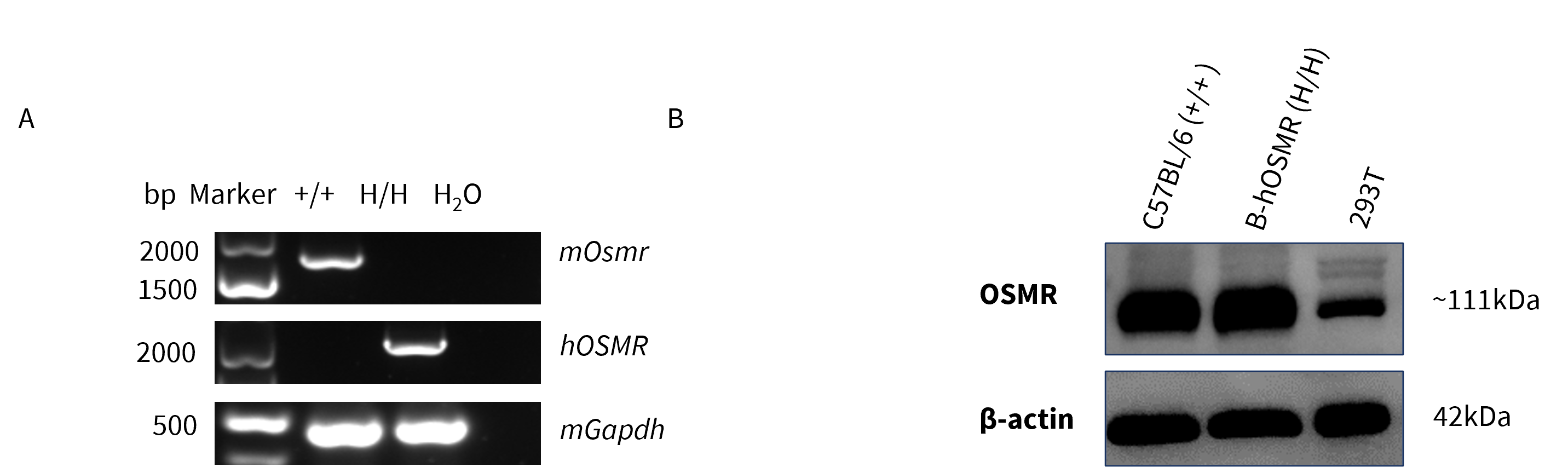
      • Human OSMR mRNA is specifically and correctly expressed in B-hOSMR mice.
      • Human OSMR protein was detected in homozygous B-hOSMR mice.

      Strain specific analysis of OSMR gene expression in wild-type mice and B-hOSMR mice by RT-PCR and western blot. (A) mRNA expression. Mouse Osmr mRNA was exclusively detectable in the kidney of wild-type mice (+/+). Human OSMR mRNA was exclusively detectable in homozygous B-hOSMR mice (H/H). (B) Protein expression. Kidney was collected from wild-type C57BL/6 mice (+/+) and homozygous B-hOSMR mice (H/H), and analyzed by western blot with anti-OSMR antibody. The OSMR protein can be detected in homozygous B-hOSMR mice. The antibody was cross-reactive between human and mouse.

      In Vivo Efficacy of Anti-Human IL31RA Antibody in hIL31-Induced Pruritus Model

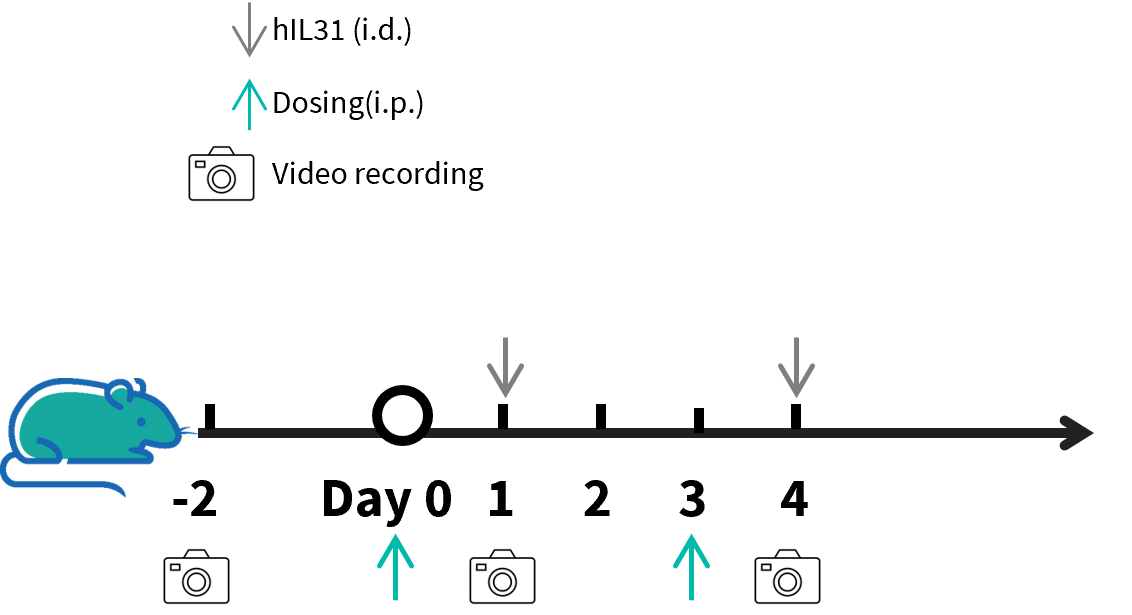
      Experimental schedule for the induction of pruritus model and in vivo efficacy of anti-human IL31RA antibody in B-hIL31/hIL31RA/hOSMR mice. Human IL31 was administered to the B-hIL31/hIL31RA/hOSMR mice (female, 12-week-old, 6 mice/group) to induce the  scratching behaviors. Meanwhile, the mice were treated with nemolizumab analog (in house).

      • Anti-hIL31RA antibodies attenuate the scratching behaviors in IL31-induced murine pruritus model.

      Anti-hIL31RA antibodies attenuate the scratching behaviors in IL31-induced murine pruritus model. Human IL31 was administered to the B-hIL31/hIL31RA/hOSMR mice (female, 12-week-old, 6 mice/group) to induce the  scratching behaviors. Meanwhile, the mice were treated with nemolizumab analog (in-house) or PBS. Scratching behavior was recorded on day 1 (A), day 4 (B).Summary of the mouse Itching frequency in different groups shown in figure (C). As shown, IL31-treated mice show significantly increased scratching bouts. In the nemolizumab analog treatment group, blockade of IL-31 signaling with anti-hIL-31RA antibodies significantly attenuates scratching behaviors on day 4. Values are expressed as mean ± SEM. Significance was determined by the 2way ANOVA. (*P <​ 0.05, **P <​ 0.01, ***P <​ 0.0001, ns: not significant); Δ Scraching bouts: Scraching bouts of Day1 or Day4 ➖️ Scraching boutsof Day-2.
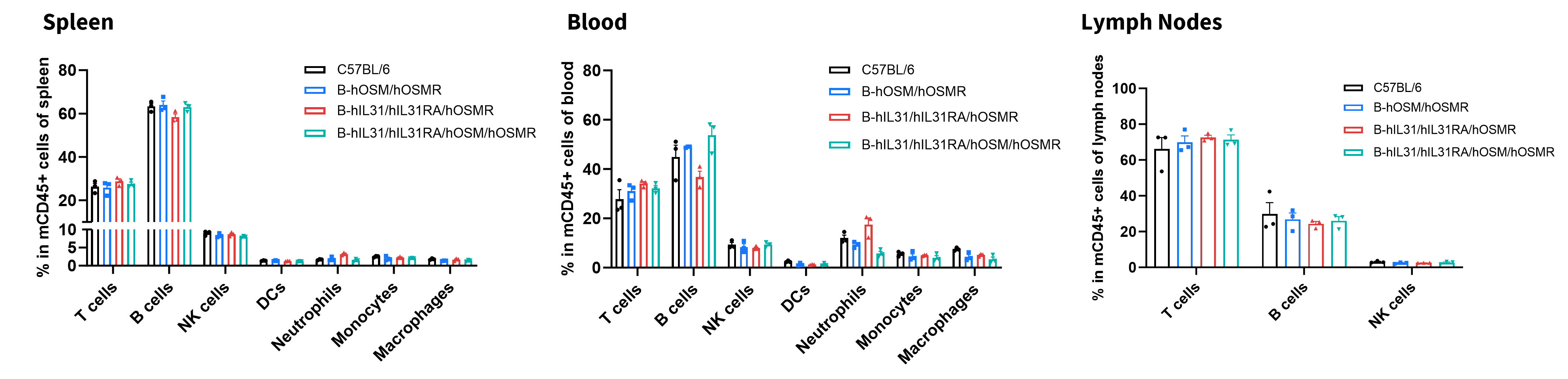
      Analysis of Leukocyte Subpopulations
      • The percentages of T cells, B cells, NK cells, DCs, neutrophils, monocytes, and macrophages in homozygous B-hIL31/hIL31RA/hOSMR mice were similar to those in C57BL/6 mice.
      • Humanization of IL31, IL31RA and OSMR does not affect normal immune cell development or splenic distribution.

      Analysis of leukocyte subpopulations by flow cytometry in immune organs and blood. Splenocytes, peripheral blood, and lymph nodes were isolated from female C57BL/6, B-hOSM/hOSMR mice, B-hIL31/hIL31RA/hOSMR mice and B-hIL31/hIL31RA/hOSM/hOSMR mice (female, 6 or 7-week-old, n = 3). Single live cells were gated on the CD45⁺ population and analyzed by flow cytometry as indicated. Values are expressed as mean ± SEM.
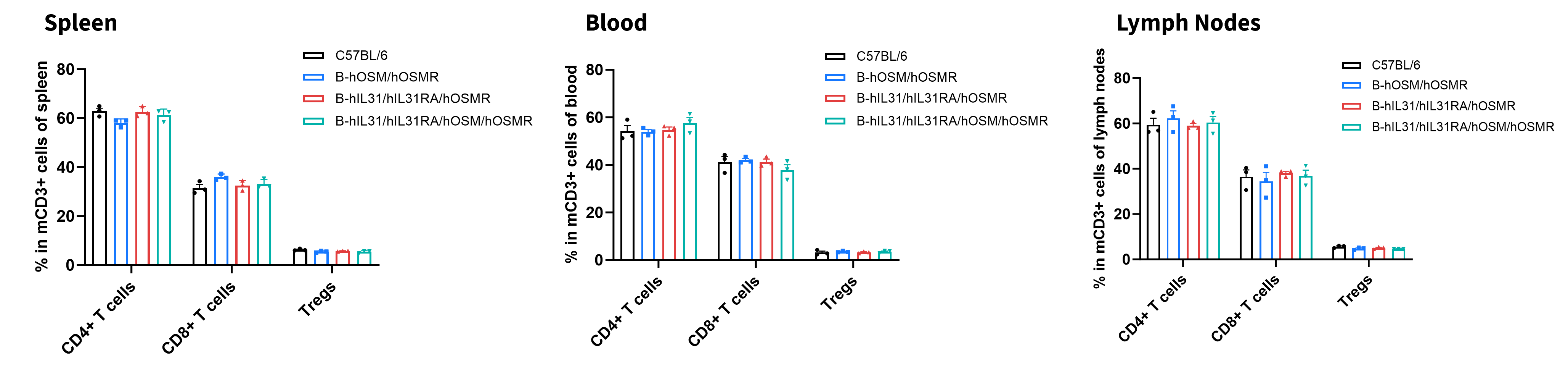
      Analysis of T Cell Subpopulations
      • The proportions of CD4⁺ T cells, CD8⁺ T cells, and Tregs in homozygous B-hIL31/hIL31RA/hOSMR mice were comparable to those in C57BL/6 mice.
      • Humanization of IL31, IL31RA and OSMR does not affect normal T cell development, differentiation, or splenic distribution.

      Analysis of T-cell subpopulations by flow cytometry in immune organs and blood. Splenocytes, peripheral blood, and lymph nodes were isolated from female C57BL/6, B-hIL31/hIL31RA/hOSMR mice, B-hOSM/hOSMR mice and B-hIL31/hIL31RA/hOSM/hOSMR mice (female, 6 or 7-week-old, n = 3). Single live cells were gated on the CD3⁺ T-cell population and analyzed by flow cytometry as indicated. Values are expressed as mean ± SEM.

      * When publishing results obtained using this animal model, please acknowledge the source as follows: The animal model [B-hIL31/hIL31RA/hOSMR mice] (Cat# 130746) was purchased from Biocytogen.