Description
Lipoprotein(a): A highly polymorphic particle that is structurally similar to but larger than Low-density lipoprotein (LDL).
- Gene Information: Lipoprotein(a) is a highly polymorphic particle that is structurally similar to but larger than low-density lipoprotein (LDL).
- Protein Expression: LPA encoding apo(a) highly expressed in the liver. Apo(a) is noncovalently and covalently bound to apoB-100.
- Signaling Pathway: Human Apo(a) does not tightly associate with mouse ApoB in the plasma. Human Apo(a) efficiently interacts with human ApoB, producing high plasma concentrations of human-like Lp(a) in the plasma.
- Therapeutic Method: A new generation of Lp(a)-specific therapeutics covers siRNAs, ASOs, small molecules, and CRISPR/Cas9 editing technologies. These drug categories feature unique action mechanisms, pharmacokinetic behaviors, and development timelines. Researchers are particularly focused on their ability to cut Lp(a) levels and, correspondingly, lower projected ASCVD risk.
Targeting strategy
LPA
- The full coding sequences (CDS) of the human LPA gene, which is driven by the Alb promoter, were inserted into the Gt(ROSA)26Sor gene locus site. And there’s no LPA gene in the mouse genome sequence.
Apo(a) Protein Expression Analysis
- Human Apo(a) was detected in homozygous B-hLPA mice.
Strain-specific Apo(a) protein expression analysis in B-hLPA mice by ELISA. Serum was collected from homozygous B-hLPA mice (H/H) of both genders (n=3/group) at different ages. Human Apo(a) was detectable in these homozygous B-hLPA mice at different ages.
Blood Chemistry
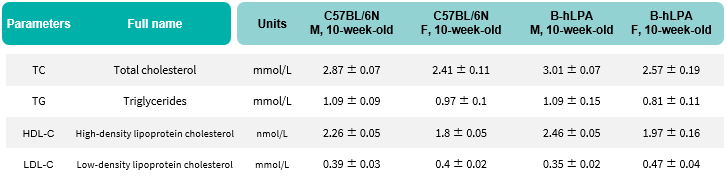
- Humanization of LPA does not alter blood chemistry parameters in 10-week-old mice.
Biochemical test of B-hLPA mice. Values are expressed as mean ± SD.
The Inhibitory Efficiency of the Nucleic Acid Drugs Against Human LPA
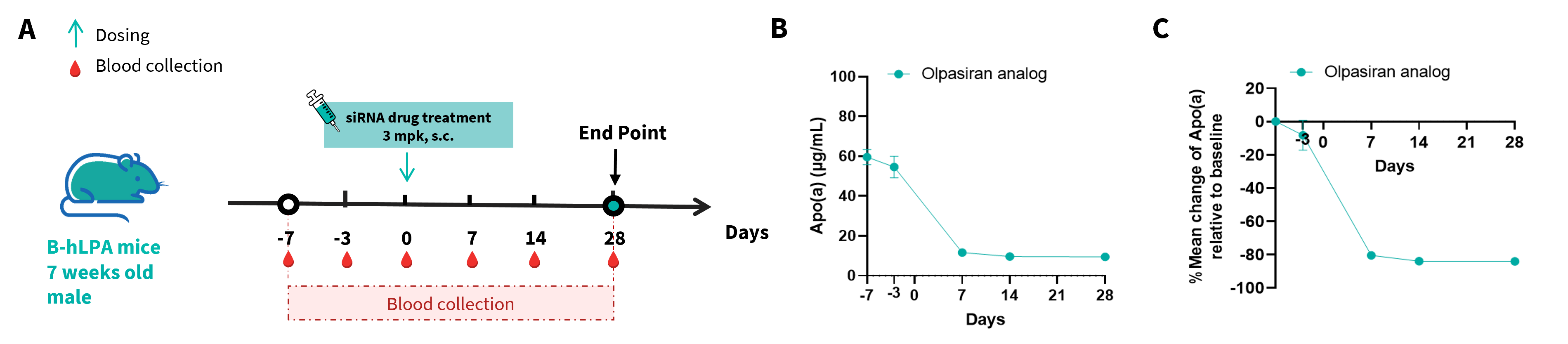
- The human Apo(a) levels reduced after the administration of a single dose, demonstrating that B-hLPA mice provide a powerful preclinical model for in vivo evaluation of human LPA-targeted nucleic acid drugs.
The inhibitory efficiency of the nucleic acid drugs against human LPA in B-hLPA mice. The human LPA targeted nucleic acid drugs (provided by a client) was administered to the B-hLPA mice (H/+, 7-week-old, male) individually. (A) The schematic diagram of experimental processing. (B-C) The expression of human Apo(a) in the serum on days -7, -3, 0, 7, 14, 28. The human Apo(a) levels reduced after the administration of a single dose. Values are expressed as mean ± SEM.
* When publishing results obtained using this animal model, please acknowledge the source as follows: The animal model [B-hLPA mice] (Cat# 112723) was purchased from Biocytogen.