

B-hALPL mice

C57BL/6-Alpltm1(ALPL)Bcgen/Bcgen • 113706


B-hALPL mice

Product nameB-hALPL mice
Catalog number113706
Strain nameC57BL/6-Alpltm1(ALPL)Bcgen/Bcgen
Strain backgroundC57BL/6
NCBI gene ID249 (Human)
AliasesHOPS; HPPA; HPPC; HPPI; HPPO; TNAP; TNALP; APTNAP; TNSALP; AP-TNAP; TNS-ALP

在此页面上

  • Description
  • Targeting strategy
  • Phenotypic analysis

海报

查看全部

    发表文章

      相关产品

      查看全部
      Description
      • Background: ALPL encodes tissue-nonspecific alkaline phosphatase, an age-up-regulated phosphatase that promotes bone matrix mineralization and is causally linked to brain aging. Additionally, ALPL acts as a highly conserved brain vascular receptor that enables engineered AAV vectors (e.g., VCAP-102) to cross the BBB via receptor-mediated transcytosis, enhancing CNS delivery of therapeutics.
      • Targeting strategy: The exons 2-12 of mouse Alpl gene that encode whole protein domains are replaced by human counterparts in B-hALPL mice. The promoter, 5’UTR and 3’UTR regions of the mouse gene are retained. The mouse Alpl gene transcription and translation will be disrupted.

      • Validation: Human ALPL mRNA was detectable only in homozygous humanized B-hALPL mice, but not in wild-type C57BL/6JNifdc mice, and hALPL sequences were confirmed by Sanger Sequencing. Human ALPL protein was detectable in liver, spleen, lung, kidney and brain from homozygous B-hALPL mice and wild-type C57BL/6JNifdc mice, as the antibody was cross-reactive between human and mouse.
      • Application: This model can be used both to investigate the mechanisms of ALPL-related diseases and to study ALPL-targeted strategies for crossing the blood–brain barrier.
      Targeting Strategy

      Gene targeting strategy for B-hALPL mice. The exons 2-12 of mouse Alpl gene that encode whole protein domains are replaced by human counterparts in B-hALPL mice. The promoter, 5’UTR and 3’UTR regions of the mouse gene are retained. The mouse Alpl gene transcription and translation will be disrupted.

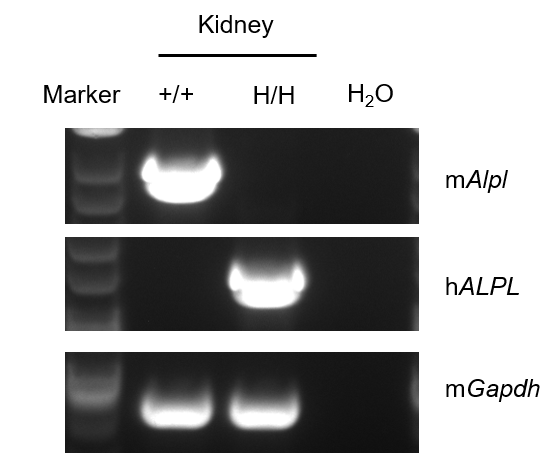
      mRNA Expression Analysis in Humanized B-hALPL mice

      Species specific analysis of ALPL gene expression in wild-type C57BL/6JNifdc mice and homozygous humanized B-hALPL mice by RT-PCR. Kidney were collected from wild-type C57BL/6JNifdc mice (+/+) and homozygous humanized B-hALPL mice (H/H), then cDNA libraries were synthesized by reverse transcription, followed by PCR with mouse or human ALPL primers. Mouse Alpl mRNA was only detectable in wild-type C57BL/6JNifdc mice. Human ALPL mRNA was detectable only in homozygous B-hALPL mice, but not in wild-type C57BL/6JNifdc mice, and hALPL sequences were confirmed by Sanger Sequencing.
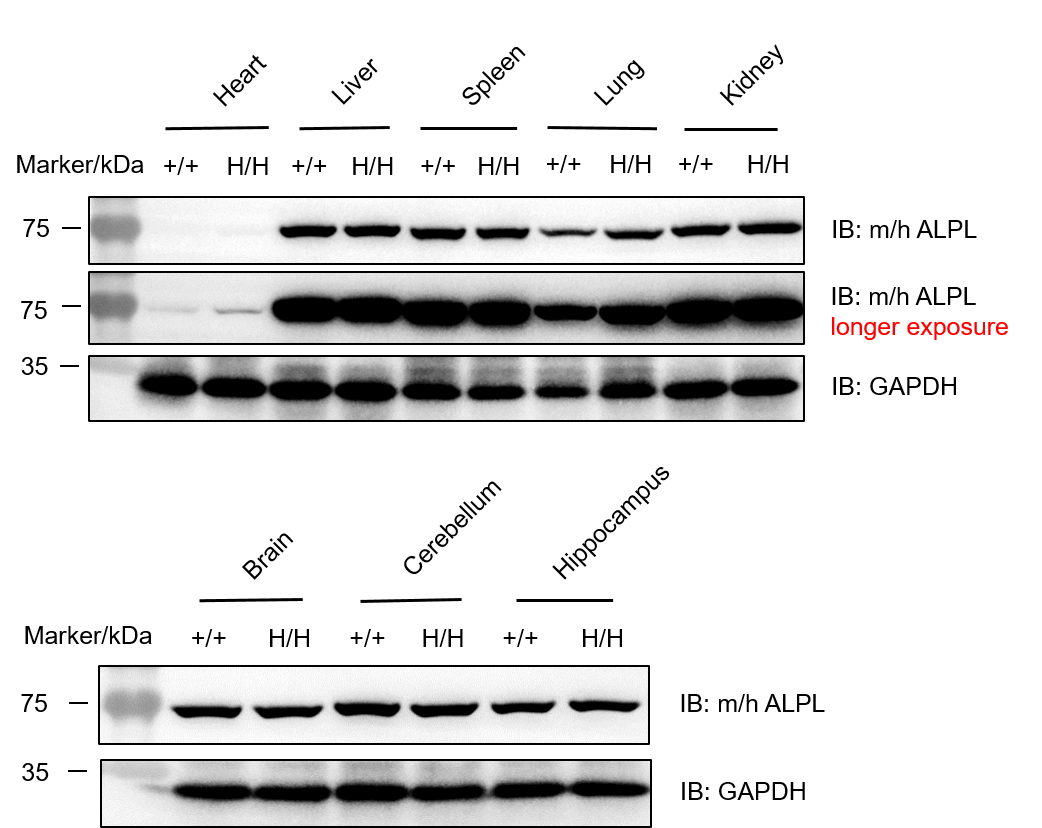
      Protein Expression Analysis in Humanized B-hALPL mice

      Western blot analysis of ALPL protein expression in homozygous B-hALPL mice. Various tissue lysates were collected from wild-type C57BL/6JNifdc mice (+/+) and homozygous B-hALPL mice (H/H), and then analyzed by western blot with anti-ALPL antibody (Abways, CY5421). 40 μg total proteins were loaded for western blotting analysis. GAPDH was detected as an internal control. HeLa lysates were detected as positive control. Human ALPL protein was detectable in liver, spleen, lung, kidney and brain from homozygous B-hALPL mice and wild-type C57BL/6JNifdc mice, as the antibody was cross-reactive between human and mouse.

      * When publishing results obtained using this animal model, please acknowledge the source as follows: The animal model [B-hALPL mice] (Cat# 113706) was purchased from Biocytogen.