Description
- Gene Information: This gene encodes component C2 of the classical pathway of the complement system. The encoded protein undergoes proteolytic processing mediated by component C1 resulting in C2a and C2b fragments. C2a fragment, in turn, selectively cleaves components C3 and C5 of the complement system.
- Protein Expression: It is constitutively expressed mainly in the liver under physiological conditions to maintain the complement level in blood.
- Signaling Pathway: C2 participates in the classical and lectin pathways of complement, serving as a key component in the complement cascade activation pathway.
- Therapeutic Inhibition: Several antibody-based therapeutics targeting C2 are currently being explored as immunomodulators in the fields of oncology, inflammation, and transplant rejection. The therapeutic rationale lies in modulating complement system activity to achieve clinical efficacy.
Targeting strategy
Gene targeting strategy for B-hC2 mice.
- The exons 1~8 of mouse C2 gene were replaced by human exons 1~18 (with 3’UTR) that encode the whole molecule in B-hC2 mice.
- The promoter and 5’UTR region of the mouse gene are retained.
- The human C2 protein expression is driven by endogenous mouse C2 promoter.
mRNA expression analysis by RT-PCR
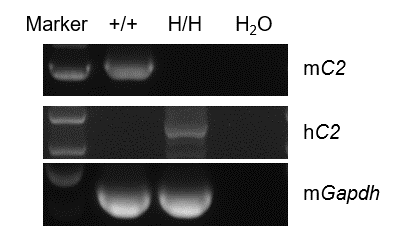
- Human C2 mRNA was detectable only in homozygous B-hC2 mice but not in wild-type mice.
Strain specific analysis of C2 mRNA expression in wild-type C57BL/6JNifdc mice and B-hC2 mice by RT-PCR. Liver RNA were isolated from wild-type C57BL/6JNifdc mice (+/+) and homozygous B-hC2 mice (H/H), then cDNA libraries were synthesized by reverse transcription, followed by PCR with mouse and human C2 primers. Mouse C2 mRNA was only detectable in wild-type mice. Human C2 mRNA was detectable only in homozygous B-hC2 mice but not in wild-type mice.
C2 Protein Expression Analysis
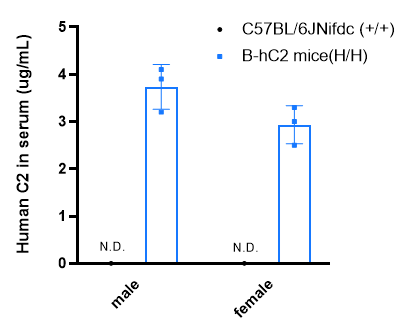
- Human C2 was detected in homozygous B-hC2 mice, but not in wild-type mice.
Strain specific C2 expression analysis in wild-type C57BL/6 mice and homozygous humanized B-hC2 mice by ELISA. Serum was collected from wild-type C57BL/6JNifdc mice (+/+) (mix from 3 male & 3female, 11-week-old) and homozygous B-hC2 mice (H/H) (3 male & 3female, 11-week-old) . Expression level of human C2 were analyzed by ELISA (anti-human C2 ELISA kit: Abcam, ab254501). Human C2 was exclusively detectable in homozygous B-hC2 mice. Values are expressed as mean ± SEM.
Functional Validation in serum by ELISA
- To rigorously validate the functional integrity of the complement cascade in B-hC2 mice, we employed the HIT420 (Classical Pathway) and HIT421 (Lectin Pathway) functional assays. Unlike traditional hemolytic tests, these kits utilize a solid-phase activation mechanism to quantify the formation of activation products.
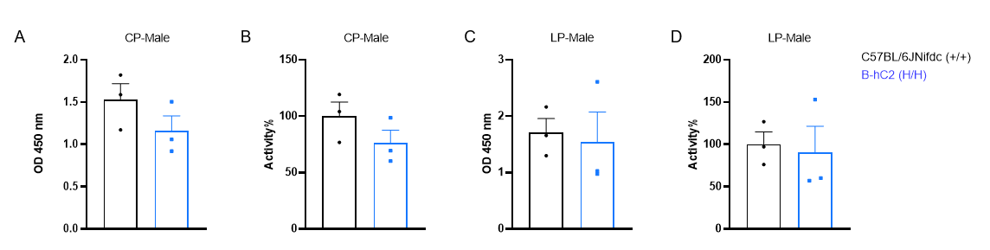
Functional activity of the Complement pathway and Lectin Complement of homozygous B-hC2 mice. Serum was collected from wild-type C57BL/6JNifdc mice (+/+) and homozygous B-hC2 mice (H/H) (male, 10 weeks old, n=3) and evaluate the functional activity with the complement kit (Classical Complement Pathway, Mouse Assay, Hycult Biotech, HIT420; Lectin Complement Pathway, Mouse Assay, Hycult Biotech, HIT421). (A) The OD values at 1:20 serum dilution, assayed using the Classical Complement Pathway Assay Kit. (B) Classical Complement Pathway Activity% compared with male wild-type C57BL/6JNifdc mice. (C) The OD values at 1:20 serum dilution, assayed using the Lectin Complement Pathway Assay Kit. (D) Lectin Complement Pathway Activity% compared with male wild-type C57BL/6JNifdc mice.
* When publishing results obtained using this animal model, please acknowledge the source as follows: The animal model [B-hC2 mice] (Cat# 111031) was purchased from Biocytogen.