B-hSGLT2 mice

C57BL/6JNifdc-Sglt2tm3(SGLT2)Bcgen/Bcgen • 114459

B-hSGLT2 mice

Catalog Number: 114459
Strain Name: C57BL/6JNifdc-Sglt2tm3(SGLT2)Bcgen/Bcgen
Strain Background: C57BL/6JNifdc
NCBI gene ID: 6524 (Human)
Aliases: SGLT2
---
可提供授权方案
B-hSGLT2 mice

在此页面上

  • Description
  • Targeting strategy
  • Phenotypic analysis
  • Efficacy

海报

查看全部

    发表文章

      Description

      SGLT2: Key Glucose Transporter & Metabolic Therapeutic Target

      • Gene Information: Encoded by SLC5A2 gene on chromosome 16p11.2, a member of the solute carrier 5 (sodium-dependent glucose cotransporter) family.
      • Protein Expression: Predominantly located on the apical membrane of early segments (S1/S2) of renal proximal tubule epithelial cells.
      • Signaling Pathway: Acts as a sodium-glucose cotransporter, responsible for ~90% of renal glucose reabsorption, driven by the electrochemical gradient of sodium.
      • Therapeutic Inhibition: SGLT2 inhibitors, SGLT2-targeted nucleic acid drugs block SGLT2 protein function or SLC5A2 synthesis to promote urinary glucose excretion and lower blood glucose, with superior cardiorenal protection and lower hypoglycemic risk than classic antidiabetic agents.
      Targeting strategy
      • A CDS that encodes the whole molecule (ATG to STOP codon) of human SGLT2 gene, including 3’UTR were inserted right after mouse Sglt2 exon 4 and replaced the exons 4-14 coding region of mouse Sglt2 gene.
      • The human SGLT2 protein expression will be driven by endogenous mouse Sglt2 promoter, while mouse Sglt2 gene transcription and translation will be disrupted.
      mRNA expression analysis
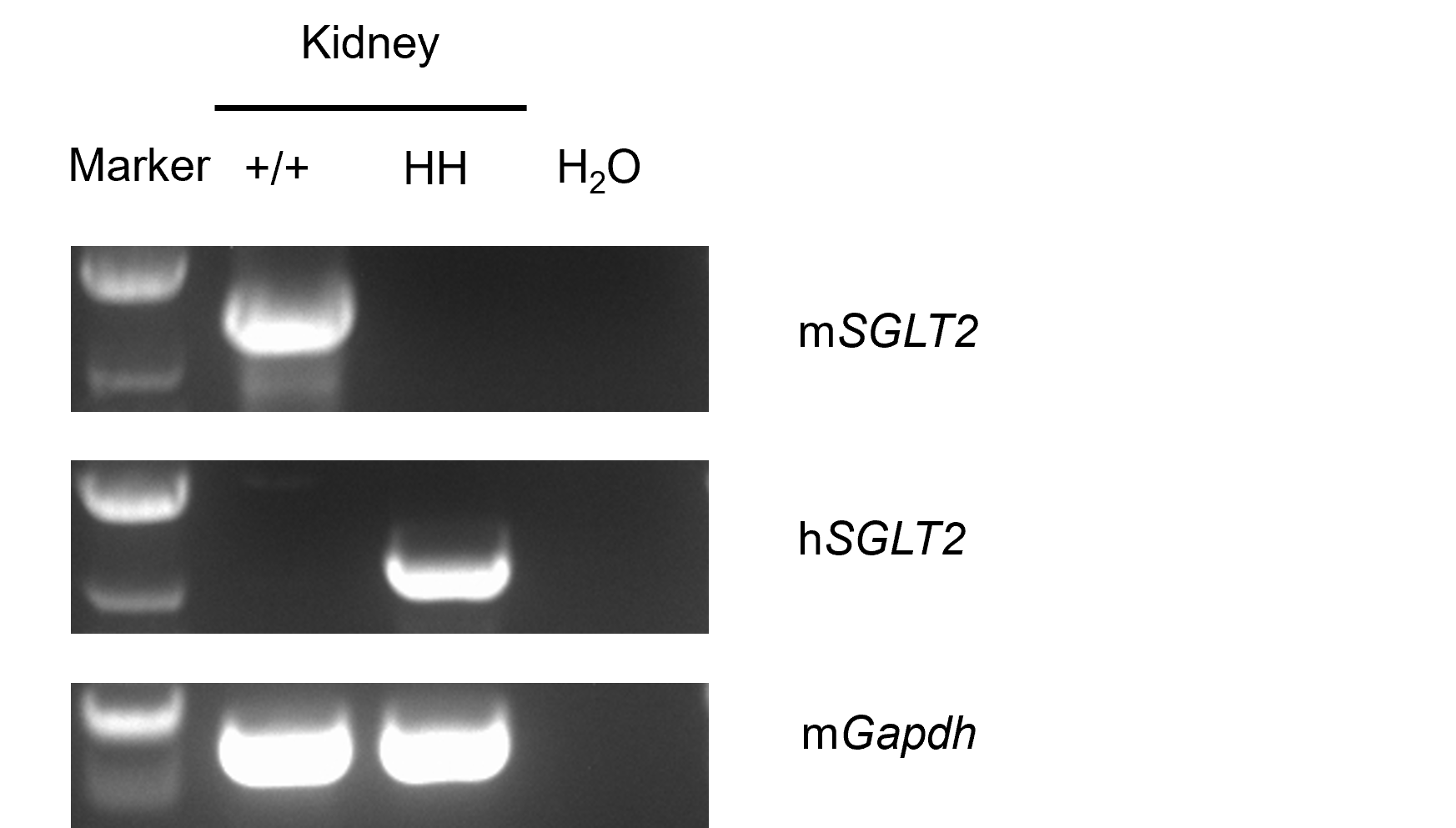
      • Mouse Sglt2 mRNA was only detected in wild-type mice.
      • Human SGLT2 mRNA was exclusively detectable in homozygous B-hSGLT2 mice but not in wild-type mice.

      Strain specific analysis of SGLT2 mRNA expression in wild-type C57BL/6JNifdc and B-hSGLT2 mice by RT-PCR. Kidney RNA were isolated from wild-type C57BL/6JNifdc (+/+) and homozygous B-hSGLT2 mice (H/H), then cDNA libraries were synthesized by reverse transcription, followed by PCR with mouse or human SGLT2 primers.

      • (A) Mouse SGLT2 mRNA was only detected in kidney of wild-type mice.
      • (B) Human SGLT2 mRNA was exclusively detectable in kidney of homozygous B-hSGLT2 mice but not in wild-type mice. The CT value  of human SGLT2 was approximately 24 (total cycle: 40).

      Strain specific analysis of SGLT2 gene expression in wild-type C57BL/6JNifdc mice and B-hSGLT2 mice by RT-qPCR. Tissue RNA were isolated from wild-type C57BL/6JNifdc mice (+/+) and homozygous B-hSGLT2 mice (H/H) (male, 7 week-old, n=3), then cDNA libraries were synthesized by reverse transcription, followed by qPCR with mouse (A) or human SGLT2 (B) primers. . Values are expressed as mean ± SEM. Significance was determined by unpaired t-test.  *P < 0.05, **P < 0.01, ***P < 0.001.
      IHC Analysis
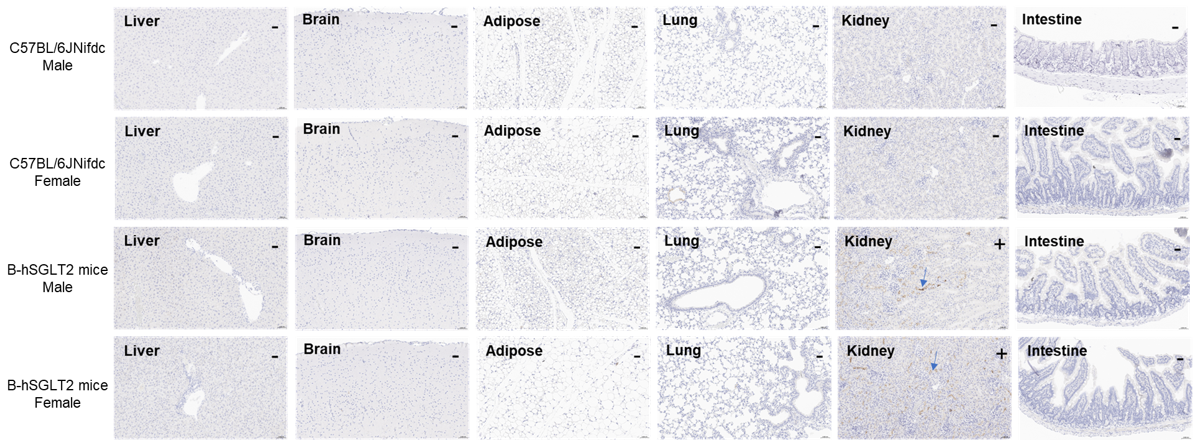
      • Human SGLT2 was detectable only in the kidney tissue of homozygous B-hSGLT2 mice but not in wild-type mice.

      IHC analysis of SGLT2 protein expression in wild-type C57BL/6JNifdc mice and homozygous B-hSGLT2 mice. Various tissue lysates were collected from wild-type C57BL/6JNifdc mice (+/+) and homozygous B-hSGLT2 mice (H/H), and then analyzed by IHC with anti-SGLT2 antibody (Abcam, ab320086).  Scale, 40x.

      Inhibitory efficiency of the SGLT2 targeted nucleic acid drugs

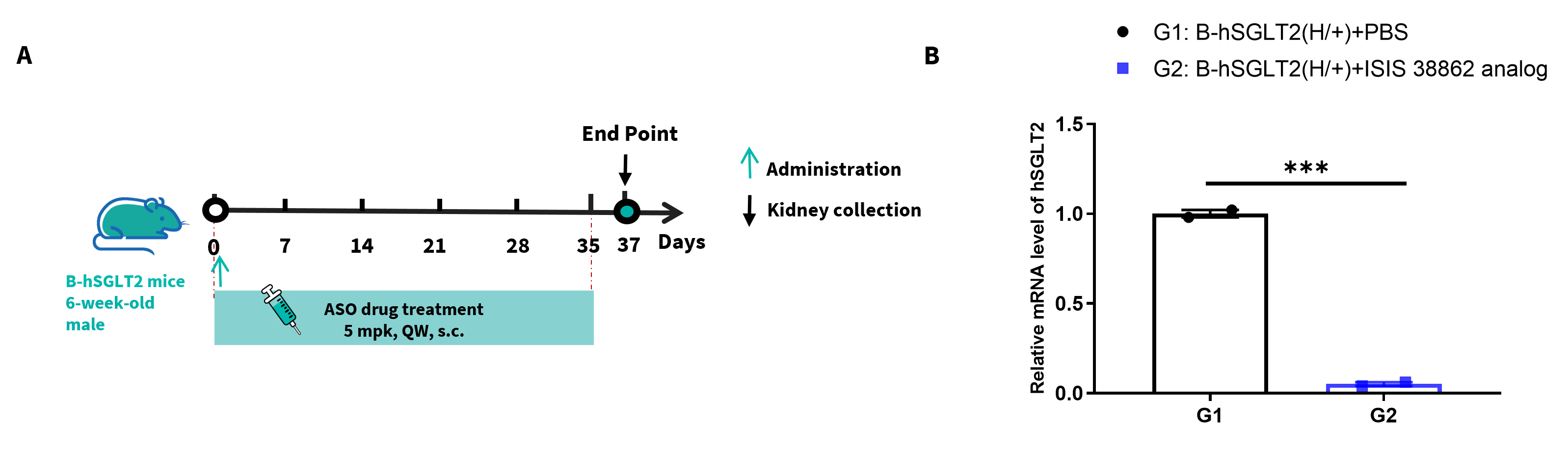
      The inhibitory efficiency of the nucleic acid drugs against human SGLT2 in B-hSGLT2 mice. B-hSGLT2 mice were randomly divided into two groups (n=2, 6-week-old, male). The human SGLT2 targeted nucleic acid drugs (synthesized according to patents) and PBS were administered to the mice individually. The mice were sacrificed on day 37, and the kidneys were collected to detect the human SGLT2 mRNA expression by qRT-PCR. (A) The schematic diagram of experimental processing. (B) The expression of human SGLT2 mRNA in kidneys. The human SGLT2 in the treatment group (G2) was significantly reduced compared to the control group. Values are expressed as mean ± SEM. Significance was determined by t-test, *P<0.05, **P<0.01, ***P<0.001.

      * When publishing results obtained using this animal model, please acknowledge the source as follows: The animal model [B-hSGLT2 mice] (Cat# 114459) was purchased from Biocytogen.