
C57BL/6-Tnfsf15tm2(TNFSF15)Bcgen Tnfrsf25tm3(TNFRSF25)Bcgen Il7rtm1(IL7R)Bcgen/Bcgen • 114152


Gene targeting strategy for B-hTL1A/hDR3/hIL7R mice.
The exons 1-4 of mouse Tl1a gene that encode extracellular domain were replaced by human counterparts in B-hTL1A/hDR3/hIL7R mice. The genomic region of mouse Tl1a gene that encodes transmembrane domain and cytoplasmic portion was retained. The promoter, 5’UTR and 3’UTR region of the mouse gene were also retained. The human TL1A expression was driven by endogenous mouse Tl1a promoter, while mouse Tl1a gene transcription and translation will be disrupted.
The exons 1-10 of mouse DR3 gene that encode the whole molecule (ATG to STOP codon), including promoter, 5’UTR and 3’UTR were replaced by human counterparts in B-hTL1A/hDR3/hIL7R mice. The human DR3 expression was driven by human DR3 promoter, while mouse DR3 gene transcription and translation will be disrupted.
The exons 1-6 of mouse Il7r gene that encode the extracellular region were replaced by human IL7R exons 1-6 in B-hTL1A/hDR3/hIL7R mice.
Note: B-hTL1A/hDR3/hIL7R mice were obtained by mating B-hTL1A/hDR3 mice (113082) and B-hIL7R mice (110082).


Soluble TL1A expression analysis in B-hTL1A/hDR3/hIL7R mice by ELISA. Bone marrow derived dendritic cells (BMDCs) were produced by culturing the bone marrow from wild-type C57BL/6JNifdc mice (+/+), and B-hTL1A/hDR3/hIL7R mice (H/H;H/H;H/H), which were stimulated with1 μg/mL LPS in vitro for 24 hrs. After stimulation, the supernatants were collected and the levels of soluble TL1A were measured using a species-specific human TL1A ELISA kit (R&D, DY1319-05). Soluble human TL1A was exclusively detectable in homozygous B-hTL1A/hDR3/hIL7R mice. Values are expressed as mean ± SEM. ND: not detectable.
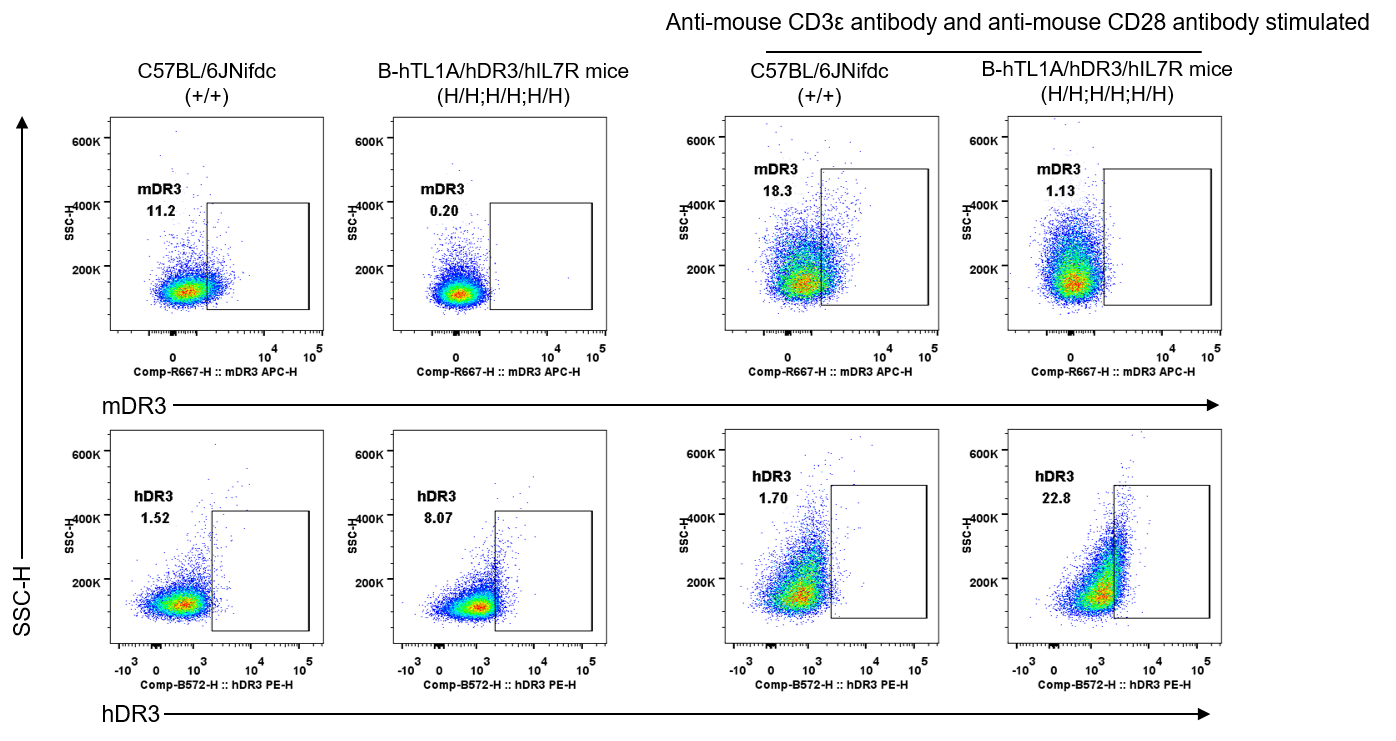
Strain specific DR3 expression analysis in homozygous B-hTL1A/hDR3/hIL7R mice by flow cytometry. Splenocytes were collected from wild-type C57BL/6JNifdc (+/+) and homozygous B-hTL1A/hDR3/hIL7R mice (H/H;H/H;H/H) stimulated with anti-mouse CD3ε antibody and anti-mouse CD28 antibody in vivo for 24 h, protein expression was analyzed by flow cytometry with species-specific anti-mouse DR3 antibody (BioLegend, 144407) and anti-human DR3 antibody (Biolegend, 307105). Mouse DR3 was detectable on CD4+ T cells of wild-type C57BL/6JNifdc mice. Human DR3 was detectable on CD4+ T cells of homozygous B-hTL1A/hDR3/hIL7R mice.
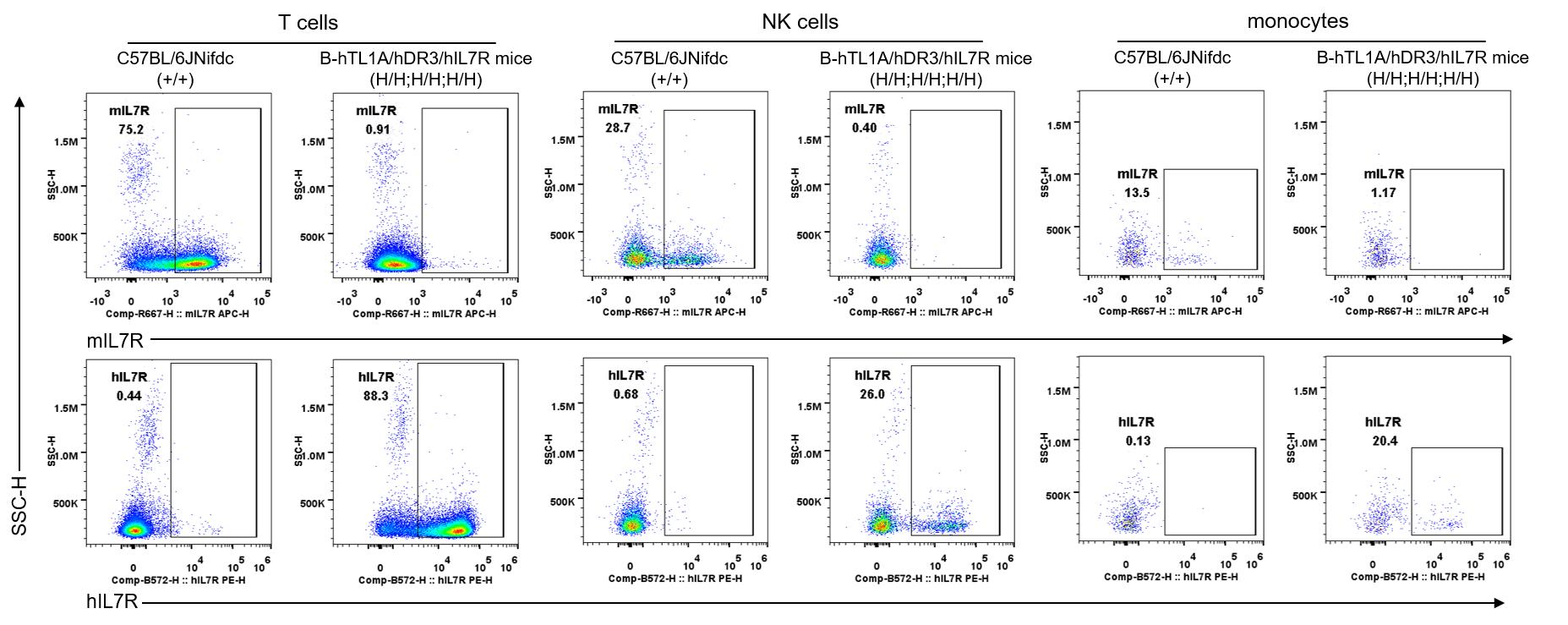
Strain specific IL7R expression analysis in homozygous B-hTL1A/hDR3/hIL7R mice by flow cytometry. Splenocytes were collected from wild-type C57BL/6JNifdc mice (+/+) and homozygous B-hTL1A/hDR3/hIL7R mice (H/H;H/H;H/H), protein expression was analyzed by flow cytometry with species-specific anti-mouse IL7R antibody (Biolegend, 135011) and anti-human IL7R antibody (Biolegend, 351303). Mouse IL7R was detectable in wild-type C57BL/6JNifdc mice. Human IL7R was detectable in homozygous B-hTL1A/hDR3/hIL7R mice.

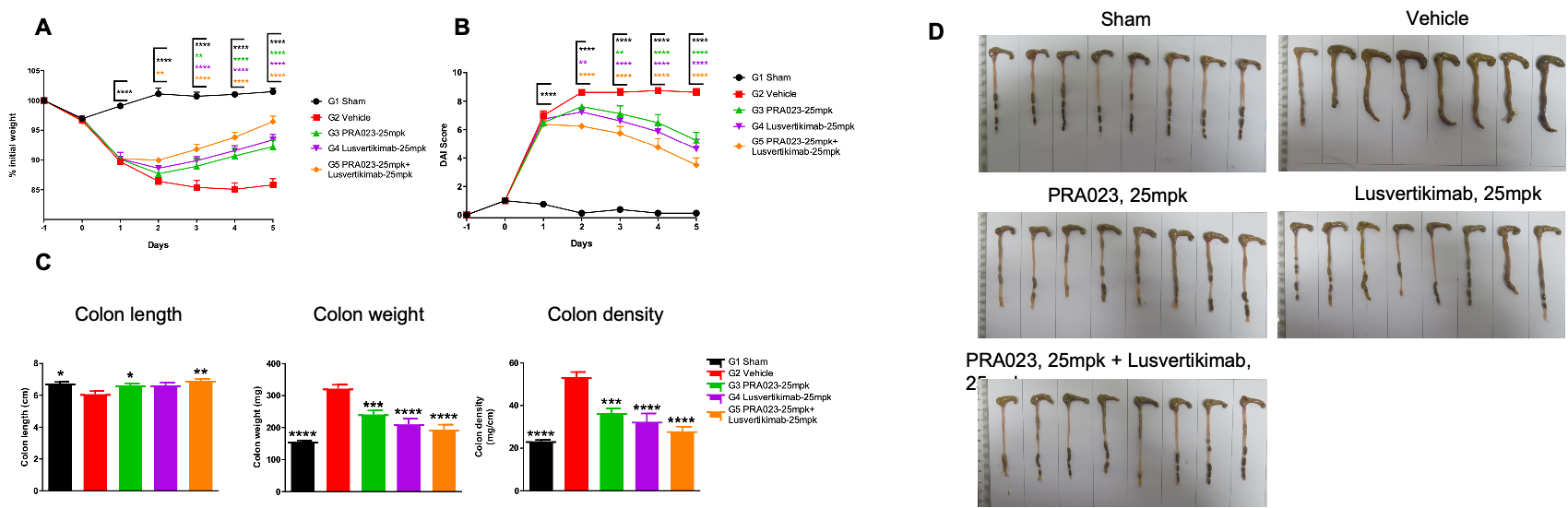
TNBS solution was instilled into the colon lumen of B-hTL1A/hDR3/hIL7R mice (female, 8-10 weeks-old, n=8). The control group (Sham) received intrarectal injections of 50% ethanol. The treatment groups received anti-human TL1A antibody PRA023 (25 mpk, commercially purchased), anti-human IL7R antibody Lusvertikimab (25 mpk, commercially purchased) alone or in combination. Body weight and DAI score were recorded daily. On day 5, the mice were sacrificed, and colon length and weight were recorded. (A) Body weight change. (B) DAI score. (C) Colon Index. (D) Colon photo. A TNBS-induced acute colitis model was established in B-hTL1A/hDR3/hIL7R mice. Administration of anti-human TL1A antibody PRA023 and anti-human IL7R antibody Lusvertikimab effectively improved TNBS-induced acute colitis, and their combination provided better efficacy. The results indicate that B-hTL1A/hDR3/hIL7R mice are a powerful tool for evaluating in vivo efficacy of the combination of anti-human TL1A antibody and anti-human IL7R antibody. Values are expressed as mean ± SEM. *p<0.05, **p<0.01, ***p<0.001, ****p<0.0001, versus Vehicle, ANOVA.
Note: This experiment was conducted by WuXi AppTec using in B-hTL1A/hDR3/hIL7R mice.