Introduction:
FcRn is a pH-dependent receptor that binds and recycles IgG, preventing its lysosomal degradation to extend plasma half-life. Separately, Rag2 is essential for V(D)J recombination in lymphocyte maturation, and its absence results in a lack of functional T and B cells, preventing the formation of Anti-Drug Antibodies (ADA).
Biocytogen's B-hFcRn, Rag2 KO mouse model is a tool for PK/PD/safety evaluation of human IgG therapeutics that circumvents ADA via T and B cell deficiency.
Methods:
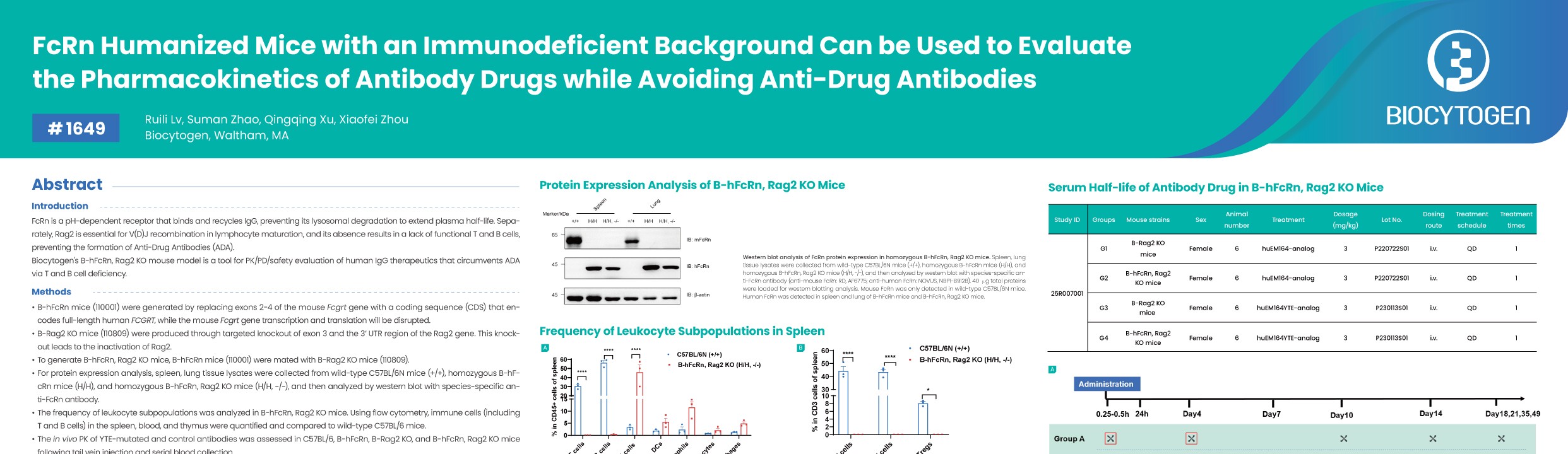
- B-hFcRn mice (110001) were generated by replacing exons 2-4 of the mouse Fcgrt gene with a coding sequence (CDS) that encodes full-length human FCGRT, while the mouse Fcgrt gene transcription and translation will be disrupted. B-Rag2 KO mice (110809) were produced through targeted knockout of exon 3 and the 3’ UTR region of the Rag2 gene. This knockout leads to the inactivation of Rag2. To generate B-hFcRn, Rag2 KO mice, B-hFcRn mice (110001) were mated with B-Rag2 KO mice (110809).
- For protein expression analysis, spleen, lung tissue lysates were collected from wild-type C57BL/6N mice (+/+), homozygous B-hFcRn mice (H/H), and homozygous B-hFcRn, Rag2 KO mice (H/H, -/-), and then analyzed by western blot with species-specific anti-FcRn antibody.
- The frequency of leukocyte subpopulations was analyzed in B-hFcRn, Rag2 KO mice. Using flow cytometry, immune cells (including T and B cells) in the spleen, blood, and thymus were quantified and compared to wild-type C57BL/6 mice.
- The in vivo PK of YTE-mutated and control antibodies was assessed in C57BL/6, B-hFcRn, B-Rag2 KO, and B-hFcRn, Rag2 KO mice following tail vein injection and serial blood collection.
Results:
- Western blot analysis results indicated that human FcRn was detected in the spleen and lung of B-hFcRn, Rag2 KO mice.
- Flow cytometry analysis revealed that T cells and B cells were undetectable in the spleen, blood, and thymus of homozygous B-hFcRn, Rag2 KO mice.
- PK data suggest ADA formation against our YTE antibody in immunocompetent mice, its absence in Rag2 KO mice, and a half-life-extending effect that was confined to hFcRn humanized mice.
Conclusions:
The B-hFcRn, Rag2 KO mouse model, deficient in T and B cells yet expressing human FcRn, provides a valuable tool for assessing the PK/PD of antibody candidates that are susceptible to ADA interference in immunocompetent mice.