
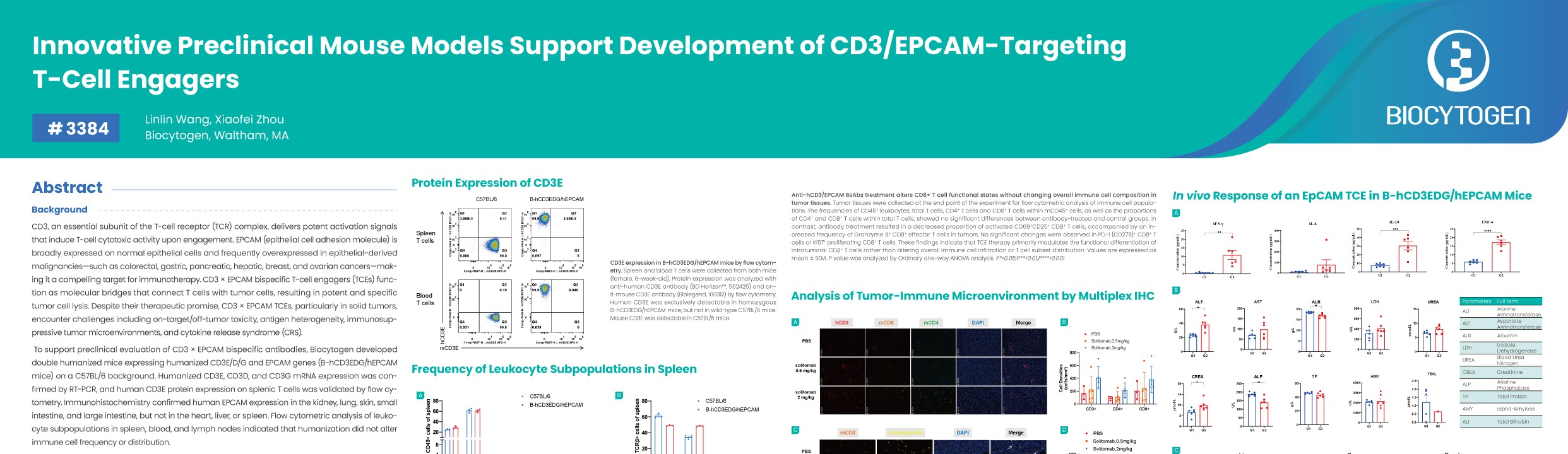
CD3, an essential subunit of the T-cell receptor (TCR) complex, delivers potent activation signals that induce T-cell cytotoxic activity upon engagement. EPCAM (epithelial cell adhesion molecule) is broadly expressed on normal epithelial cells and frequently overexpressed in epithelial-derived malignancies—such as colorectal, gastric, pancreatic, hepatic, breast, and ovarian cancers—making it a compelling target for immunotherapy. CD3 × EPCAM bispecific T-cell engagers (TCEs) function as molecular bridges that connect T cells with tumor cells, resulting in potent and specific tumor cell lysis. Despite their therapeutic promise, CD3 × EPCAM TCEs, particularly in solid tumors, encounter challenges including on-target/off-tumor toxicity, antigen heterogeneity, immunosuppressive tumor microenvironments, and cytokine release syndrome (CRS).
To support preclinical evaluation of CD3 × EPCAM bispecific antibodies, Biocytogen developed double humanized mice expressing humanized CD3E/D/G and EPCAM genes (B-hCD3EDG/hEPCAM mice) on a C57BL/6 background. Humanized CD3E, CD3D, and CD3G mRNA expression was confirmed by RT-PCR, and human CD3E protein expression on splenic T cells was validated by flow cytometry. Immunohistochemistry confirmed human EPCAM expression in the kidney, lung, skin, small intestine, and large intestine, but not in the heart, liver, or spleen. Flow cytometric analysis of leukocyte subpopulations in spleen, blood, and lymph nodes indicated that humanization did not alter immune cell frequency or distribution.
In a syngeneic tumor model, B-hCD3EDG/hEPCAM mice bearing EPCAM-humanized MC38 tumors exhibited significant tumor growth inhibition following solitomab treatment. This was accompanied by increased proportions of cytotoxic CD8⁺ T cells and effector CD4⁺ T cells at the tumor site, elevated cytotoxic CD8⁺ T cells in the spleen, and enhanced T-cell proliferation in the blood. However, drug-related toxicity was observed in the ileum, characterized by focal epithelial cell necrosis in crypts, goblet cell hyperplasia, and eosinophilic infiltration.
A single-dose toxicity study further demonstrated transient cytokine release, with elevated serum levels of TNFα, IL-6, IL-10, and IFNγ within 24 hours post-dose, returning to baseline within 72 hours.
Collectively, these results validate the B-hCD3EDG/hEPCAM mouse model as a robust and physiologically relevant platform for pharmacological efficacy and safety assessment of CD3 × EPCAM bispecific antibodies in oncology research.