
Background:
Urothelial carcinoma (UC) affects over 600,000 patients worldwide annually, with the incidence rate increasing over the past decade. Metastatic urothelial carcinoma (mUC) has a poor prognosis, with the 5-year survival rate estimated to be as low as 10-15%.
Nectin-4 is highly expressed in mUC. It is a clinically validated target for mUC with enfortumab vendotin (EV) and pembrolizumab combination as the newly established SOC for first-line metastatic and locally advanced UC. TROP2 is also highly expressed in UC, and sacituzumab govetecan (SG) has shown therapeutic activity in later-line mUC. Nectin-4xTROP2 bsADC aims to target these two clinically validated targets in mUC to further improve efficacy and reduce toxicity.
Method:
Fully human antibodies against Nectin-4 and TROP2 were generated with Biocytogen's RenLite® transgenic mice. We selected the arms of the bispecific antibody based on their internalization activities in constructing and evaluating the bispecific antibody in a 1+1 format. The bispecific antibody was conjugated to both vcMMAE at DAR of 4 and Biocytogen’s proprietary linker-payload BLD1102 at DAR of 4, respectively. BLD1102 is composed of a novel TOP1 inhibitor payload and a highly hydrophilic and enzyme-cleavable linker. The resulting ADCs were tested in CDX and PDX tumor models in mice, along with relevant benchmark ADCs for anti-tumor activity.
Results:
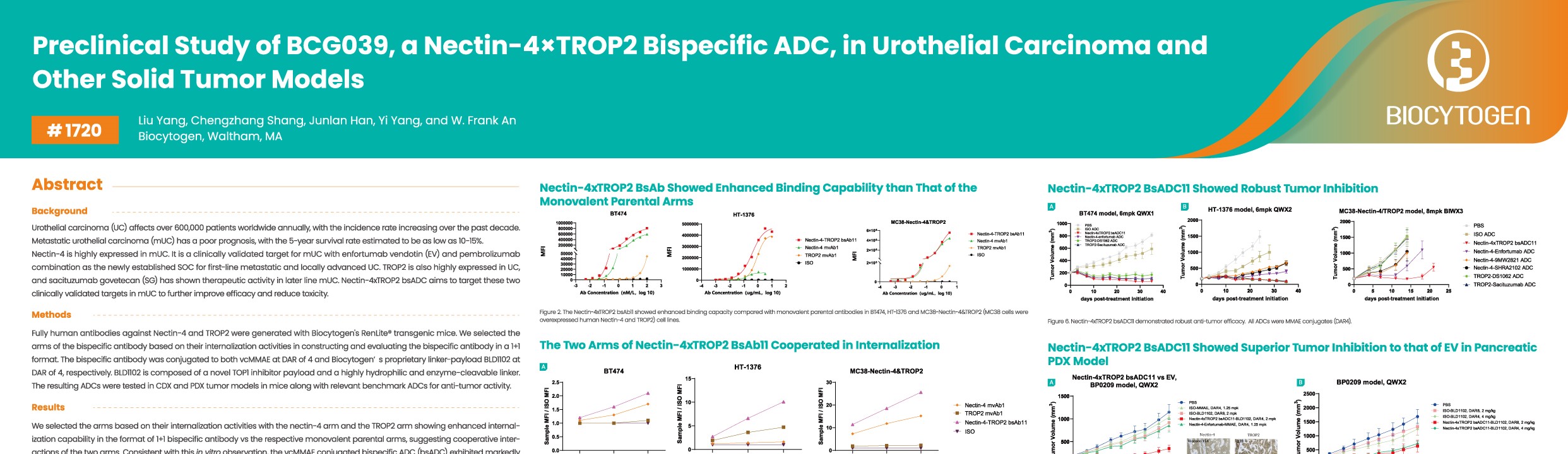
We selected the arms based on their internalization activities, with the nectin-4 arm and the TROP2 arm showing enhanced internalization capability in the format of 1+1 bispecific antibody vs the respective monovalent parental arms, suggesting cooperative interactions of the two arms. Consistent with this in vitro observation, the vcMMAE conjugated bispecific ADC (bsADC) exhibited markedly increased anti-tumor activity compared with the monovalent parental ADCs in mouse CDX/PDX models. BCG039, the BLD1102-conjugated bsADC, also demonstrated tumor growth inhibition superior to benchmark anti-nectin-4 and certain benchmark anti-TROP2 ADCs. The bispecific antibody has excellent developability and is now in CMC development.
Conclusion:
BCG039, a bsADC targeting Nectin-4 and TROP2, showed superior anti-tumor efficacy in mice compared to single-targeting parental ADCs and relevant benchmark ADCs. The cooperative interaction of the two arms may also help reduce the toxicity observed with single-targeting ADCs against these targets in mUC.