In recent years, CRBN ligands have gradually become popular E3 ligase ligands. They can be used to design and synthesize PROTACs and molecular glue degraders, playing an important role in these fields.
CRBN, together with DDB1 (damaged DNA binding protein 1), Cul4A (Cullin 4A), and ROC1, forms the E3 ubiquitin ligase complex (CRL4). As a substrate receptor, CRBN binds certain proteins, promoting their ubiquitination and proteasome-dependent degradation. Through its E3 ligase function, CRBN regulates the degradation of various proteins, which is crucial for cell growth, differentiation, and apoptosis. CRBN is expressed not only in tumor cells but also in normal cells. In the treatment of multiple myeloma (MM), immunomodulatory drugs targeting CRBN (such as thalidomide and lenalidomide) show significant efficacy. These drugs alter the substrate specificity of CRBN, inducing degradation of tumor-associated proteins and thereby inhibiting cancer cell growth. Additionally, CRBN-based PROTACs (Proteolysis Targeting Chimeras) are currently being developed as a novel cancer treatment strategy. CRBN-based PROTACs recruit the CRBN complex to the target protein, leading to its polyubiquitination and subsequent proteasome degradation.
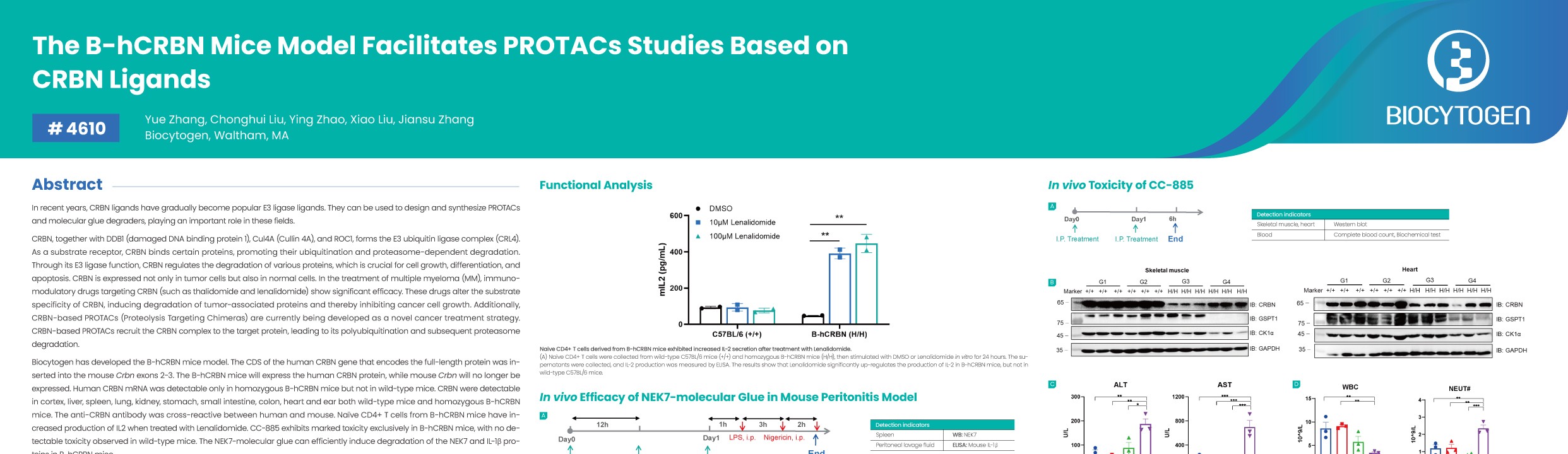
Biocytogen has developed the B-hCRBN mouse model. The CDS of the human CRBN gene that encodes the full-length protein was inserted into the mouse Crbn exons 2-3. The B-hCRBN mice will express the human CRBN protein, while mouse Crbn will no longer be expressed. Heart, liver, spleen, lung, kidney, stomach, small intestine, colon, and cortex were collected from homozygous B-hCRBN mice. Human CRBN mRNA was only detectable in homozygous B-hCRBN mice. The cortex, liver, lung, kidney, and spleen were collected from homozygous B-hCRBN mice, and then analyzed by western blot with anti-CRBN antibody. CRBN was detectable in homozygous B-
hCRBN mice. Naïve CD4+ T cells from B-hCRBN mice have increased production of IL-2 when treated with Lenalidomide. CC-885 exhibits marked toxicity exclusively in B-hCRBN mice, with no detectable toxicity observed in wild-type mice. The body weight, complete blood count, and blood biochemistry of male and female B-hCRBN mice were analyzed. The main organs were dissected, weighed, and analyzed by H&E staining. No obvious abnormalities were found in all the organs detected (brain, heart, lung, liver, spleen, stomach, small intestine, colon, kidney, uterus, ovary, and testis).
In summary, the development of the B-hCRBN mouse model has been successful, as it successfully expresses the human CRBN protein and can be used functionally. Tumor cell lines inoculated in B-hCRBN mice can be used to study the in vivo efficacy and safety evaluation of CRBN small molecule drugs, molecular glue drugs based on CRBN, or PROTAC drugs based on CRBN.