Abstract:
Background:
Small-cell lung cancer (SCLC) is an aggressive neuroendocrine carcinoma, comprising ~15% of all lung cancers, with a 5-year survival rate under 4%. Over 80% of patients present with brain metastases and extensive-stage disease. Despite the approval of tarlatamab and ongoing development of DLL3- or B7-H3-targeted ADCs, tumor relapse and heterogeneity in target expression continue to pose challenges. Delta-like ligand 3 (DLL3), B7-H3, and seizure-related homolog 6 (SEZ6) have been validated targets for SCLC.
Methods:
We designed two bispecific ADCs (bsADCs) targeting DLL3×B7-H3 and DLL3×SEZ6, respectively. Each bsADC was constructed in a 1+1 IgG format and conjugated with a novel topoisomerase I (TOP1) inhibitor payload using a highly hydrophilic, enzyme-cleavable linker (DAR 8), capable of inducing potent bystander effects. We used in vitro internalization activity, in vivo anti-tumor efficacy in SCLC CDX or PDX models, and developability screening as primary selection criteria.
Results:
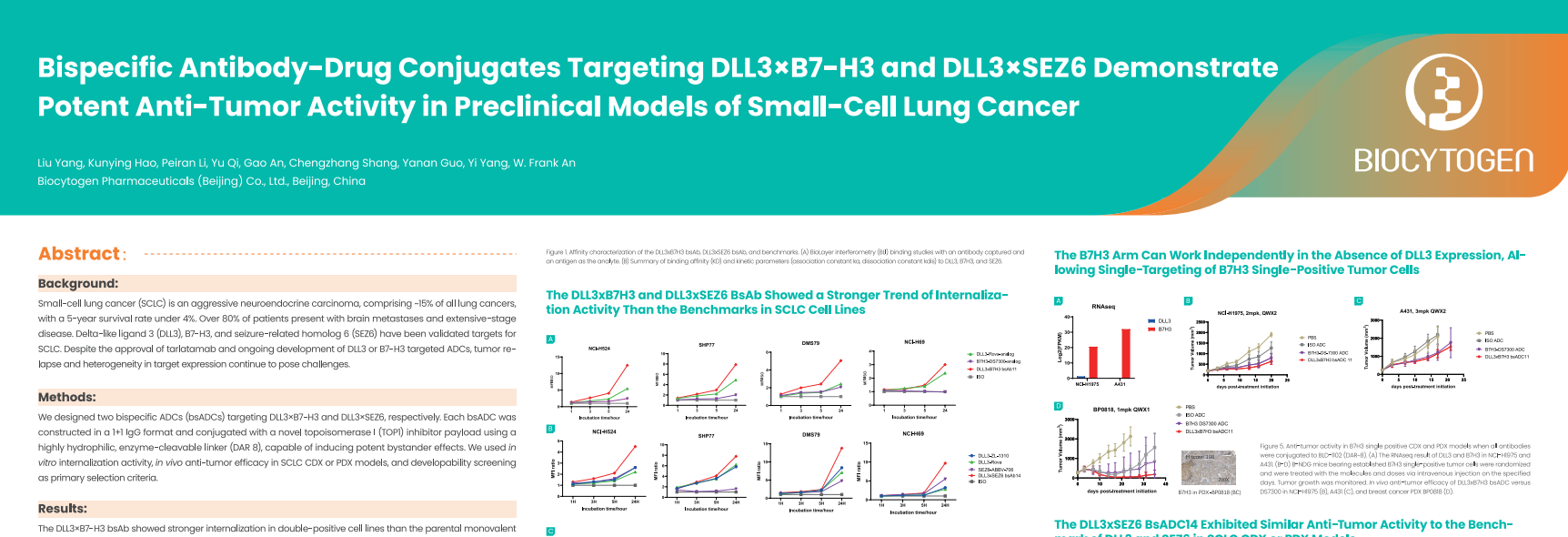
The DLL3×B7-H3 bsAb showed stronger internalization in double positive cell lines than the parental monovalent arms and outperformed the naked antibodies of DS-7300 and rovalpituzumab (Rova). The DLL3×B7-H3 bsADC demonstrated robust anti–tumor efficacy that was superior to DS-7300 ADC when all antibodies were conjugated to BLD–1102 and tested in SCLC CDX models. The bsADC outperformed DS-7300 with original payload in SCLC PDX model. The B7-H3 arm can work independently in the absence of DLL3 expression, allowing single–targeting of B7-H3 single positive tumor cells.
The DLL3×SEZ6 bsAb exhibited a stronger trend of internalization activity than benchmarks and parental monovalent antibodies in SCLC cell lines. The DLL3×SEZ6 bsADC demonstrated comparable efficacy to benchmark with same payload and showed more potent anti-tumor efficacy than parental monovalent ADCs in SCLC CDX models.
DLL3×B7-H3 and DLL3×SEZ6 bsAbs exhibited excellent stability under stress conditions, suggesting them as promising candidates for CMC development.
Conclusions:
DLL3×B7-H3 and DLL3×SEZ6 bsADCs represent two novel and complementary strategies for addressing tumor heterogeneity and limited treatment options in SCLC. Their dual-targeting mechanisms enhanced specificity, broadened patient coverage, and resulted in robust preclinical efficacy, supporting further development toward clinical translation.