Introduction:
APOC3 (Apolipoprotein C3) is primarily expressed by hepatocytes, with minor expression in intestinal epithelial cells. In the bloodstream, APOC3 associates with triglyceride-rich lipoproteins (TRLs), which include chylomicrons (CM) produced in the intestine, very-low-density lipoproteins (VLDL) produced inthe liver, and high-density lipoproteins (HDL). A small amount of APOC3 is also bound to low-density lipoproteins (LDL). APOC3 increases plasma triglyceride levels by inhibiting lipoprotein lipase (LPL) activity and raisestriglyceride and cholesterol levels by interfering with the clearance of TRLs and their remnants through hepatic LDL receptors (LDLR) and low-density lipoprotein receptor-related protein 1 (LRP1). Reduced clearance of TRLs is strongly correlated with elevated plasma APOC3 levels, making APOC3 a promising therapeutic target for reducing the risk of dyslipidemia and cardiovascular disease.
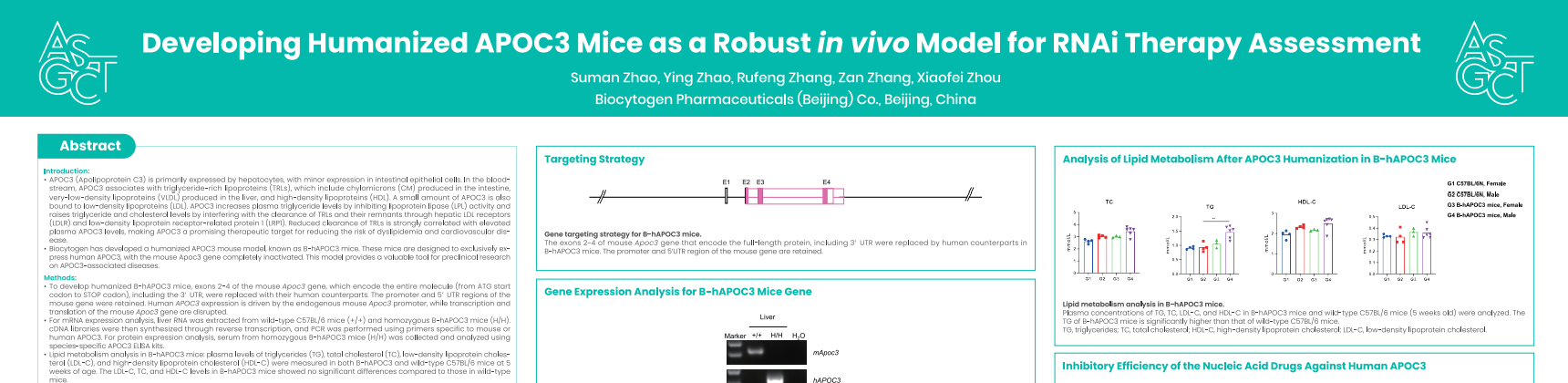
Biocytogen has developed a humanized APOC3 mouse model, known as B-hAPOC3 mice. These mice are designed to exclusively express human APOC3, with the mouse Apoc3 gene completely inactivated. This model provides a valuable tool for preclinical research on APOC3-associated diseases.
Methods:
- To develop humanized B-hAPOC3 mice, exons 2-4 of the mouse Apoc3gene, which encode the entire molecule (from ATG start codon to STOP codon), including the 3’UTR, were replaced with their human counterparts. The promoter and 5’UTR regions of the mouse gene were retained. Human APOC3 expression is driven by the endogenous mouse Apoc3 promoter, while transcription and translation of the mouse Apoc3gene are disrupted.
- For mRNA expression analysis, liver RNA was extracted from wild-type C57BL/6 mice (+/+) and homozygous B-hAPOC3 mice (H/H). cDNA libraries were then synthesized through reverse transcription, and PCR was performed using primers specific to mouse or human APOC3. For protein expression analysis, serum from homozygous B-hAPOC3 mice (H/H) was collected and analyzed using species-specific APOC3 ELISA kits.
- Lipid metabolism analysis in B-hAPOC3 mice: plasma levels of triglycerides (TG), total cholesterol (TC), low-density lipoprotein cholesterol (LDL-C), and high-density lipoprotein cholesterol (HDL-C) were measured in both B-hAPOC3 and wild-type C57BL/6 mice at 5 weeks of age. The LDL-C, TC, and HDL-C levels in B-hAPOC3 mice showed no significant differences compared to those in wild-type mice.
- The efficacy of nucleic acid drugs in inhibiting human APOC3 was assessed in B-hAPOC3 mice. B-hAPOC3 mice were randomly divided into two groups (n=3/group, 6 weeks old). Each group received a subcutaneous injection of either 10 mg/kg of nucleic acid drugs targeting human APOC3 (synthesized as per the patent) or PBS. The nucleic acid drugs were delivered in a PBS aqueous solution.
Results:
- RT-PCR results indicated that human APOC3 mRNA was detectable only in homozygous B-hAPOC3 mice but not in wild-type mice. Proteinanalysis showed that APOC3 was present in homozygous B-hAPOC3 mice.
- Lipid metabolism analysis showed that triglyceride (TG) levels in male B-hAPOC3 mice were significantly higher than those in wild-type C57BL/6 mice.
- Compared to the control group, the treatment group showed a significant decrease in triglyceride levels. Human APOC3 mRNA expression in the treatment group was also significantly reduced, with an inhibition rate of73.4%. These results demonstrate that B-hAPOC3 mice provide a powerful preclinical model for the in vivo evaluation of human APOC3-targeted nucleic acid drugs.
Conclusions:
- B-hAPOC3 mice effectively express human APOC3 and maintain normal functions. These mice offer a robust in vivo model for assessing RNAi therapy in research on APOC3-associated lipid disorders.