Abstract:
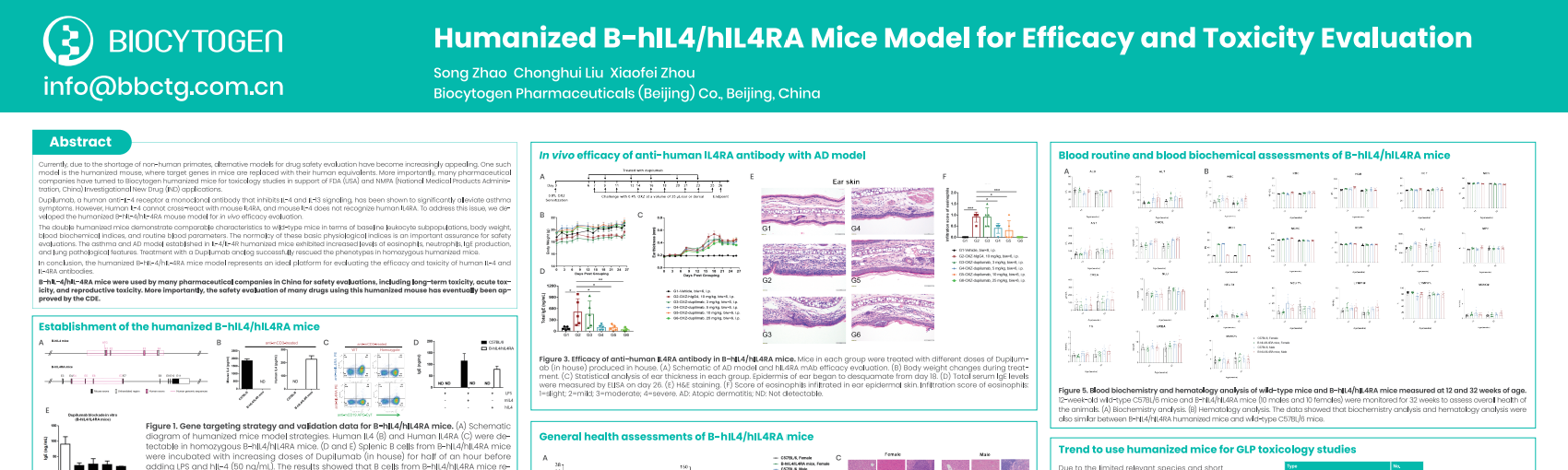
Currently, due to the shortage of non-human primates, alternative models for drug safety evaluation have become increasingly appealing. One such model is the humanized mouse, where target genes in mice are replaced with their human equivalents. More importantly, many pharmaceutical companies have turned to Biocytogen humanized mice for toxicology studies in support of FDA (USA) and NMPA (National Medical Products Administration, China) Investigational New Drug (IND) applications.
Dupilumab, a human anti-IL-4 receptor α monoclonal antibody that inhibits IL-4 and IL-13 signaling, has been shown to significantly alleviate asthma symptoms. However, Human IL-4 cannot cross-react with mouse IL4RA, and mouse IL-4 does not recognize human IL4RA. To address this issue, we developed the humanized B-hIL-4/hIL-4RA mouse model for in vivo efficacy evaluation.
The double-humanized mice demonstrate comparable characteristics to wild-type mice in terms of baseline leukocyte subpopulations, body weight, blood biochemical indices, and routine blood parameters. The normalcy of these basic physiological indices is an important assurance for safety evaluations. The asthma and AD model established in IL-4/IL-4R humanized mice exhibited increased levels of eosinophils, neutrophils, IgE production, and lung pathological features. Treatment with a Dupilumab analog successfully rescued the phenotypes in homozygous humanized mice.
In conclusion, the humanized B-hIL-4/hIL-4RA mice model represents an ideal platform for evaluating the efficacy and toxicity of human IL-4 and IL-4RA antibodies.