
Delivering large molecular drugs into the brain and muscles is highly challenging due to several barriers and structural limitations. For the brain, the blood-brain barrier (BBB) is a significant obstacle, formed by endothelial cells with tight junctions, restricts the passage of large molecules from the blood stream into the brain. For muscles, the structure of muscle cells themselves makes it difficult for large molecular drugs to enter because of low permeability and tight junctions between muscle cells.
Biocytogen has successfully developed a humanized TFR1 mouse model via genomic knock-in, which is named B-hTFR1 mice, and provides a promising solution to overcome these barriers and facilitate the delivery of large molecular drugs into the brain, muscles, and eyes. Humanized TFR1 expression was exclusively detected on erythroid cells, spleen, heart, liver, lung, kidney, colon, stomach, skeletal muscle and brain microvascular endothelium in B-hTFR1 mice. The proportions of various immune cells in the spleen, blood, and lymph nodes, and the blood biochemistry and blood routine indicators of B-hTFR1 mice were similar to those of wild-type C57BL/6 mice.
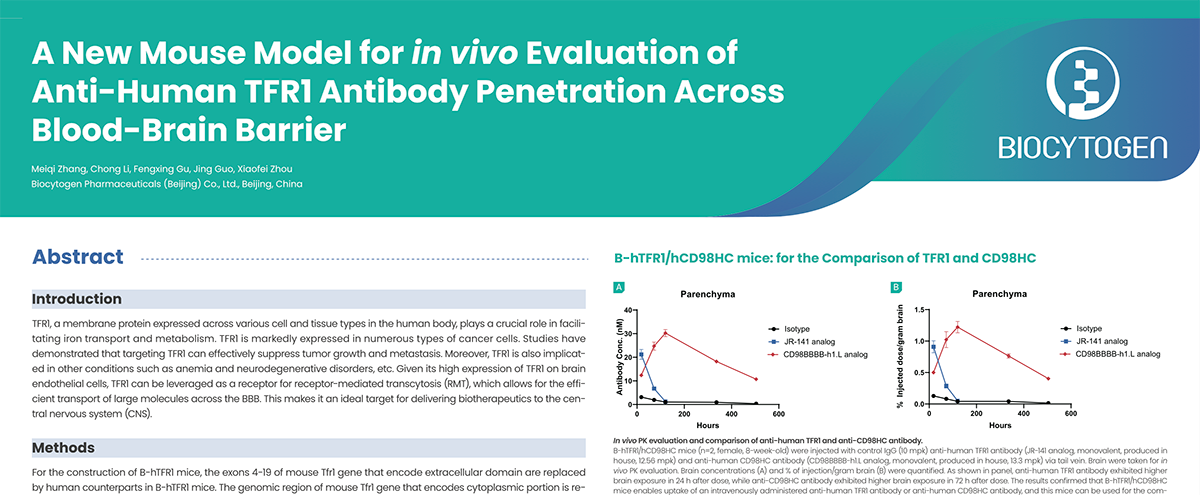
In vivo pharmacokinetic evaluation of anti-human TFR1 bispecific antibodies (BsAbs) showed the BsAbs exhibited higher serum clearance and enhanced brain exposure after dose, which confirmed that B-hTFR1 mice enables uptake of an intravenously administered anti-human TFR1 BsAbs into brain. By mating B-hTFR1 mice and B-hTAU mice, the B-hTFR1/hTAU mice enables drugs delivery into brain and hTAU mRNA levels in the double humanized mice showed a significant decrease in the treatment group. Similarly, mating B-hTFR1 mice with B-hDMPK mice generated B- hTFR1/hDMPK mice, which allowed the delivery of intravenously administered antibody oligonucleotide conjugates (AOC) drugs into muscles and hDMPK mRNA levels exhibited a significant reduction in the muscle of treatment group.
In conclusion, B-hTFR1 mice provide a powerful preclinical model for in vivoevaluation of effective delivery of protein therapeutics to the brain and muscle.