Introduction:
Glucose-dependent insulinotropic peptide (GiP)is one of the incretin hormones that communicate nutrient intake withsystemic metabolism. GIPR,gastric Inhibitory polypeptide receptor, belongs to the G-protein coupled receptor family.GiPR is expressed in many tissues, including the pancreas,stomach, brain,liver, etc. This protein plays a crucial role inregulating insulin secretion, glucose, and lipid metabolism.Both agonism and antagonism of the GiPR can reduce bodyweight in response to overnutrition in preclinical models.
Methods:
Here, we generated a humanized GIPR model (B-hGiIPR mice) by replacing the murine Giopr gene that encodes thefull-length protein with the corresponding human GIPR CDS, including 3'UTR.For mRNA expression analysis, brain,eWAT and ingWAT RNA were isolated from wild-type C57BL/6 mice (+/+)and ho-mozygous B-hGIPR mice (H/H),then cDNA libraries were synthesized by reverse transcription, followed by PCR with mouse or human GIPR primers.
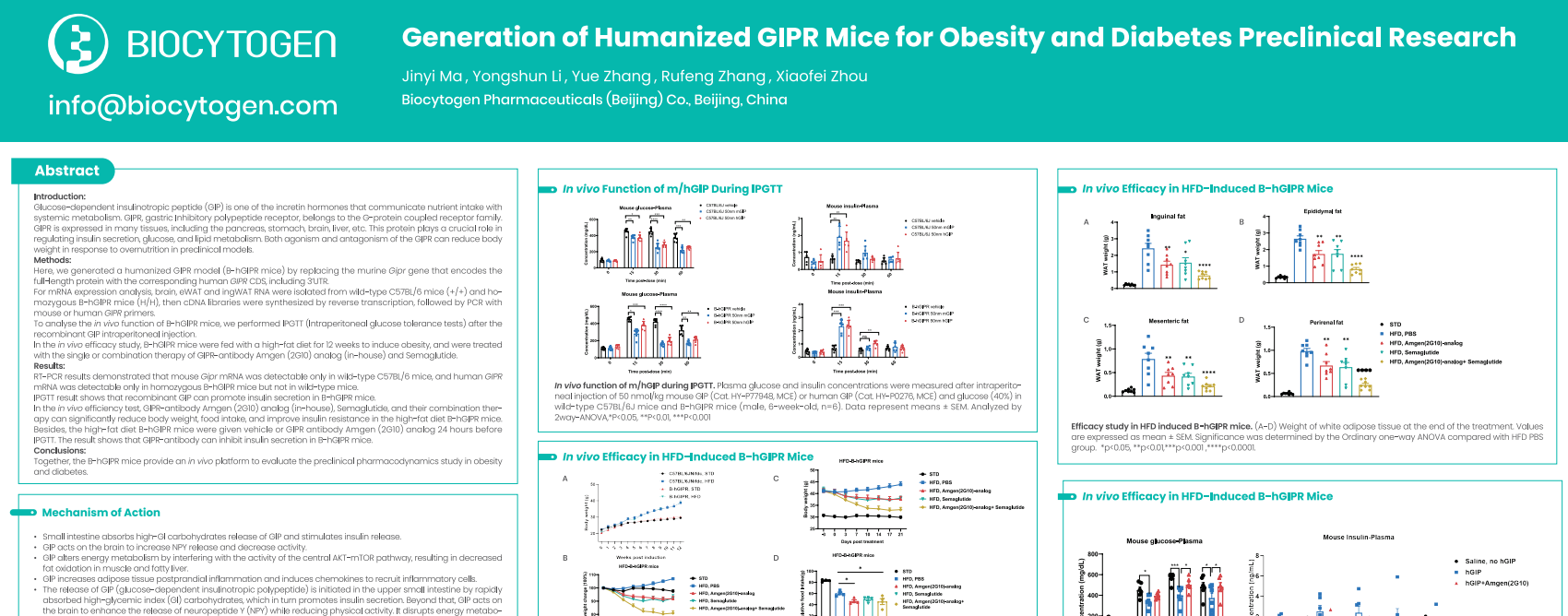
To analyse the in vivo function of B-hGIPR mice, we performed IPGTT (Intraperitoneal glucose tolerance tests) after therecombinant GIP intraperitoneal injection.
In the in vivo efficacy study, B-hGIPR mice were fed with a high-fat diet for 12 weeks to induce obesity, and were treatedwith the single or combination therapy of GlIPR-antibody Amgen (2G10) analog (in-house) and Semaglutide.
Results:
RT-PCR results demonstrated that mouse Gijor mRNA was detectable only in wild-type C57BL/6 mice, and human GIPRmRNA was detectable only in homozygous B-hGIPR mice but not in wild-type mice.
IPGTT result shows that recombinant GIP can promote insulin secretion in B-hGIPR mice.
In the in vivo efficiency test, GIPR-antibody Amgen (2G10) analog (in-house),semaglutide,and their combination ther-apy can significantly reduce body weight,food intake, and improve insulin resistance in the high-fat diet B-hGIPR mice.Besides, the high-fat diet B-hGIPR mice were given vehicle or GiPR antibody Amgen (2G10) analog 24 hours beforeIPGTT. The result shows that GIPR-antibody can inhibit insulin secretion in B-hGIPR mice.
Conclusions:
Together, the B-hGiPR mice provide an in vivo platform to evaluate the preclinical pharmacodynamics study in obesityand diabetes.