


B-hGDF8 mice
C57BL/6N-Gdf8tm1(GDF8)Bcgen/Bcgen • 112413

B-hGDF8 mice

Catalog Number
112413
Strain Name
C57BL/6N-Gdf8tm1(GDF8)Bcgen/Bcgen
Strain Background
C57BL/6N
NCBI gene ID
2660 (Human)
Aliases
GDF8, MSLHP

在此页面上

  • Description
  • Targeting strategy
  • Phenotypic analysis
  • Efficacy

海报

查看全部

    发表文章

      Description
      • Growth differentiation factor 8 (GDF8), also known as myostatin (MSTN), is a secreted ligand of the TGF-beta superfamily that negatively regulates skeletal muscle growth, muscle cell proliferation, and differentiation.
      • GDF8/myostatin signaling restrains satellite-cell activation and protein synthesis, making GDF8 a key therapeutic target for muscle wasting, sarcopenia, cachexia, obesity, and body composition research.
      • GDF8 humanized mice (B-hGDF8 mice) are target-humanized mice in which exons 1-3 of the mouse Gdf8 gene encoding the full-length protein were replaced by human GDF8 exons 1-3.
      • GDF8 humanized mice (B-hGDF8 mice) express human GDF8 mRNA in skeletal muscle and maintain circulating GDF8 protein detectable by ELISA, supporting translational evaluation of human GDF8-targeted therapeutics.
      • GDF8 humanized mice (B-hGDF8 mice) are suitable for preclinical pharmacology and efficacy studies of human GDF8/myostatin-targeted antibodies, inhibitors, and other biologics for muscle and metabolic disease research.

      Key Advantages

      • Humanized GDF8/myostatin target for translational drug evaluation
      • Human GDF8 mRNA expression confirmed in skeletal muscle
      • Circulating GDF8 protein detectable in plasma by ELISA
      • Supports anti-GDF8 antibody and myostatin inhibitor efficacy studies
      • Applicable to muscle growth, obesity, and body composition research

      Validation

      • Molecular Validation:
        Human GDF8 mRNA was detectable in homozygous GDF8 humanized mice (B-hGDF8 mice) by RT-PCR, while mouse Gdf8 mRNA was detectable in wild-type C57BL/6 mice.
      • Protein Validation:
        Plasma GDF8 protein was detected in homozygous GDF8 humanized mice (B-hGDF8 mice) by ELISA; GDF8 was also detectable in wild-type C57BL/6 mice because the ELISA kit cross-recognizes human and mouse GDF8.
      • Efficacy Validation:
        In HFD-induced GDF8 humanized mice (B-hGDF8 mice), anti-GDF8 monoclonal antibody treatment promoted lean tissue growth and helped prevent semaglutide-induced lean tissue loss, supporting in vivo evaluation of GDF8-targeted therapeutics.

      Application

      • GDF8/myostatin-targeted drug development
      • Anti-GDF8 antibody efficacy evaluation
      • Myostatin inhibitor pharmacology studies
      • Muscle wasting, sarcopenia, cachexia, and muscle growth research
      • Obesity, body composition, and metabolic disease studies
      Targeting strategy

      GDF8

      The exons 1-3 of the mouse Gdf8 gene that encode the full-length protein and 3’UTR are replaced by human counterparts in GDF8 humanized mice (B-hGDF8 mice). The promoter and 5’UTR region of the mouse gene are retained. The human GDF8 expression is driven by the endogenous mouse Gdf8 promoter, while mouse Gdf8 gene transcription and translation will be disrupted.

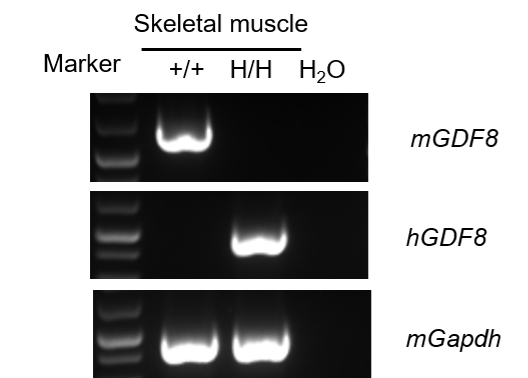
      mRNA Expression Analysis in GDF8 Humanized Mice
      • Mouse Gdf8 mRNA was detectable only in wild-type C57BL/6 mice.
      • Human GDF8 mRNA was detectable only in homozygous GDF8 humanized mice but not in wild-type mice.

      Strain-specific analysis of mouse and human GDF8 mRNA expression in wild-type C57BL/6 mice and GDF8 humanized mice by RT-PCR. Total RNA was isolated from skeletal muscle tissues of wild-type C57BL/6 mice (+/+) and homozygous GDF8 humanized mice (H/H). cDNA was synthesized by reverse transcription, followed by PCR amplification using mouse- or human-specific GDF8 primers. Mouse Gdf8 mRNA was detected exclusively in wild-type C57BL/6 mice, whereas human GDF8 mRNA was detected exclusively in homozygous GDF8 humanized mice and was not detected in wild-type mice.

      • Human GDF8 mRNA was detectable in the muscle of homozygous GDF8 humanized mice.

      RT-qPCR analysis of human GDF8 mRNA expression in skeletal muscles of GDF8 humanized mice. Gastrocnemius, quadriceps, tibialis anterior, and soleus muscles were collected from homozygous GDF8 humanized mice (H/H) (male, 10 weeks old, n = 5). Total RNA was isolated and reverse-transcribed into cDNA, followed by quantitative real-time PCR (RT-qPCR) using human GDF8-specific primers. Human GDF8 mRNA was detected in skeletal muscle tissues of homozygous GDF8 humanized mice. Relative human GDF8 mRNA expression levels were normalized to those in the gastrocnemius muscle. Values are expressed as mean ± SEM.

      GDF8 Protein Expression Analysis in GDF8 Humanized Mice
      • Human and mouse GDF8 proteins were both detectable in wild-type C57BL/6 and GDF8 humanized mice, but not in Gdf8 KO mice. The ELISA kit cross-recognized human and mouse GDF8.

      Strain-specific analysis of GDF8 (myostatin) protein expression in wild-type C57BL/6 mice and GDF8 humanized mice by ELISA. Plasma samples were collected from wild-type C57BL/6 mice (+/+) and homozygous GDF8 humanized mice (H/H) (male, 6 weeks old). GDF8 protein expression was analyzed by ELISA using the GDF-8/Myostatin Quantikine ELISA Kit (R&D Systems, DGDF80). GDF8 protein was detected in both wild-type C57BL/6JNifdc mice and GDF8 humanized mice. The ELISA kit cross-reacts with both human and mouse GDF8 proteins. Values are expressed as mean ± SEM.

      • Human GDF8 proteins were detectable in male and female GDF8 humanized mice.

      ELISA analysis of GDF8 (myostatin) protein expression in male and female GDF8 humanized mice. Serum samples were collected from homozygous GDF8 humanized mice (H/H) (male and female, 6 weeks old, n = 5) and analyzed by ELISA using the GDF-8/Myostatin Quantikine ELISA Kit (R&D Systems, DGDF80). Human GDF8 protein was detected in both male and female GDF8 humanized mice. Values are expressed as mean ± SEM.


      In vivo Efficacy in High-Fat Diet (HFD)-Induced Model of GDF8 Humanized Mice

      In vivo efficacy evaluation of anti-GDF8 antibody in a high-fat diet (HFD)-induced obesity model using GDF8 humanized mice. GDF8 humanized mice were fed a high-fat diet (HFD) for 14 weeks to induce obesity. Following the induction period, mice were treated with PBS, semaglutide, or an anti-GDF8 antibody. Body weight was monitored throughout the treatment period. Changes in lean tissue mass and fat tissue mass relative to day −1 were assessed using a body composition analyzer.
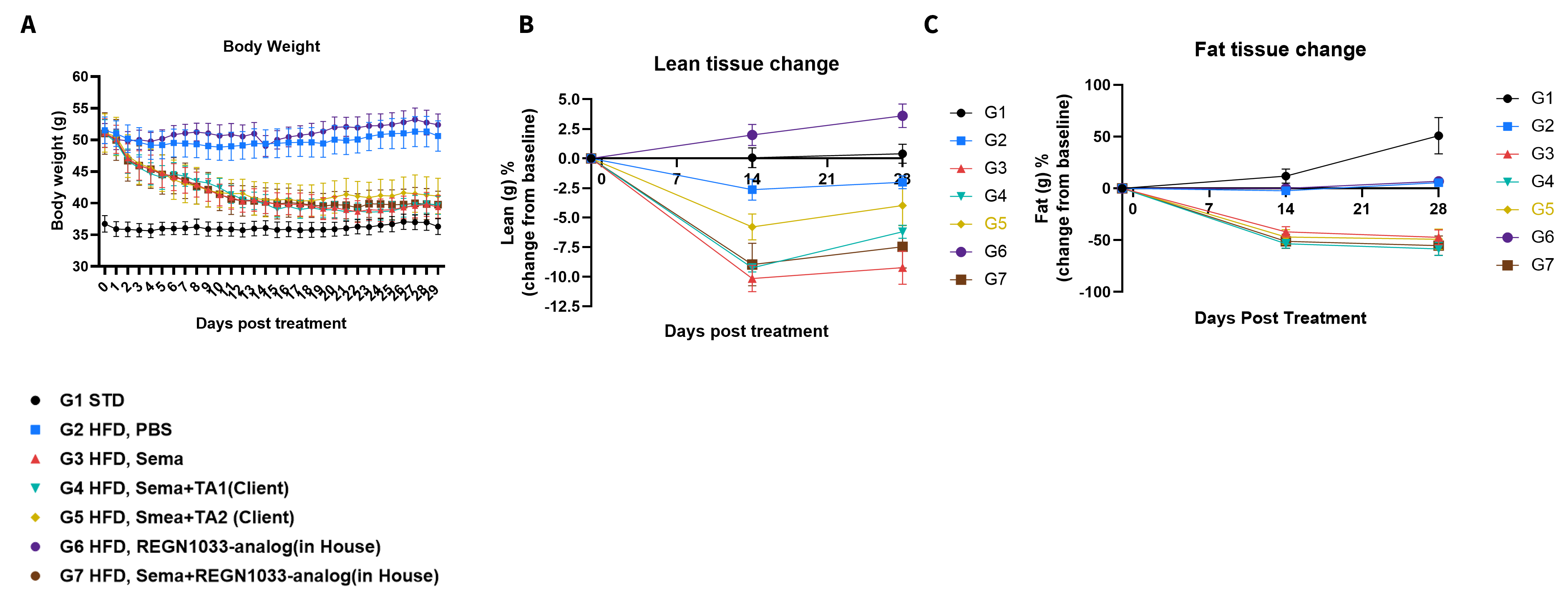
      • GDF8 blocking antibody promoted lean tissue growth, and in combination with semaglutide, it prevented semaglutide-induced lean tissue loss.

      In vivo efficacy evaluation in a high-fat diet (HFD)-induced obesity model using GDF8 humanized mice. GDF8 humanized mice were fed a high-fat diet (HFD) for 14 weeks to induce obesity. (A) Body weight changes following treatment. (B) Changes in lean tissue mass relative to day −1, assessed using a body composition analyzer. (C) Changes in fat tissue mass relative to day −1, assessed using a body composition analyzer.
      Note: Data are shared upon the client's approval.
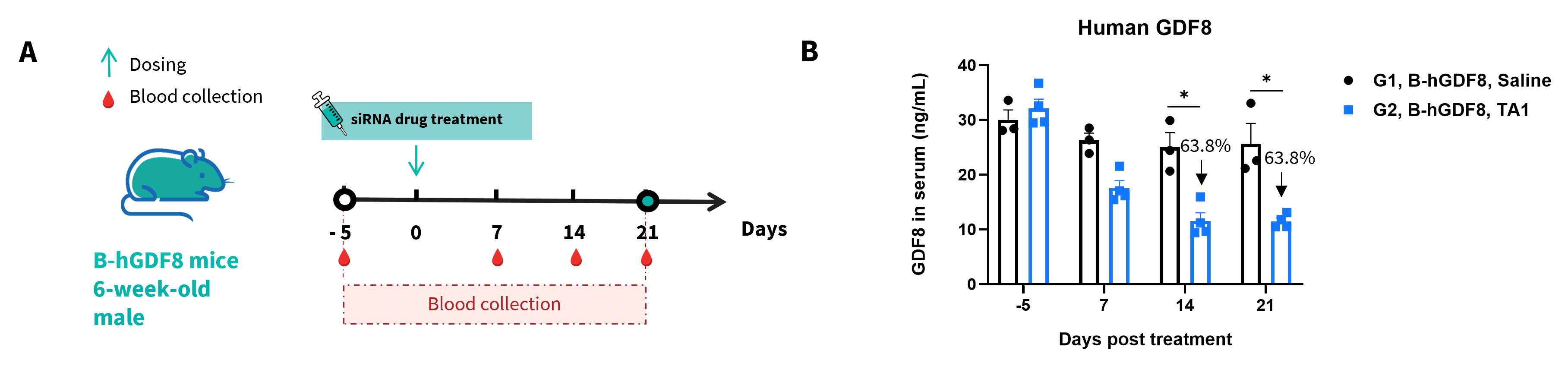
      Inhibitory Efficacy of Nucleic Acid Drugs Against Human GDF8 in GDF8 Humanized Mice
      • The human GDF8 levels in the treatment group were reduced compared to the control group, demonstrating that GDF8 humanized mice provide a powerful preclinical model for in vivo evaluation of human GDF8-targeted nucleic acid drugs.

      Inhibitory efficacy of GDF8-targeting nucleic acid therapeutics in homozygous GDF8 humanized mice. Homozygous GDF8 humanized mice (6 weeks old, n = 3–4 per group) were randomly divided into two groups. Mice received either a client-provided human GDF8-targeting nucleic acid therapeutic formulated in an aqueous saline solution or saline alone. (A) Schematic illustration of the experimental procedure. (B) Changes in serum GDF8 protein expression levels on days −5, 7, 14, and 21, relative to pre-administration levels. Statistical significance was determined using two-way ANOVA. *p < 0.05. Values are expressed as mean ± SEM.
      Note: Data are shared upon the client's approval.

      * When publishing results obtained using this animal model, please acknowledge the source as follows: The animal model [B-hGDF8 mice] (Cat# 112413) was purchased from Biocytogen.