Humanized Mouse Models for IND-Enabling Toxicology Studies

As human-specific therapeutics continue to advance, safety assessment increasingly depends on models that accurately recapitulate human target biology. Conventional toxicology species often lack the human target required for meaningful target engagement, driving the adoption of drug-target humanized mouse models for more predictive and translationally relevant toxicology studies.
Biocytogen's target-humanized mouse models express human target proteins in vivo, enabling translationally relevant toxicology studies for human-specific therapeutics. Backed by extensive experience supporting global biopharmaceutical partners, our models have been successfully applied in IND-enabling programs across diverse targets and modalities.

Why Choose Humanized Mice ?

Regulatory Endorsement

2021 June
2021 June image

Humanized mice are a reliable option when relevant species are limited, as supported by ICH S4(R1) guidelines.

Regulatory Endorsement icon
2022 Feb
2022 Feb image

Humanized mice serve as an alternative to NHPs for DART studies, as recommended by the FDA.

Regulatory Endorsement icon
2025 April
2025 April image

Reduce animal testing requirements for drugs, with humanized transgenic models suggested as a new approach methodology by the FDA.

Regulatory Endorsement icon
Accelerate IND-Enabling
Timelines

Fast-track the transition from preclinical research to regulatory approval.

Assess On-Target
Toxicity

Evaluate human-specific pharmacology and target-dependent safety in vivo using the clinical candidate directly.

Address Multi-Target
Development Challenges

An ideal platform for IND-enabling tox studies, especially for therapeutics with complex target cross-reactivity.

Streamline DART
Studies

Leverage shorter breeding cycles with FDA-recognized humanized mouse models for DART studies.

Scale Study
Capacity

Larger, synchronized cohorts to strengthen statistical power and robust datasets.

IND-Enabling Toxicology Services

General Toxicology Study

Single-Dose Toxicity (Acute)
  • Evaluates the effects of single high-dose exposure
  • Identifies dose-limiting toxicities and target organs of toxicity

Repeat-Dose Toxicity (Subchronic/Chronic)
  • Evaluates systemic toxicity following prolonged and repeated administration
  • Determines the No Observed Adverse Effect Level (NOAEL)
  • Evaluates the reversibility of adverse effects
Popular Targets

Key
Achievements

19

drug candidates, general
toxicology studies approved

27

additional client programs
currently in progress
General Toxicology Study image

Reproductive Toxicology Study

Fertility and Early Embryonic Development
  • Reproductive function and mating performance
Embryo-Fetal Development
  • Teratogenicity (malformations) and embryolethality
Pre- and Postnatal Development
  • Maternal health and offspring development
Popular Targets
Oncology
Autoimmune
Metabolic Diseases
Other

Key
Achievements

13

drug candidates, reproductive toxicology
studies carried out in clinical phases

11

additional client programs
currently in progress

Reproductive Toxicology Study image

Trusted by Global Industry Partners for Toxicology Studies

2

drugs received NMPA BLA approval

30

drug candidates received NMPA IND approval (LAG3, IL4/IL4R, 4-1BB, CCR8, CD20, CD3, TSLP)

11

drug candidates received FDA IND approval (CCR8, IL4/IL4R, PD-L1/4-1BB, CD3, TSLP, IL3R)

7

drug candidates received dual FDA/NMPA IND approvals

21

drug candidates used humanized mice in DART studies

1

drug candidate received dual FDA/TGA IND approvals

19

drug candidates, general toxicology has been approved

13

drug candidates, reproductive toxicology has been carried out in clinical phase

Case Studies

Case 1
Repeated-Dose Toxicity Studies Using IL4/IL4RA Humanized Mice

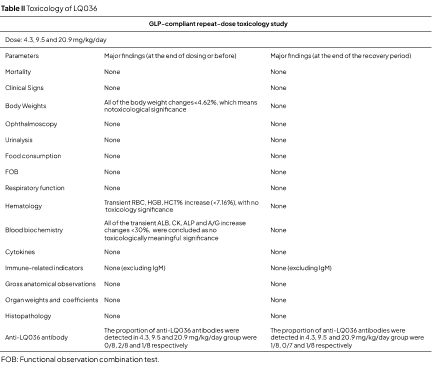
Biocytogen's B-HIL4/IL4RA mice were used in a repeated-dose toxicology study of LQ035, a novel inhalable anti-IL-4Rα nanobody for asthma. The study evaluated tolerability, cytokine profiles, immune markers, ADA responses, and NOAEL, demonstrating the model’s utility for safety assessment of inflammatory disease therapeutics. (Zhu et al. J Allergy Clin Immunol, 2024)

Data Highlights
Data Highlights icon 1
NOAEL identified: 20.9 mg/kg
Data Highlights icon 2
Toxicological Findings: No significant toxicological changes were observed across various measured parameters.
Data Highlights icon 3
Cytokines & Immune Markers: Key cytokines IL-2, IL-6, IL-10, IFN-γ, TNF-α and immune markers (IgA, IgG, C3, CIC, T cells, CD4+, CD8+, CD4+/CD8+ ratio) remained normal.
Data Highlights icon 4
Low immunogenicity: Anti-drug antibodies were detected in only a few mice.
Data Highlights icon 5
Current Status: Phase III clinical development in China
Data Highlights image
Case 2
Reproductive Toxicity Evaluation in TL1A/IL23A/IL12B Humanized Mice

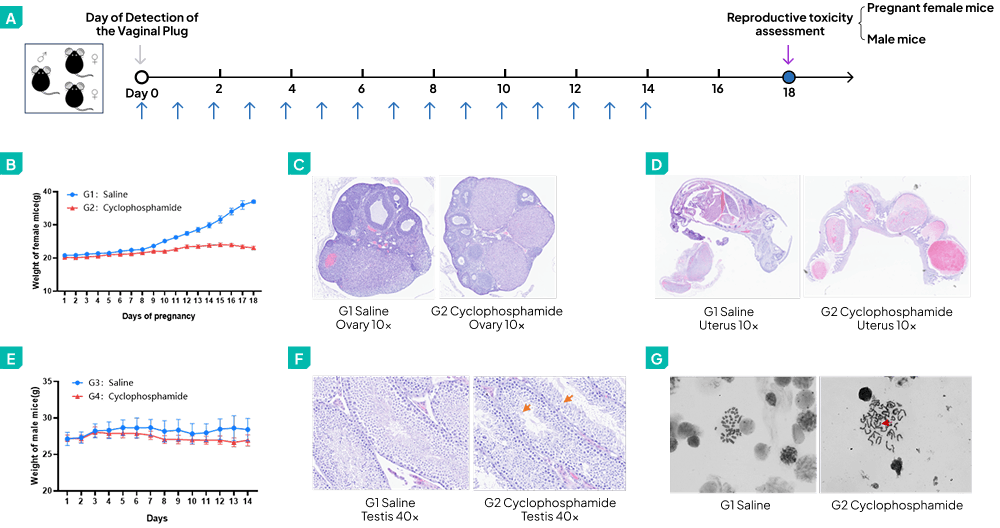
Biocytogen's B-hTL1A/hIL23A/hIL12B mice were utilized to support reproductive toxicity evaluation of cyclophosphamide. The study included comprehensive assessments of reproductive toxicity, germ cell genotoxicity, pregnancy outcomes, and embryo-fetal development, supporting DART-related safety evaluation.

Data Highlights
Data Highlights icon 6 Adult Reproductive Toxicity Assessment
  • Maternal & Paternal Body Weight: Monitors body weight changes and pregnancy-associated weight gain.
  • Female Histopathology (Ovary/Uterus): Evaluates ovarian follicular development and uterine histopathological changes.
  • Male Histopathology (Testis): Assesses seminiferous tubule atrophy and spermatogenic cell reduction.
  • Germ Cell Genotoxicity: Analyzes chromosomal aberrations in testicular spermatocytes.
Data Highlights icon 7 Fetal & Developmental Toxicity Assessment
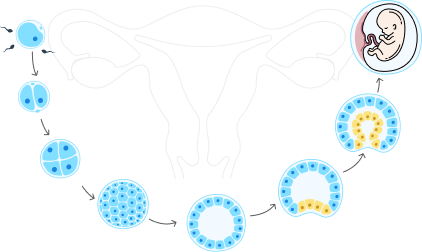
  • Pregnancy Outcomes: Monitors embryo-fetal lethality and rates of fetal resorption.
  • Skeletal Examination: Evaluates skeletal variations and developmental abnormalities.
  • Visceral Examination: Inspects internal organs for structural abnormalities.
Data Highlights image 2
Data Highlights image 3

IND-Ready Support

Established Toxicology Partnerships icon
Established Toxicology Partnerships

Extensive experience working with major safety assessment centers

IND-Ready Data Packages icon
IND-Ready Data Packages

High-standard product data can be directly used as supplementary files for IND applications

Comprehensive Study Support icon
Comprehensive Study Support

Comprehensive production and breeding data support long-term and reproductive toxicology studies

IND-Ready Support & Cutting-Edge Technology

Cutting-Edge Technology

Proven Gene Editing Expertise icon
Proven Gene Editing Expertise

10-year gene editing expertise, closely mimic expression patterns in human or WT mice

In-Depth Model Validation icon
In-Depth Model Validation

In vivo expression, functionality, and drug binding verified to ensure clinical relevance and reproducibility

Rapid & Synchronized Animal Supply icon
Rapid & Synchronized Animal Supply

Our proprietary IVF technology enables synchronized delivery of large cohorts, with weight differences controlled within 3g

Humanized Mouse Model Data Package

Basic Data Package
  • Mouse health status and growth curves
  • Hematology and serum biochemistry
  • Immune cell development
  • Major tissues and organs (weight, gross anatomy, and histopathology)
  • Reproductive performance and breeding
Species Correlation Verification
  • Target expression: mRNA level, protein level, tissue level
  • Function verification of targets: In vitro experiments, efficacy responses of positive control drug.
  • Test article binding verification: Primary cell binding, tissue cross reaction
  • Test article activity verification: In vitro experiment and in vivo PD analysis.

Advance Your Preclinical Toxicology & Safety Programs

Connect with Biocytogen to explore our toxicology services and discover how humanized models can support your IND-enabling development programs.