
B-hLPA/hAPOB mice

C57BL/6-Gt(ROSA)26Sortm2(LPA) Bcgen Apobtm1(APOB)Bcgen /Bcgen • 113427

B-hLPA/hAPOB mice

Catalog Number: 113427
Strain Name: C57BL/6-Gt(ROSA)26Sortm2(LPA) Bcgen Apobtm1(APOB)Bcgen /Bcgen
Strain Background: C57BL/6
NCBI gene ID: 4018,338 (Human)
Aliases: LP; AK38; APOA; FLDB; FCHL2; LDLCQ4; apoB-48; apoB-100
---
可提供授权方案
B-hLPA/hAPOB mice

在此页面上

  • Description
  • Targeting strategy
  • Phenotypic analysis
  • Efficacy

海报

查看全部

    发表文章

      Description

      Lipoprotein(a): A highly polymorphic particle that is structurally similar to but larger than Low-density lipoprotein (LDL).

      • Gene Information: Lipoprotein(a) (Lp(a)) is assembled when Apo(a) binds to Apolipoprotein B-100 (ApoB-100), and this lipoprotein is strongly associated with atherosclerosis and aortic valve calcification.
      • Protein Expression: LPA encoding apo(a) highly expressed in the liver. Apo(a) is noncovalently and covalently bound to apoB-100. Apolipoprotein B serves as the primary apolipoprotein of chylomicrons and LDL, acting as the ligand for the LDL receptor. It exists in two plasma isoforms: intestinal ApoB-48 and hepatic ApoB-100.
      • Signaling Pathway: Human Apo(a) efficiently interacts with human ApoB, producing Lp(a) in the plasma.
      • Therapeutic Method: A new generation of Lp(a)-specific therapeutics covers siRNAs, ASOs, small molecules, and CRISPR/Cas9 editing technologies. These drug categories feature unique action mechanisms, pharmacokinetic behaviors, and development timelines. Researchers are particularly focused on their ability to cut Lp(a) levels and, correspondingly, lower projected ASCVD risk.
      Targeting strategy

      LPA

      • The full coding sequences (CDS) of the human LPA gene, which is driven by the Alb promoter, were inserted into the Gt(ROSA)26Sor gene locus site. And there’s no LPA gene in the mouse genome sequence.

      APOB

      • The exons 1-29 of the mouse Apob gene that encode the whole molecule (ATG to STOP codon), including 5’UTR and 3’UTR, were replaced by human counterparts in B-hAPOB mice. The human APOB expression is driven by the human APOB promoter, while the mouse Apob gene transcription and translation will be disrupted.
      Apo(a) Protein Expression Analysis
      • Human Apo(a) was exclusively detectable in homozygous B-hLPA/hAPOB mice, but not in wild-type C57BL/6JNifdc mice.

      Strain-specific Apo(a) expression analysis in wild-type C57BL/6JNifdc mice and homozygous humanized B-hLPA/hAPOB mice by ELISA. Serum was collected from wild-type C57BL/6JNifdc mice (+/+) and homozygous B-hLPA/hAPOB mice (H/H, H/H) (n=3, 6 weeks old, female; n=3, 6 weeks old, male). The expression level of human Apo(a) was analyzed by ELISA (Abcam, ab212165). Human Apo(a) was exclusively detectable in homozygous B-hLPA/hAPOB mice, but not in wild-type C57BL/6JNifdc mice. Values are expressed as mean ± SEM.

      APOB Protein Expression Analysis
      • Human APOB was exclusively detectable in homozygous B-hLPA/hAPOB mice, but not in wild-type C57BL/6JNifdc mice.

      Strain-specific APOB expression analysis in wild-type C57BL/6JNifdc mice and homozygous humanized B-hLPA/hAPOB mice by ELISA. Serum was collected from wild-type C57BL/6JNidfc mice (+/+) and homozygous B-hLPA/hAPOB mice (H/H, H/H) (n=3, 6 weeks old, female; n=3, 6 weeks old, male). Expression levels of mouse and human APOB were analyzed by ELISA (Mouse: Abcam, ab230932; Human: ab108807). Human APOB was exclusively detectable in homozygous B-hLPA/hAPOB mice, but not in wild-type C57BL/6JNidfc mice. Values are expressed as mean ± SEM.

      Lp(a) Expression Analysis
      • Human Lp(a) complex was exclusively detectable in homozygous B-hLPA/hAPOB mice, but not in B-hLPA mice and B-hAPOB mice

      Strain-specific Lp(a) complex expression analysis in heterozygous humanized B-hLPA/hAPOB mice by ELISA. Serum was collected from heterozygous B-hLPA/hAPOB mice (H/+, H/+) (n=2, 11 weeks old, male), heterozygous B-hAPOB mice (H/+) (n=2, 11 weeks old, male), and homozygous B-hLPA mice (H/H) (n=2, 8 weeks old, male). Lp(a) complex can be detected in heterozygous humanized B-hLPA/hAPOB mice, but not in homozygous B-hLPA mice and heterozygous B-hAPOB mice.

      Note: Data was shared from a client. Values are expressed as mean ± SEM.

      • Human Lp(a) complex was exclusively detectable in homozygous B-hLPA/hAPOB mice.

      Strain-specific Lp(a) complex expression analysis in homozygous humanized B-hLPA/hAPOB mice by ELISA. Serum was collected from homozygous B-hLPA/hAPOB mice (H/H, H/H) (n=3, 8 weeks old, male and female) to measure Lp(a) complex. Values are expressed as mean ± SEM.

      Note: Data was shared from another client.
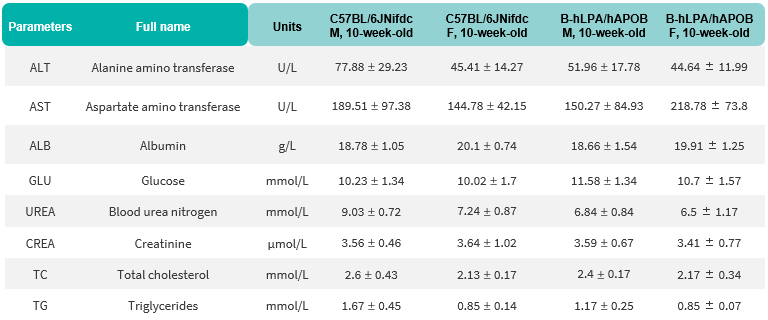
      Blood Chemistry
      • Humanization of LPA and APOB does not alter blood chemistry parameters in 10-week-old mice.

      Biochemical test of B-hLPA/hAPOB mice. Values are expressed as mean ± SD.
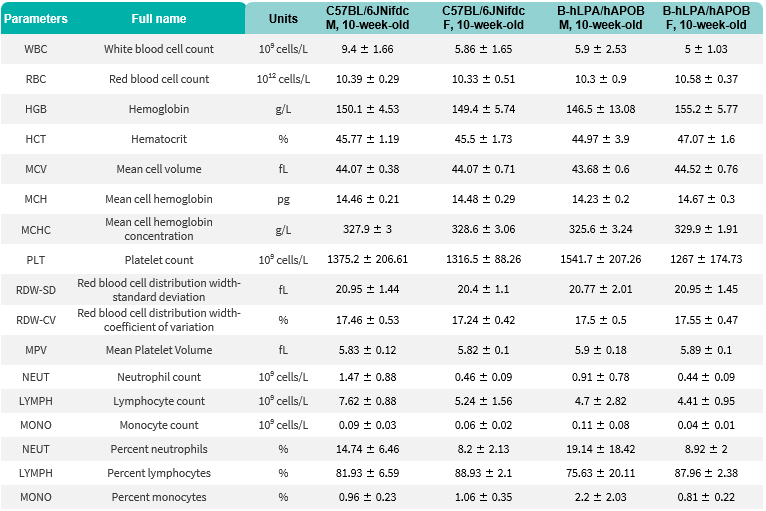
      Hematology Analysis
      • Humanization of LPA and APOB does not alter hematology analysis parameters in 10-week-old mice.

      Complete blood count (CBC) of B-hLPA/hAPOB mice. Values are expressed as mean ± SD.
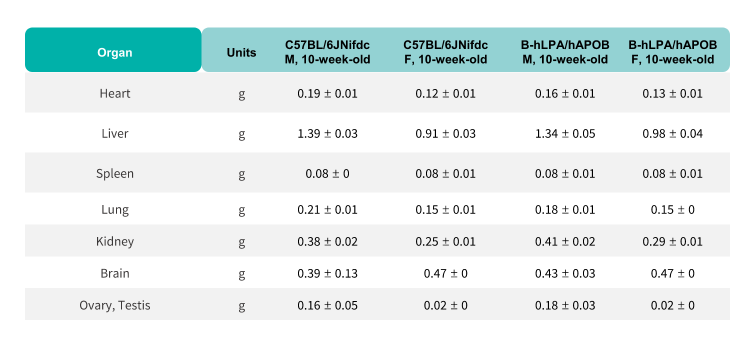
      Organ Weight
      • No abnormalities were observed.

      Average weights of major organs in B-hLPA/hAPOB mice.
      Histopathological Analysis
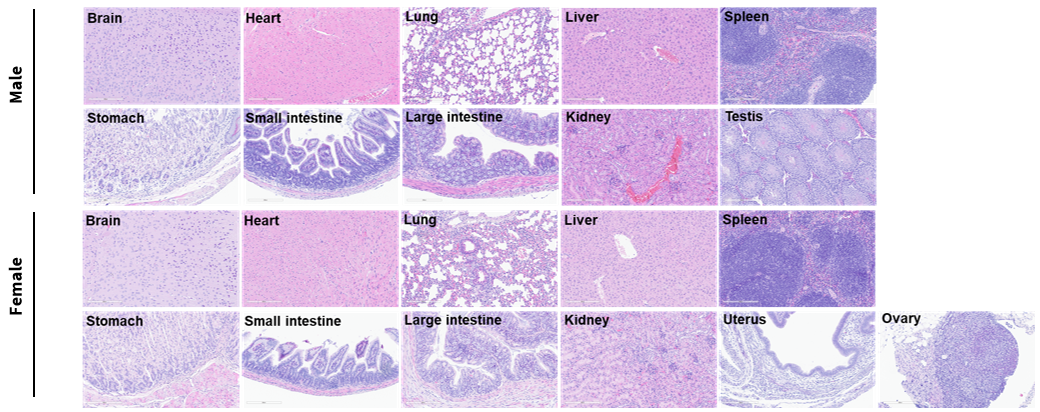
      • No obvious abnormalities were observed in any organs examined (brain, heart, lung, liver, spleen, stomach, small intestine, large intestine, kidney, ovary, uterus, testis, and ovary).

      Histopathological analysis of organs in B-hLPA/hAPOB mice. Major organs from B-hLPA/hAPOB mice were collected at 10 weeks of age and analyzed by H&E staining (male, n = 10; female, n = 10).
      Gross Organ Anatomy (Female)
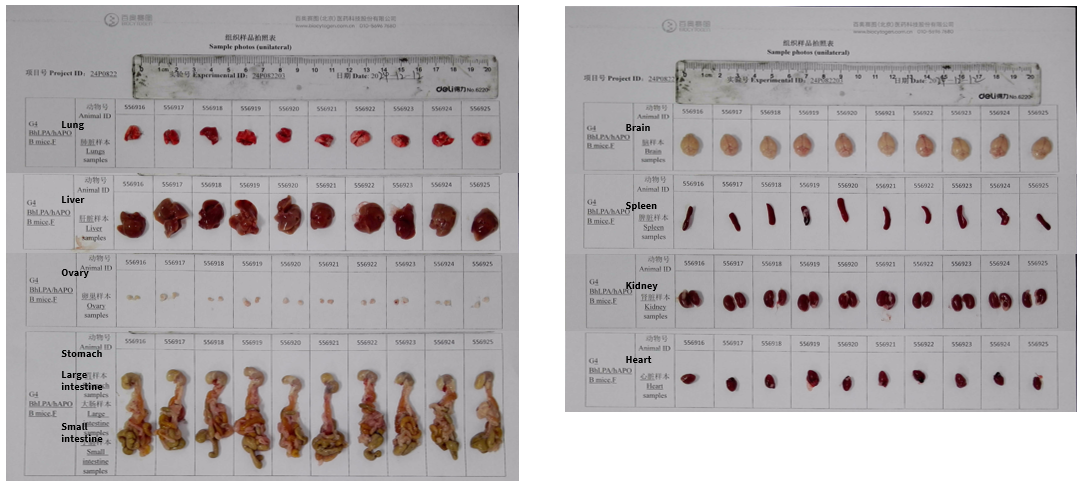
      • No abnormalities were observed.

      Organs of female B-hLPA/hAPOB mice (10-week-old, n = 10).
      Gross Organ Anatomy (Male)
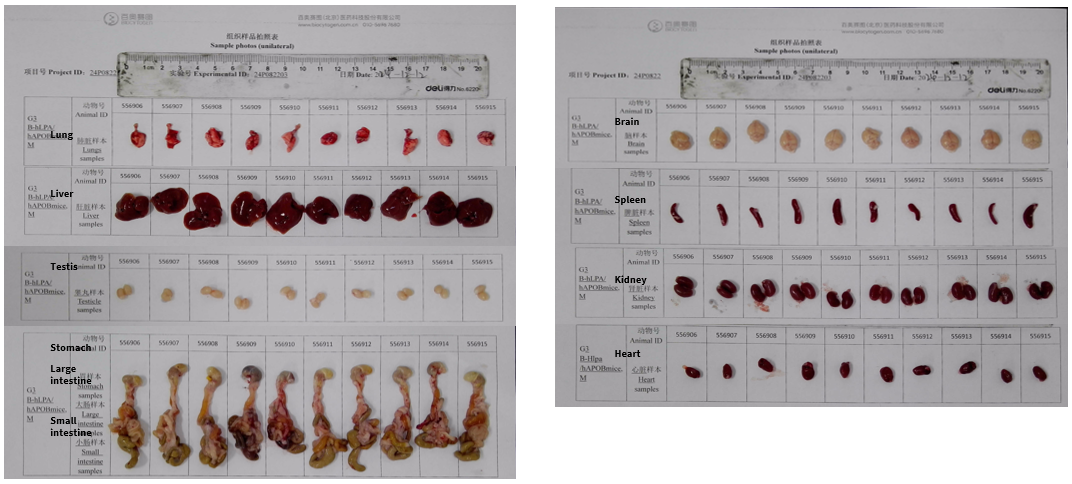
      • No abnormalities were observed.

      Organs of male B-hLPA/hAPOB mice (10-week-old, n = 10).

      The Inhibitory Efficiency of the Small Molecule Drug Against Lp(a)
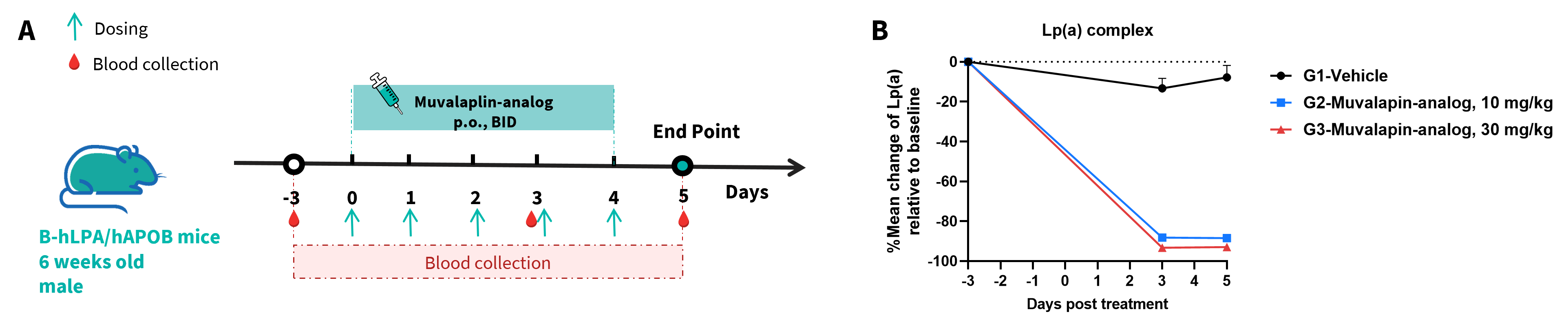
      • The human Lp(a) levels reduced after the small molecule drug treatment in B-hLPA/hAPOB mice.

      Changes of plasma Lp(a) levels in B-hLPA/hAPOB mice in response to muvalapin. B-hLPA/hAPOB mice were randomly divided into three groups (male, 6 weeks old, n=3). Muvalapin and vehicle (1% hydroxyethyl cellulose(HEC), 0.25% Tween-80 ) were administered to the mice individually. Plasma of B-hLPA/hAPOB mice were collected to measure the Lp(a) complex (Capture antibody in ab212165 combined with ab27622 as detection antibody). (A) The schematic diagram of experimental processing. (B) % Mean change of Lp(a) complex relative to baseline after administration.
      The Inhibitory Efficiency of the Nucleic Acid Drugs Against Human LPA
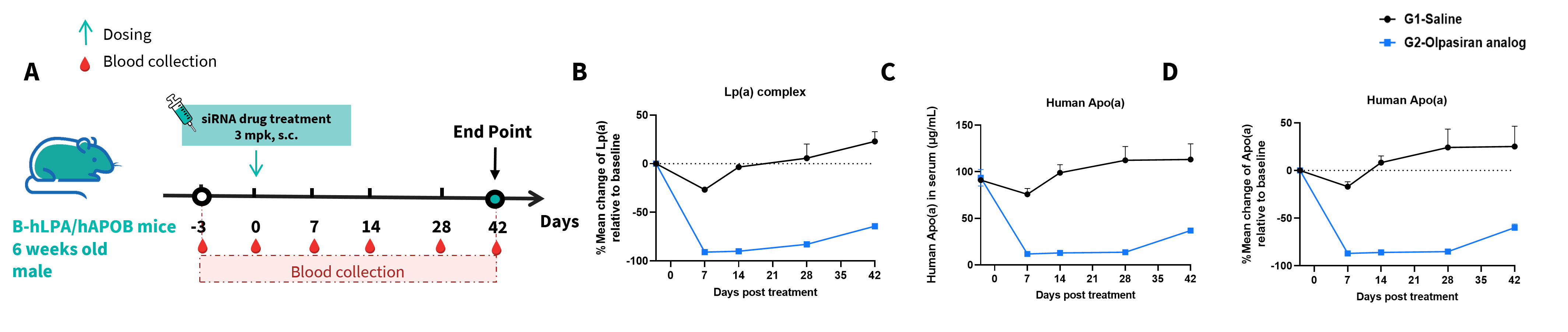
      • The human Apo(a) and Lp(a) levels reduced after the administration of a single dose, demonstrating that B-hLPA/hAPOB mice provide a powerful preclinical model for in vivo evaluation of human LPA-targeted nucleic acid drugs.

      Changes of plasma Lp(a) and Apo(a) levels in B-hLPA/hAPOB mice in response to siRNA drug target LPA. B-hLPA/hAPOB mice were randomly divided into two groups (male, 6 weeks old, n=3). Human siRNA drug (Olpasiran analog, provided by the client) and saline were administered to the mice individually. Plasma of B-hLPA/hAPOB mice was collected to measure the Lp(a) complex (Capture antibody in ab212165 combined with ab27622 as detection antibody) and human Apo(a) (Abcam, ab212165). (A) The schematic diagram of experimental processing. (B) % Mean change of Lp(a) complex relative to baseline after administration of a single dose (C) Human Apo(a) concentration after administration of a single dose. (D) % Mean change of human Apo(a) relative to baseline after administration of a single dose.

      * When publishing results obtained using this animal model, please acknowledge the source as follows: The animal model [B-hLPA/hAPOB mice] (Cat# 113427) was purchased from Biocytogen.