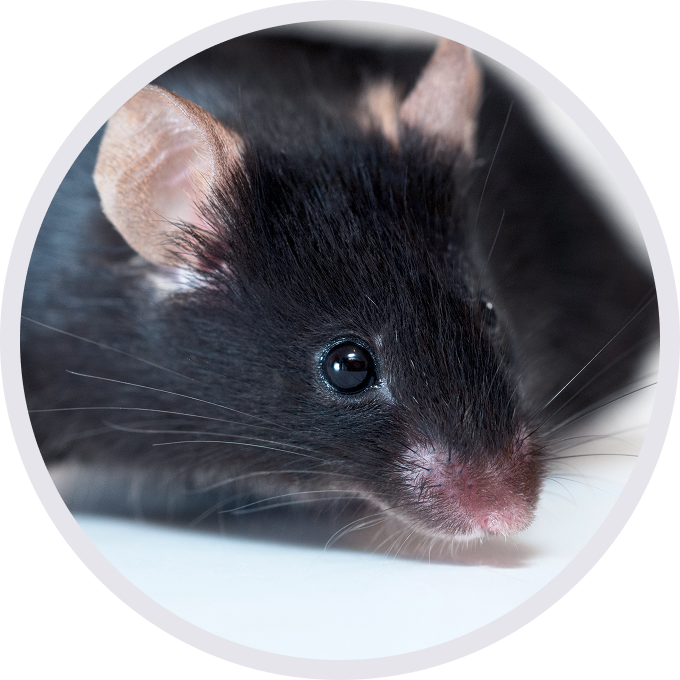
C57BL/6-Acvr2atm1(ACVR2A)Bcgen/Bcgen • 111393


Gene editing strategy for B-hACVR2A mice. The exons 1-11 of the mouse Acvr2a gene that encode the whole molecule, including promoter, 5’UTR, and part 3’UTR, were replaced by the exons 1-11 of the human counterparts, including human promoter, 5’UTR, and human 3’UTR in B-hACVR2A mice. The human ACVR2A expression is driven by the human ACVR2B promoter, while the mouse Acvr2a gene transcription and translation will be disrupted.

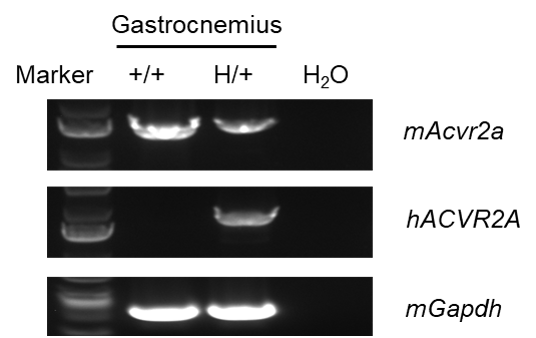
Species specific analysis of ACVR2A mRNA expression in wild-type C57BL/6JNifdc mice and heterozygous humanized B-hACVR2A mice by RT-PCR. Gastrocnemius were collected from wild-type C57BL/6JNifdc mice (+/+) and heterozygous B-hACVR2A mice (H/+), then cDNA libraries were synthesized by reverse transcription, followed by PCR with mouse or human ACVR2A primers. Human ACVR2A mRNA was detectable only in heterozygous B-hACVR2A mice, but not in wild-type C57BL/6JNifdc mice. Human sequences were confirmed via Sanger Sequencing.

Species specific analysis of ACVR2A mRNA expression in wild-type C57BL/6JNifdc mice and homozygous humanized B-hACVR2A mice by RT-qPCR. Gastrocnemius, brown fat, and inguinal fat were collected from wild-type C57BL/6JNifdc mice (+/+) (male and female, n=3, 8-week-old) and homozygous B-hACVR2A mice (H/H) (male and female, n=3, 8-week-old), then cDNA libraries were synthesized by reverse transcription, followed by RT-qPCR with mouse or human ACVR2A primers. Human ACVR2A mRNA was detectable only in homozygous B-hACVR2A mice, but not in wild-type C57BL/6JNifdc mice. Mouse Acvr2a mRNA was exclusively detectable in wild-type mice but not in B-hACVR2A mice. All results were normalized to the gastrocnemius muscle. Values are expressed as mean ± SEM.
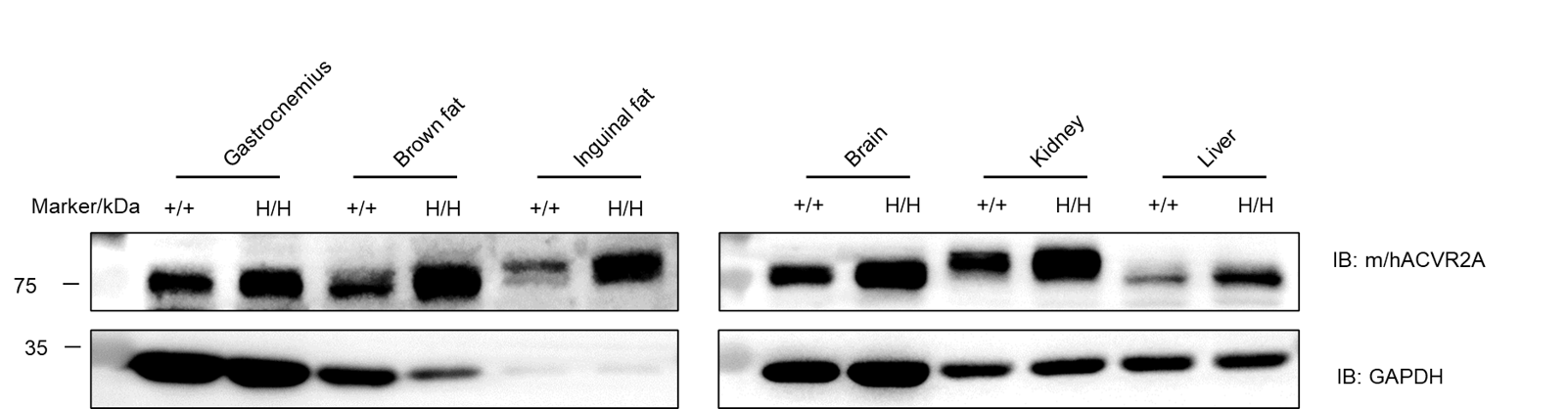
Western blot analysis of ACVR2A protein expression in homozygous B-hACVR2A mice. Various tissue lysates were collected from wild-type C57BL/6JNifdc mice (+/+) and homozygous B-hACVR2A mice (H/H) (male, 8-week-old), and then analyzed by western blot with anti-ACVR2A antibody (R&D, AF340). 40 μg total protein was loaded for western blotting analysis. ACVR2A protein was detectable in homozygous B-hACVR2A mice and wild-type C57BL/6JNifdc mice, as the antibody cross-recognizes both human and mouse ACVR2A.

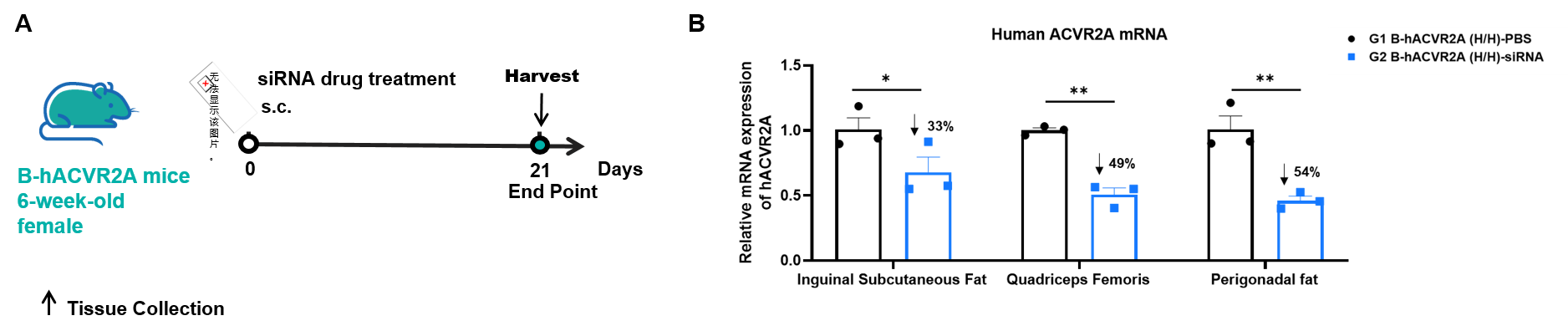
The inhibitory efficiency of the nucleic acid drugs against human ACVR2A in homozygous B-hACVR2A mice. B-hACVR2A mice (H/H) were randomly divided into two groups (female, 6-week-old, n=3). The human ACVR2A targeted nucleic acid drugs and the PBS were administered to the mice individually. The mice were sacrificed on day 21, and the inguinal subcutaneous fat, perigonadal fat, and quadriceps femoris tissue were collected to detect the expression level of human ACVR2A mRNA by qPCR. (A) The schematic diagram of experimental processing. (B) The expression of human ACVR2A mRNA was normalized to the PBS group of each tissue. Values are expressed as mean ± SEM. Significance was determined by two-way ANOVA, *P<0.05, **P<0.01, ***P<0.001.
Note: This siRNA from a client targets ACVR2A in adipose and muscle. Data are shared upon the client's approval.