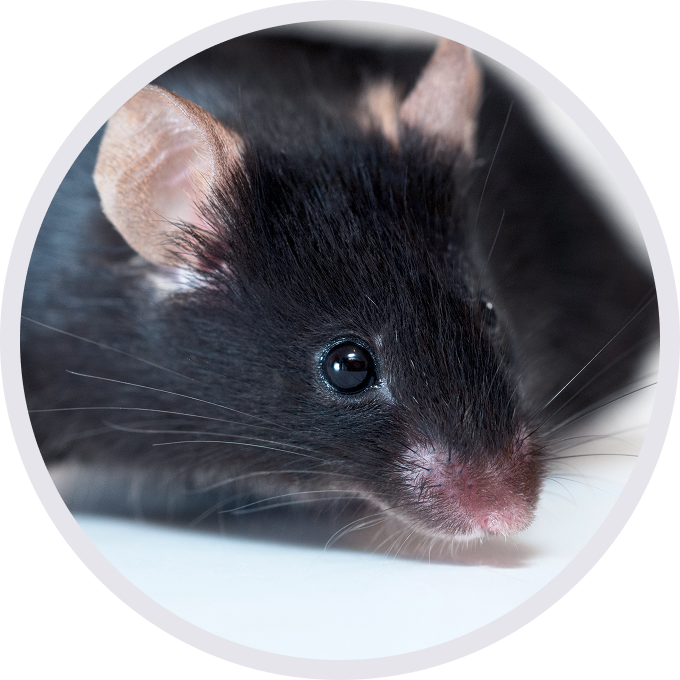
C57BL/6-Tfrctm1(TFRC)Bcgen Tg(Thy1-hAPP*K670N*M671L*I716V, Thy1-hPSEN1*M146L*L286V)5Bcgen/Bcgen • 114219

Key Advantages
Validation
Application

In B-hTFR1 mice, exons 4-19 of the mouse Tfr1 gene encoding the extracellular domain were replaced by the corresponding human TFRC sequences, while the mouse cytoplasmic portion, promoter, 5' UTR, and 3' UTR regions were retained. This design enables chimeric TfR1 expression driven by the endogenous mouse Tfr1 promoter.
B-Tg(5XFAD) mice plus express mutant human APP carrying Swedish, Florida, and London familial Alzheimer's disease mutations and human PSEN1 carrying M146L and L286V mutations under the neural-specific mouse Thy1 promoter. B-hTFR1/B-Tg(5XFAD) mice plus were obtained by mating B-hTFR1 mice with B-Tg(5XFAD) mice plus.

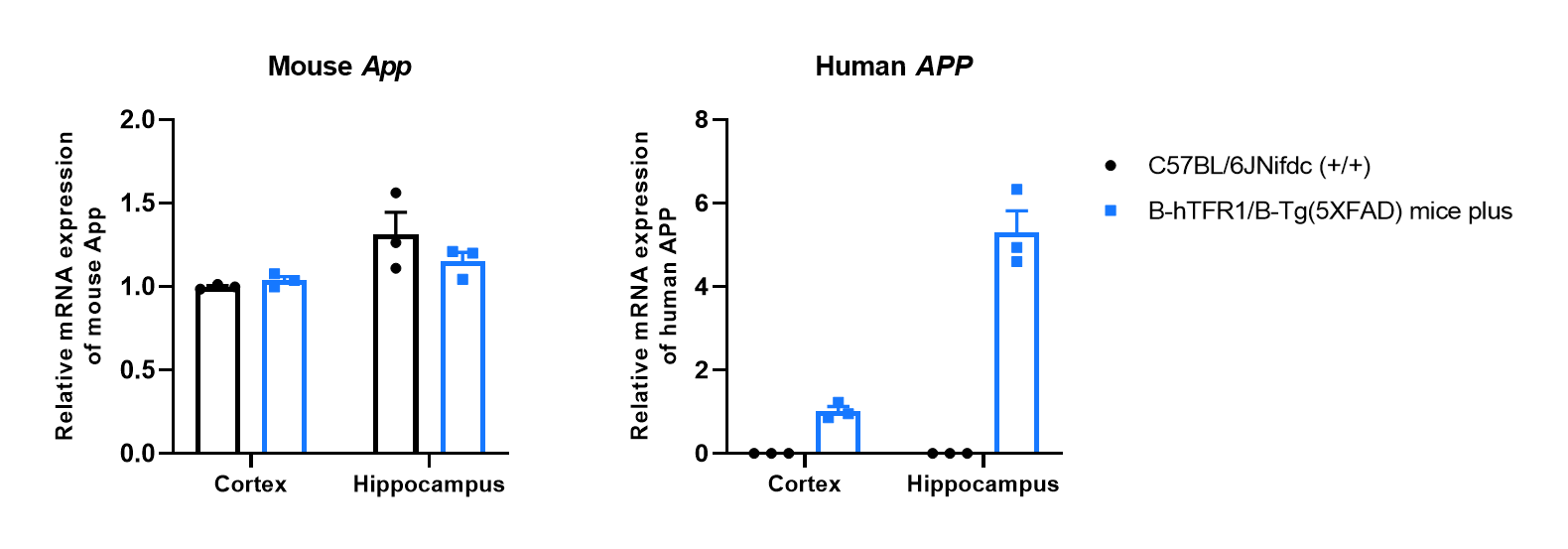
Species-specific analysis of mouse App and human APP gene expression was performed in wild-type mice and B-hTFR1/B-Tg(5XFAD) mice plus by RT-qPCR.
Cortex and hippocampus RNA were isolated from wild-type C57BL/6JNifdc mice (+/+) and B-hTFR1/B-Tg(5XFAD) mice plus. cDNA libraries were synthesized by reverse transcription followed by RT-qPCR using mouse- or human-specific APP primers. Mouse App expression was detected in both wild-type mice and B-hTFR1/B-Tg(5XFAD) mice plus. Human APP expression was detected in B-hTFR1/B-Tg(5XFAD) mice plus, not in wild-type mice. Human APP mRNA expression was significantly higher in the hippocampus than in the cortex.
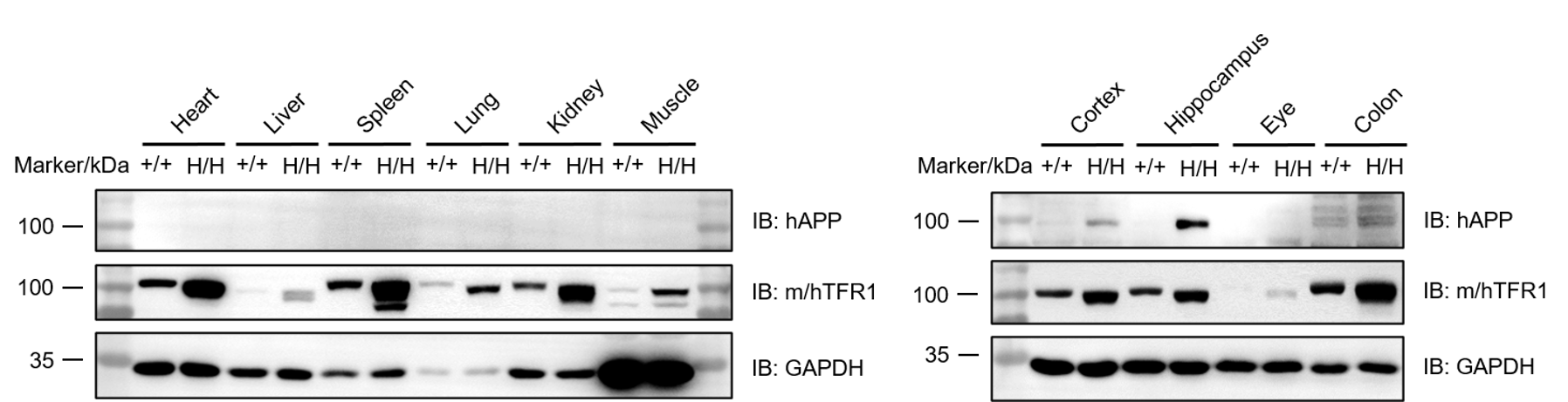
Western blot analysis of APP and TFR1 protein expression was performed in B-hTFR1/B-Tg(5XFAD) mice plus.
Various tissue lysates were collected from wild-type C57BL/6 mice (+/+) and B-hTFR1/B-Tg(5XFAD) mice plus (H/H). Protein expression was analyzed using species-specific anti-APP antibody (Abcam, ab133588) and anti-TfR1 antibody (Abcam, ab214039). A total of 40 μg protein was loaded for western blot analysis. Human APP was detected in cortex and hippocampus from B-hTFR1/B-Tg(5XFAD) mice plus but not in wild-type mice. TfR1 was detected in heart, liver, spleen, lung, kidney, muscle, cortex, hippocampus, eye, and colon from both wild-type mice and B-hTFR1/B-Tg(5XFAD) mice plus.

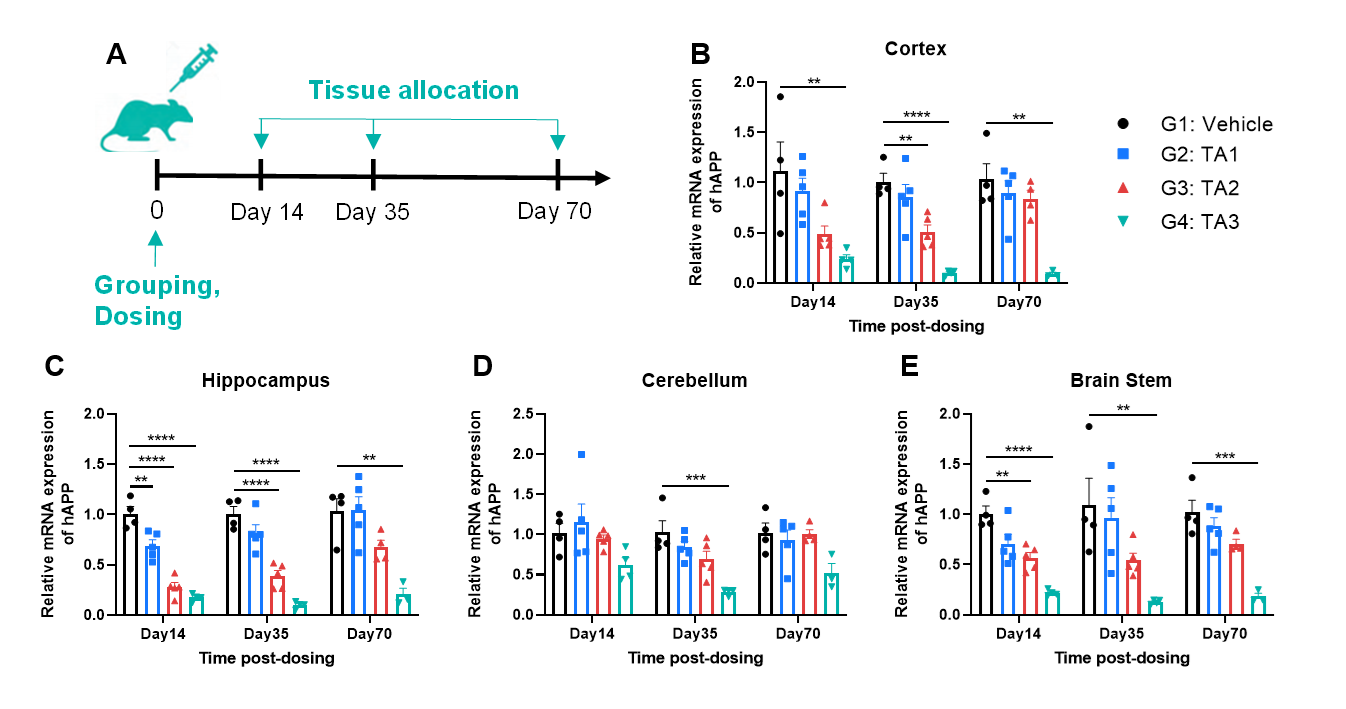
The inhibitory efficiency of oligonucleotide drugs against human APP was evaluated in B-hTFR1/B-Tg(5XFAD) mice plus.
B-hTFR1/B-Tg(5XFAD) mice plus were randomly divided into four groups (n=3-5/group, 10-week-old males). Oligonucleotide drugs TA1, TA2, TA3, or vehicle were administered individually. Mice were sacrificed on day 14, day 35, and day 70, and cortex, hippocampus, cerebellum, and brain stem tissues were collected for RT-qPCR analysis of human APP mRNA.
After administration of TA3, human APP mRNA was significantly reduced compared with the vehicle control group in multiple brain regions.
The reduction of human APP mRNA in cortex, hippocampus, cerebellum, and brain stem demonstrates that B-hTFR1/B-Tg(5XFAD) mice plus provide a powerful preclinical model for evaluating human APP-targeted oligonucleotide drugs. Values are expressed as mean ± SEM. Significance was determined by one-way ANOVA. *P < 0.05, **P < 0.01, ***P < 0.001.
This experiment was conducted in collaboration with the client using B-hTFR1/B-Tg(5XFAD) mice plus.

Q1: What are B-hTFR1/B-Tg(5XFAD) mice plus?
B-hTFR1/B-Tg(5XFAD) mice plus are genetically engineered mice combining humanized TFR1 with a 5XFAD Alzheimer's disease transgenic background for BBB delivery and human APP-targeted drug studies.
Q2: Why is TFR1 important for CNS drug delivery?
TFR1 is highly expressed on brain endothelial cells and can support receptor-mediated transcytosis, making it a valuable target for transporting large molecules across the blood-brain barrier.
Q3: What Alzheimer's disease-related genes are included in this model?
B-hTFR1/B-Tg(5XFAD) mice plus express mutant human APP and human PSEN1 driven by a neural-specific Thy1 promoter.
Q4: Can B-hTFR1/B-Tg(5XFAD) mice plus be used for oligonucleotide drug evaluation?
Yes. The model supports in vivo evaluation of human APP-targeted oligonucleotide drugs, including measurement of APP mRNA reduction in multiple brain regions.
Q5: What are the main applications of B-hTFR1/B-Tg(5XFAD) mice plus?
Applications include BBB penetration studies, TFR1-mediated CNS delivery research, Alzheimer's disease therapeutic screening, and preclinical efficacy evaluation of human APP-targeted therapeutics.