Description
Background:
- CD3 is a key component of the T cell receptor (TCR) complex, composed of γ, δ, ε, and ζ chains that form dimers (e.g., CD3γε, ζζ). Its intracellular domains contain ITAMs essential for signal transduction. When the TCR engages an MHC–peptide complex, CD3 transmits the signal into the cell, initiating cascades that drive T cell activation, proliferation, and effector functions.
- GUCY2C is a receptor expressed on intestinal epithelial cells, activated by ligands including the hormone guanylin, bacterial enterotoxin ST, and drugs like linaclotide. Ligand binding increases intracellular cGMP, activating downstream effectors to regulate fluid secretion, barrier function, and metabolism. Therapeutic antibodies targeting GUCY2C can activate this pathway to induce apoptosis and inhibit tumor growth and metastasis.
Targeting strategy:
- The targeting strategy of humanized CD3EDG are undisclosed. The exons 1-11 of mouse Gucy2c gene that encode signal peptide and extracellular domain and part of transmembrane domain are replaced by human counterparts in B-hCD3EDG/hGUCY2C mice. The genomic region of mouse Gucy2c gene that encodes cytoplasmic portion is retained. The promoter, 5’UTR and 3’UTR region of the mouse gene are also replaced by human counterparts. The chimeric GUCY2C expression is driven by endogenous human Gucy2c promoter, while mouse Gucy2c gene transcription and translation will be disrupted.
Validation:
- Mouse Cd3d and Cd3g mRNA was detectable only in wild-type mice. Human CD3D and CD3G mRNA was detectable only homozygous B-hCD3EDG/hGUCY2C mice but not in wild-type mice. Mouse Gucy2c mRNA was detectable only in wild-type mice. Human GUCY2C mRNA was detectable only homozygous B-hCD3EDG/hGUCY2C mice but not in wild-type mice.
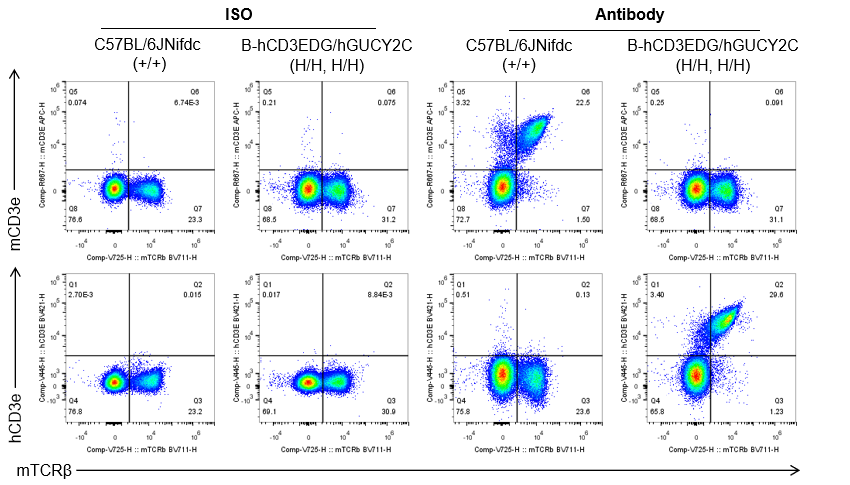
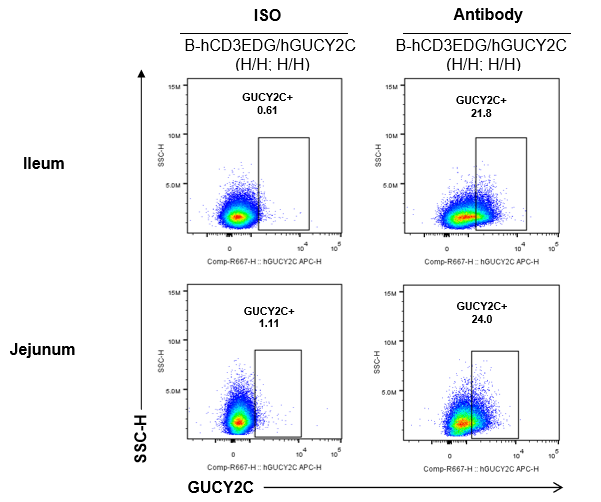
- Human CD3E was exclusively detectable in homozygous B-hCD3EDG/hGUCY2C mice, but not in wild-type C57BL/6JNifdc mice. Human GUCY2C was detectable in ileum and jejunum of B-hCD3EDG/hGUCY2C mice.
Application: This product is used for the pharmacological and safety evaluation of CD3EDG/hGUCY2C bispecific antibodies.
Targeting Strategy
Gene targeting strategy for B-hCD3EDG/hGUCY2C mice. The targeting strategy of humanized CD3EDG were undisclosed. The exons 1-11 of mouse Gucy2c gene that encode signal peptide and extracellular domain and part of transmembrane domain are replaced by human counterparts in B-hCD3EDG/hGUCY2C mice. The genomic region of mouse Gucy2c gene that encodes cytoplasmic portion is retained. The promoter and 5’UTR region of the mouse gene are replaced by human counterparts. The chimeric GUCY2C expression is driven by endogenous human Gucy2c promoter, while mouse Gucy2c gene transcription and translation will be disrupted.
mRNA Expression Analysis-CD3D and CD3G
Strain specific analysis of CD3D and CD3G mRNA expression in wild-type C57BL/6JNifdc mice and B-hCD3EDG/hGUCY2C mice by RT-PCR. Spleen RNA were isolated from wildtype C57BL/6 mice (+/+) and homozygous B-hCD3EDG/hGUCY2C mice (H/H; H/H), then cDNA libraries were synthesized by reverse transcription, followed by PCR with mouse or human CD3D and CD3G primers. Mouse Cd3d and Cd3g mRNA was detectable only in wild-type mice. Human CD3D and CD3G mRNA was detectable only homozygous B-hCD3EDG/hGUCY2C mice but not in wild-type mice.
mRNA Expression Analysis-GUCY2C
Strain specific analysis of GUCY2C mRNA expression in wild-type C57BL/6JNifdc mice and B-hCD3EDG/hGUCY2C mice by RT-PCR. Ileum RNA were isolated from wildtype C57BL/6 mice (+/+) and homozygous B-hCD3EDG/hGUCY2C mice (H/H; H/H), then cDNA libraries were synthesized by reverse transcription, followed by PCR with mouse or human GUCY2C primers. Mouse Gucy2c mRNA was detectable only in wild-type. Human GUCY2C mRNA was detectable only homozygous B-hCD3EDG/hGUCY2C mice but not in wild-type mice.
Protein Expression Analysis-CD3E
CD3E expression analysis in wild-type C57BL/6JNifdc mice and homozygous humanized B-hCD3EDG/hGUCY2C mice by flow cytometry. Spleen T cells were collected from wild-type C57BL/6JNifdc mice (+/+) and homozygous B-hCD3EDG/hGUCY2C mice (H/H; H/H). Protein expression was analyzed with anti-human CD3E antibody (BD Horizon™, 562426) and anti-mouse CD3E antibody (Biolegend, 100312) by flow cytometry. Human CD3E was exclusively detectable in homozygous B-hCD3EDG/hGUCY2C mice, but not in wild-type C57BL/6JNifdc mice.
Protein Expression Analysis-IHC-GUCY2C
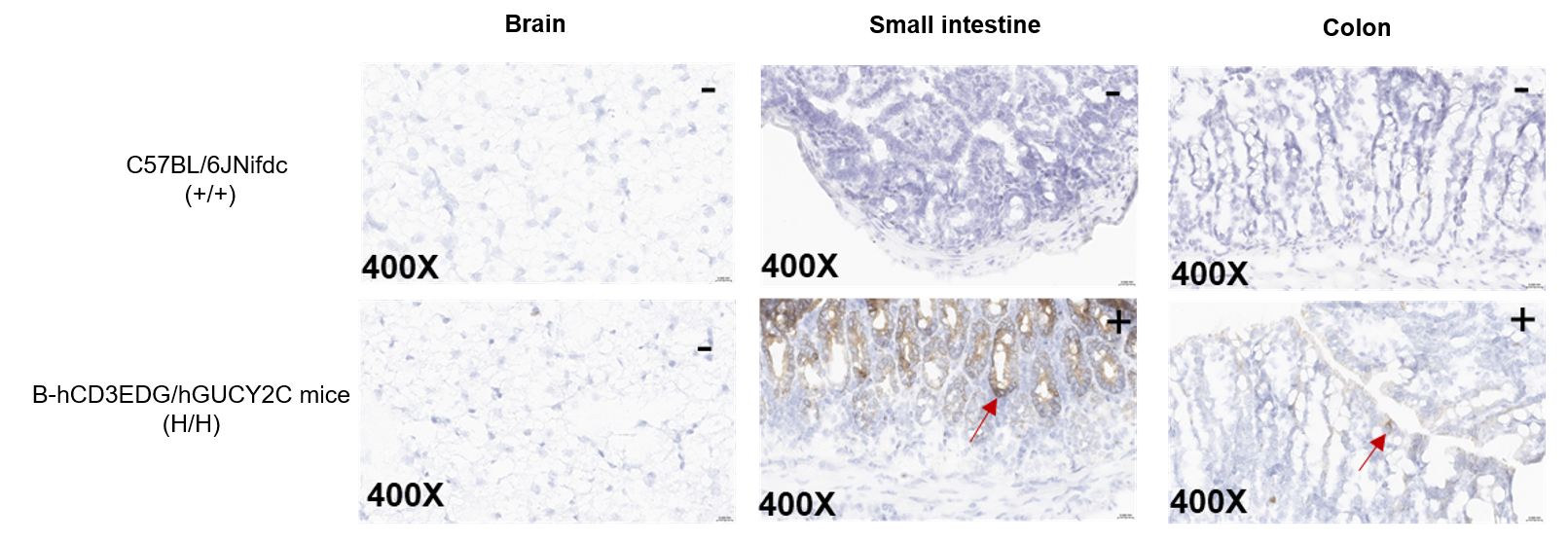
Immunohistochemical (IHC) analysis of GUCY2C protein expression in wild-type mice and B-hCD3EDG/hGUCY2C mice. Small intestine, colon and brain tissues were collected from wild-type mice and homozygous B-hCD3EDG/hGUCY2C mice and analyzed by IHC with specific-species anti-human GUCY2C antibody (R&D, MAB2157-100). Human GUCY2C was detected in small intestine and colon of B-hCD3EDG/hGUCY2C mice.
Note: For the use of this antibody, fresh tissue should be used to prepare frozen sections, as formalin-fixed tissue may destroy antigenic epitopes.
Protein Expression Analysis-GUCY2C
Strain specific GUCY2C expression analysis in homozygous B-hCD3EDG/hGUCY2C mice by flow cytometry. Ileum and Jejunum were collected from homozygous B-hCD3EDG/hGUCY2C mice (H/H; H/H) and analyzed by flow cytometry with anti-human GUCY2C Antibody (R&D, FAB2157R-100UG). Human GUCY2C was detectable in ileum and jejunum of B-hCD3EDG/hGUCY2C mice.
* When publishing results obtained using this animal model, please acknowledge the source as follows: The animal model [B-hCD3EDG/hGUCY2C mice] (Cat# 114328) was purchased from Biocytogen.