Description
EGFR and HER3: EGFR and HER3 are ERBB family receptors that drive tumor proliferation and survival.
- Gene Information: EGFR (ERBB1) and HER3 (ERBB3) are members of the ERBB receptor tyrosine kinase family. EGFR possesses kinase activity, whereas HER3 has impaired kinase activity and functions primarily through heterodimerization.
- Protein Expression: EGFR is broadly expressed in epithelial tissues and is frequently overexpressed in solid tumors. HER3 is expressed in normal and malignant tissues and is often upregulated in therapy-resistant cancers.
- Signaling Pathway: EGFR/HER3 heterodimerization activates PI3K/AKT and MAPK signaling pathways. This signaling axis promotes cell proliferation, survival, metastasis, and resistance to EGFR-targeted therapies.
- Therapeutic Inhibition: EGFR/HER3-targeted antibodies, bispecific antibodies, and ADCs can block receptor signaling and eliminate EGFR/HER3-positive tumor cells. Dual-target inhibition has shown enhanced anti-tumor activity and is being actively developed for multiple solid tumors.
Targeting strategy
EGFR
- Exons 2-17 of mouse Egfr gene that encode extracellular domain are replaced by human counterparts in B-hEGFR/hHER3 mice.
- The genomic region of mouse Egfr gene that encodes signal peptide, transmembrane domain and cytoplasmic portion is retained. The promoter, 5’UTR and 3’UTR region of the mouse gene are also retained. The chimeric EGFR expression is driven by endogenous mouse Egfr promoter, while mouse Egfr gene transcription and translation will be disrupted.
HER3
- The exons 1-17 of mouse Her3 gene that encode the extracellular domain and transmembrane domain were replaced by human HER3 exons 1-17 in B-hEGFR/hHER3 mice.
- The genomic region of mouse Her3 gene that encodes signal peptide, transmembrane domain and cytoplasmic portion is retained. The promoter, 5’UTR and 3’UTR region of the mouse gene are also retained. The chimeric HER3 expression is driven by endogenous mouse Her3 promoter, while mouse Her3 gene transcription and translation will be disrupted.
Immunohistochemical Analysis-EGFR
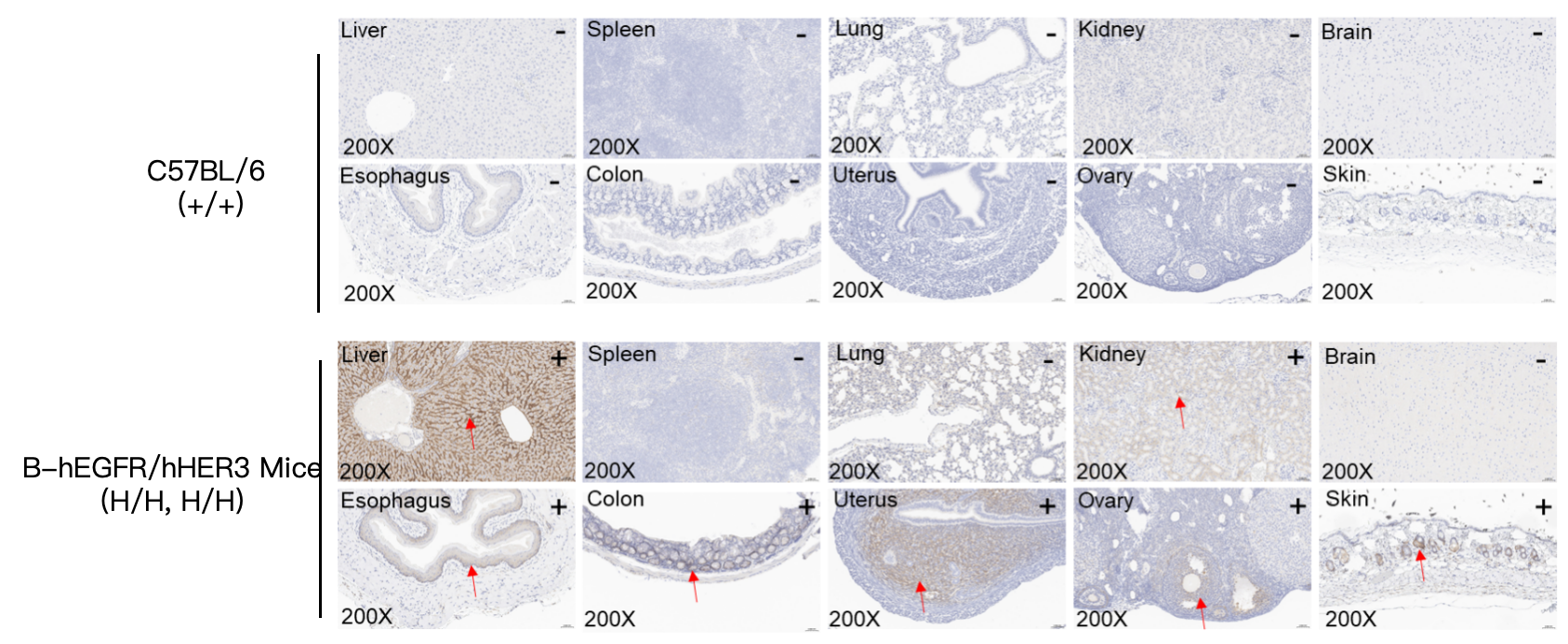
- Human EGFR expression was detected in the liver, kidney, skin, uterus, esophagus, colon and ovary of homozygous B-hEGFR/hHER3 mice.
- The antibodies were species-specific and did not bind to mouse EGFR in wild-type C57BL/6 mice.
Immunohistochemical analysis of organs in B-hEGFR/hHER3 mice. Major organs were collected from wild-type C57BL/6 mice and homozygous B-hEGFR/hHER3 mice (H/H, H/H), and analyzed by IHC using anti-EGFR antibody (Invitrogen, MA5-49312). The arrow indicates tissue cells with positive EGFR staining (brown). "+" and "-" indicate positive and negative tissues, respectively.
Immunohistochemical Analysis-HER3
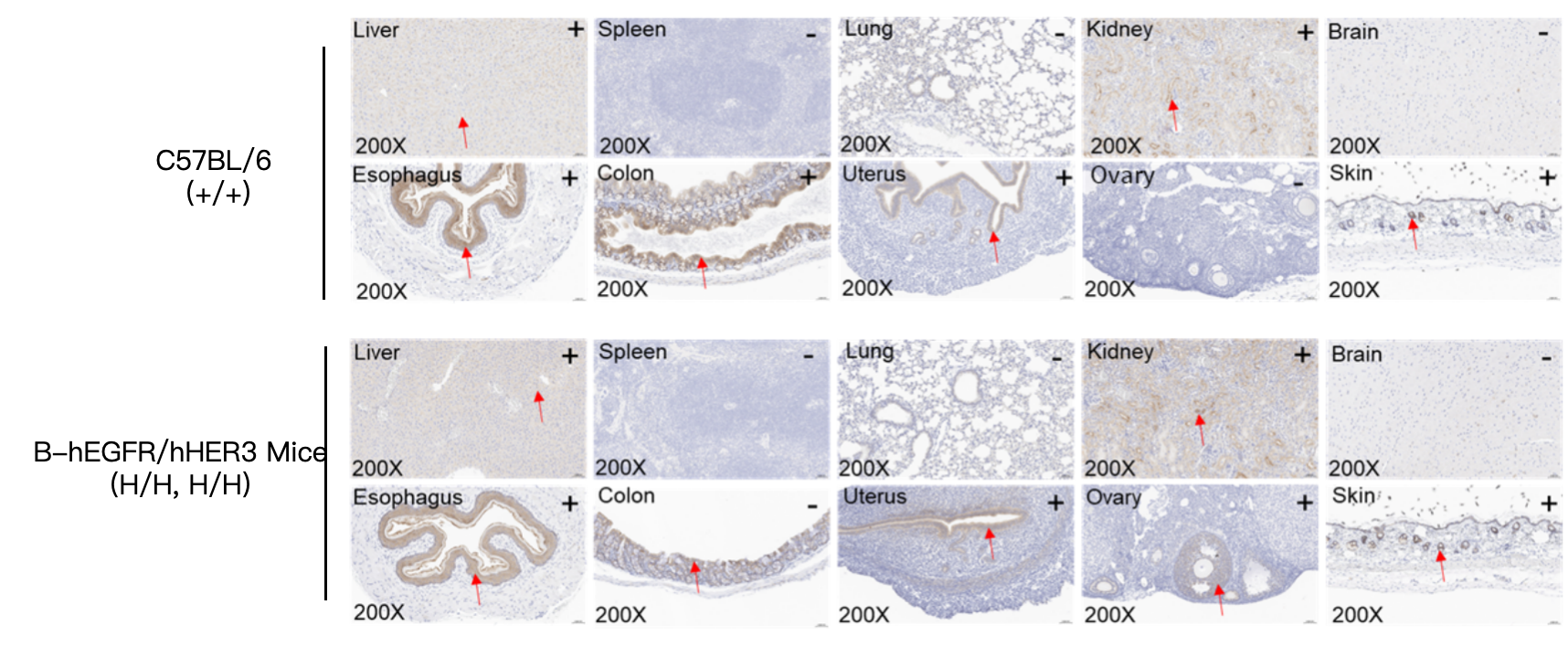
- HER3 expression was detected in the liver, kidney, skin, uterus, esophagus, colon and ovary of homozygous B-hEGFR/hHER3 mice.
- HER3 expression was detected in the liver, kidney, skin, uterus, esophagus and colon of C57BL/6 mice.
- The anti-HER3 antibody was cross-reactive between human and mouse.
Immunohistochemical analysis of organs in B-hEGFR/hHER3 mice. Major organs were collected from wild-type C57BL/6 mice and homozygous B-hEGFR/hHER3 mice (H/H, H/H), and analyzed by IHC using anti-HER3 antibody (CST, 12708). The arrow indicates tissue cells with positive HER3 staining (brown). "+" and "-" indicate positive and negative tissues, respectively.
* When publishing results obtained using this animal model, please acknowledge the source as follows: The animal model [B-hEGFR/hHER3 mice] (Cat# 113269) was purchased from Biocytogen.