Description
- Gene Information: CD146 (MCAM) is a cell adhesion molecule (CAM) that regulates cell–cell and cell–matrix interactions. It interacts with ECM ligands, including Laminin 411/421, Galectin-1/3, S100A8/A9, and matriptase, and also functions as a co-receptor for VEGFR2 and PDGFR-β.
- Protein Expression: CD146 expression is frequently elevated in highly proliferative cells, including developmental and cancer cells. Increased CD146 expression enhances ECM interactions and is associated with cancer cell proliferation, migration, invasion, and metastasis.
- Signaling Pathway: CD146 promotes pro-angiogenic and growth-related signaling through VEGFR2 and PDGFR-β and interacts with Wnt5a, Wnt1, Netrin-1, FGF4, and VEGF-C. These pathways promote cell growth, proliferation, survival, migration, and angiogenesis.
- Therapeutic Inhibition: Although specific CD146-targeted inhibitors are not described in the provided text, CD146 represents a potential therapeutic target due to its roles in tumor proliferation, invasion, angiogenesis, and metastasis.
Targeting strategy
MCAM
- Exons 2-14 of mouse Mcam gene that encode the extracellular domain and transmembrane domain are replaced by human MCAM counterparts in B-hMCAM mice.
- The genomic region of mouse Mcam gene that encodes cytoplasmic portion is retained. The promoter, 5’UTR and 3’UTR region of the mouse gene are also retained. The chimeric MCAM expression is driven by endogenous mouse Mcam promoter, while mouse Mcam gene transcription and translation will be disrupted.
MCAM mRNA expression analysis in Kidney
Strain specific analysis of MCAM gene expression in wild type mice and B-hMCAM mice by RT-PCR. Kidney RNA were isolated from wild-type C57BL/6 mice (+/+) and homozygous B-hMCAM mice (H/H), then cDNA libraries were synthesized by reverse transcription, followed by PCR with mouse or human MCAM primers.
MCAM Protein expression analysis
Strain specific MCAM expression analysis in homozygous B-hMCAM mice by western blotting. Kidney, small intestine and testis were collected from wild type C57BL/6 mice (+/+) and homozygous B-hMCAM mice (H/H), and analyzed by flow cytometry with anti-mouse MCAM antibody (R&D systems, AF6106-SP) and anti-human MCAM antibody (R&D systems, AF932-SP).
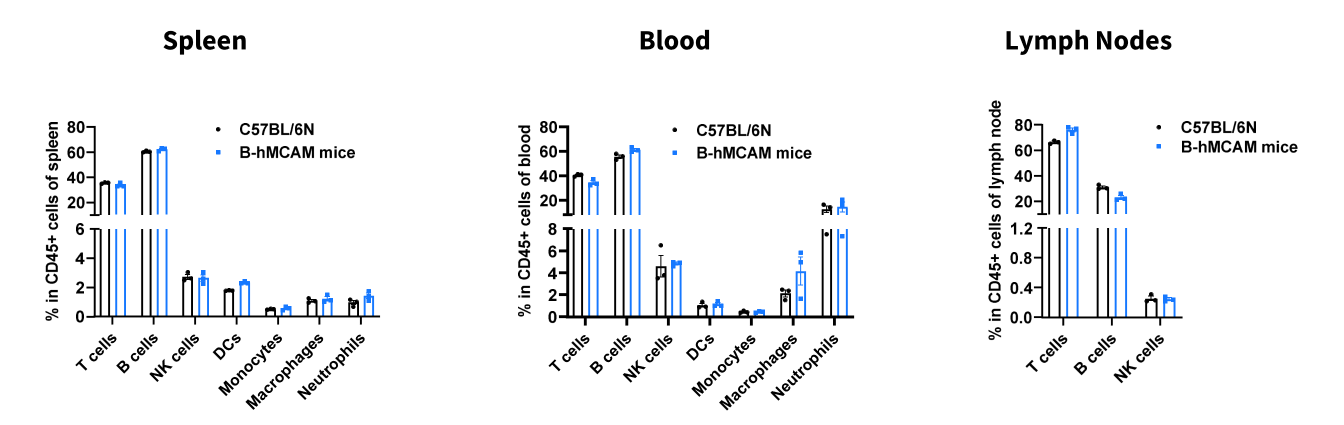
Analysis of Leukocyte Subpopulations
Analysis of leukocyte subpopulations by flow cytometry in immune organs and blood. Splenocytes, peripheral blood, and lymph nodes were isolated from female C57BL/6N and B-hMCAM mice (male, n=3, 8-week-old). Single live cells were gated on the CD45⁺ population and analyzed by flow cytometry as indicated. Values are expressed as mean ± SEM.
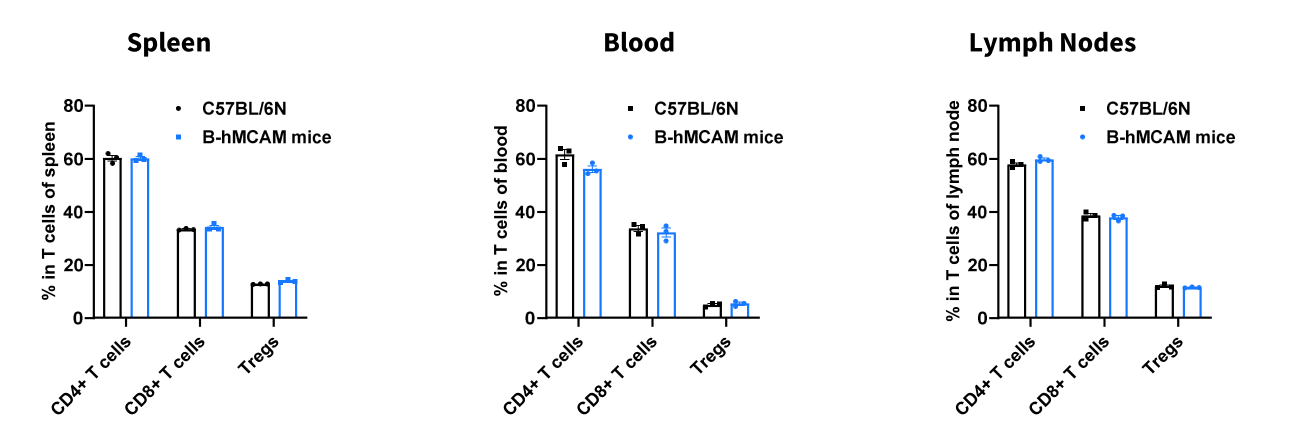
Analysis of T Cell Subpopulations
Analysis of T-cell subpopulations by flow cytometry in immune organs and blood. Splenocytes, peripheral blood, and lymph nodes were isolated from female C57BL/6N and B-hMCAM mice (male, n=3, 8-week-old). Single live cells were gated on the CD3⁺ T-cell population and analyzed by flow cytometry as indicated. Values are expressed as mean ± SEM.
* When publishing results obtained using this animal model, please acknowledge the source as follows: The animal model [B-hMCAM mice] (Cat# 111168) was purchased from Biocytogen.