Description
CD30L: A crucial co-stimulatory driver that amplifies T-cell activation
- Gene Information: TNF Superfamily Member 8 ( TNFSF8, also known as CD30L ) is a protein-coding gene located on chromosome 9q32-q33.1. This cytokine is a ligand for receptor TNFRSF8 (also known as CD30).
- Protein Expression: CD30L is rarely expressed under resting conditions and is predominantly localized on the surface of stimulated and activated immune cells. Activated T cells serve as the primary source of CD30L expression, though it is also expressed on activated B cells, monocytes, macrophages, and dendritic cells.
- Signaling Pathway: The binding of CD30 and CD30L forms a trimer, which can generate signal transduction for binding with TRAF members, induce the activation of NF-κB and MAPK pathways, and participate in the processes of tumor cell proliferation and apoptosis, as well as the activation and proliferation of T and B cells.
- Therapeutic Inhibition: Blocking the interaction between CD30 and CD30L can abrogate the co-stimulatory signals driving immune cell hyperactivation, thereby ameliorating autoimmune inflammatory responses.
Targeting Strategy
CD30L
- The exons 1 4 of mouse Cd30l gene that encode extracellular domain were replaced by human counterparts in B hCD30L mice(C).
- The genomic region of mouse Cd30l gene that encodes transmembrane domain and cytoplasmic portion was retained. The promoter and 5’UTR region of the mouse gene were also retained. The 3’UTR region of the mouse gene are replaced by human counterparts. The CD30L expression was driven by endogenous mouse Cd30l promoter, while mouse Cd30l gene transcription and translation will be disrupted.
CD30L Protein Expression Analysis in Spleen
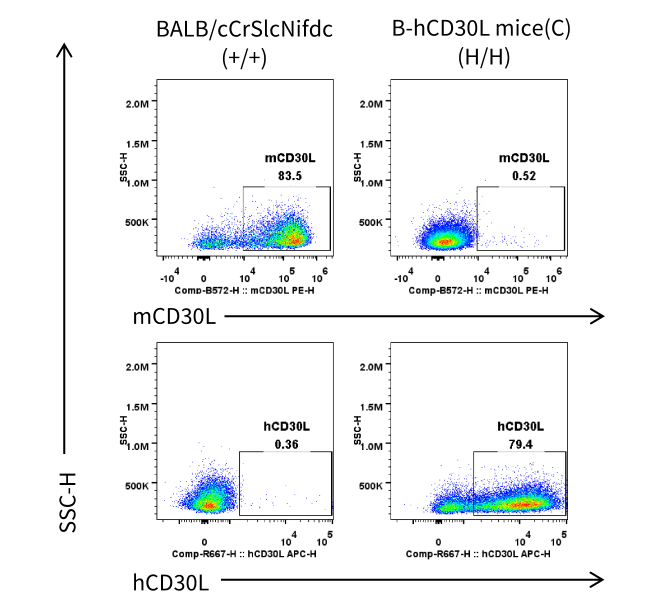
Strain specific CD30L expression analysis in wild-type BALB/cCrSlcNifdc mice and homozygous B-hCD30L mice(C) by flow cytometry. Splenocytes were collected from wild-type BALB/cCrSlcNifdc mice (+/+) and homozygous B-hCD30L mice(C) (H/H). Splenocytes are incubated in a medium containing Cell Activation Cocktail (without BrefeldinA) (Biolegend, 423303) before analysis of CD30L surface expression on gated T cells. Protein expression was analyzed with anti-mouse CD30L antibody (Biolegend, 106405) and anti-human CD30L antibody (RD, FAB1028A) by flow cytometry.
* When publishing results obtained using this animal model, please acknowledge the source as follows: The animal model [B-hCD30L mice(C)] (Cat# 114289) was purchased from Biocytogen.