
B-hCD3EDG/HLA-A11.1 plus mice

C57BL/6-Cd3etm1(CD3E)Bcgen Cd3dtm1(CD3D)Bcgen Cd3gtm1(CD3G)Bcgen B2mtm1(B2M/HLA-A11.1/H2-D)Bcgen Fcgrttm1(B2m/Fcgrt)Bcgen/Bcgen • 114543

B-hCD3EDG/HLA-A11.1 plus mice

Product nameB-hCD3EDG/HLA-A11.1 plus mice
Catalog number114543
Strain nameC57BL/6-Cd3etm1(CD3E)Bcgen Cd3dtm1(CD3D)Bcgen Cd3gtm1(CD3G)Bcgen B2mtm1(B2M/HLA-A11.1/H2-D)Bcgen Fcgrttm1(B2m/Fcgrt)Bcgen/Bcgen
Strain backgroundC57BL/6
AliasesCD3epsilon, IMD18, T3E, TCRE; CD3-DELTAELTA, IMD19, T3D, CD3D; CD3-GAMMAAMMA, IMD17, T3G, CD3G;IMD43; HLAA

在此页面上

  • Description
  • Targeting strategy
  • Phenotypic analysis

海报

查看全部

    发表文章

      Description

      CD3EDG: Signaling in T Cells for Mechanism and Therapeutic Potential

      • Gene Information: The CD3E, CD3D, and CD3G genes, located in a cluster on chromosome 11q23, encode the three invariant polypeptide chains that assemble into the CD3εδ and CD3εγ heterodimers of the T-cell receptor (TCR) complex.
      • Protein Expression: These proteins are exclusively and constitutively expressed on the surface of mature T lymphocytes and thymocytes, serving as definitive lineage markers for the T-cell population.
      • Signaling Pathway: Upon TCR engagement by an antigen-MHC complex, the CD3 chains transduce activation signals through their cytoplasmic Immunoreceptor Tyrosine-based Activation Motifs (ITAMs), which recruit ZAP-70 to trigger downstream MAPK, NF-κB, and calcium signaling pathways.
      • Therapeutic Inhibition: Therapeutic strategies utilize monoclonal antibodies or bispecific T-cell engagers (TCEs) to either modulate TCR signaling for immunosuppression in transplantation or to bypass MHC restriction by directly linking T cells to tumor cells for targeted cytotoxicity.
      Targeting strategy

      CD3EDG

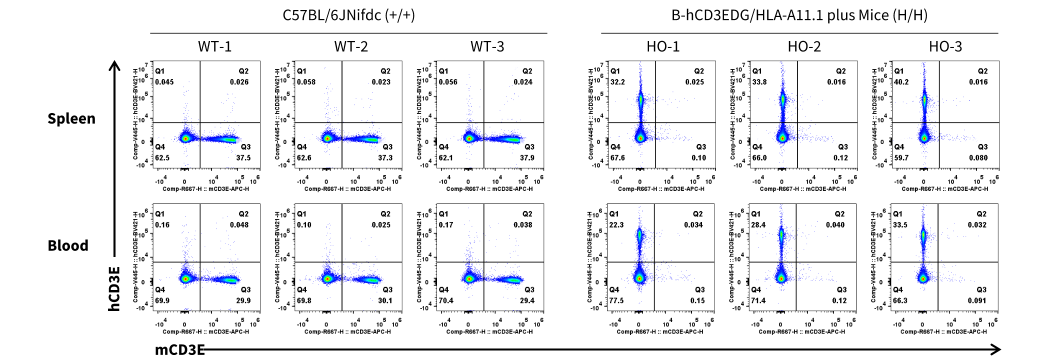
      • The chimeric human CD3EDG was expressed, while mouse Cd3edg were knocked out in B-hCD3EDG/HLA-A11.1 plus mice.

      HLA-A11.1

      • The B2M gene (Exon1 to Exon3) of mouse were replaced by the sequence encompassing the human B2M CDS and HLA-A*1101 gene that included leader sequence, α1 and α2 domains ligated to a fragment of the murine H-2Db gene containing the α3, transmembrane and cytoplasmic domains in B-hCD3EDG/HLA-A11.1 plus mice. The mouse B2M gene is knocked into exon 2 of the mouse Fcgrt gene and is fused via a linker to the remaining portion of exon 2, a strategy that enables the co-expression of mouse B2M and Fcgrt in B-hCD3EDG/HLA-A11.1 plus mice.
      B2M Protein Expression Analysis
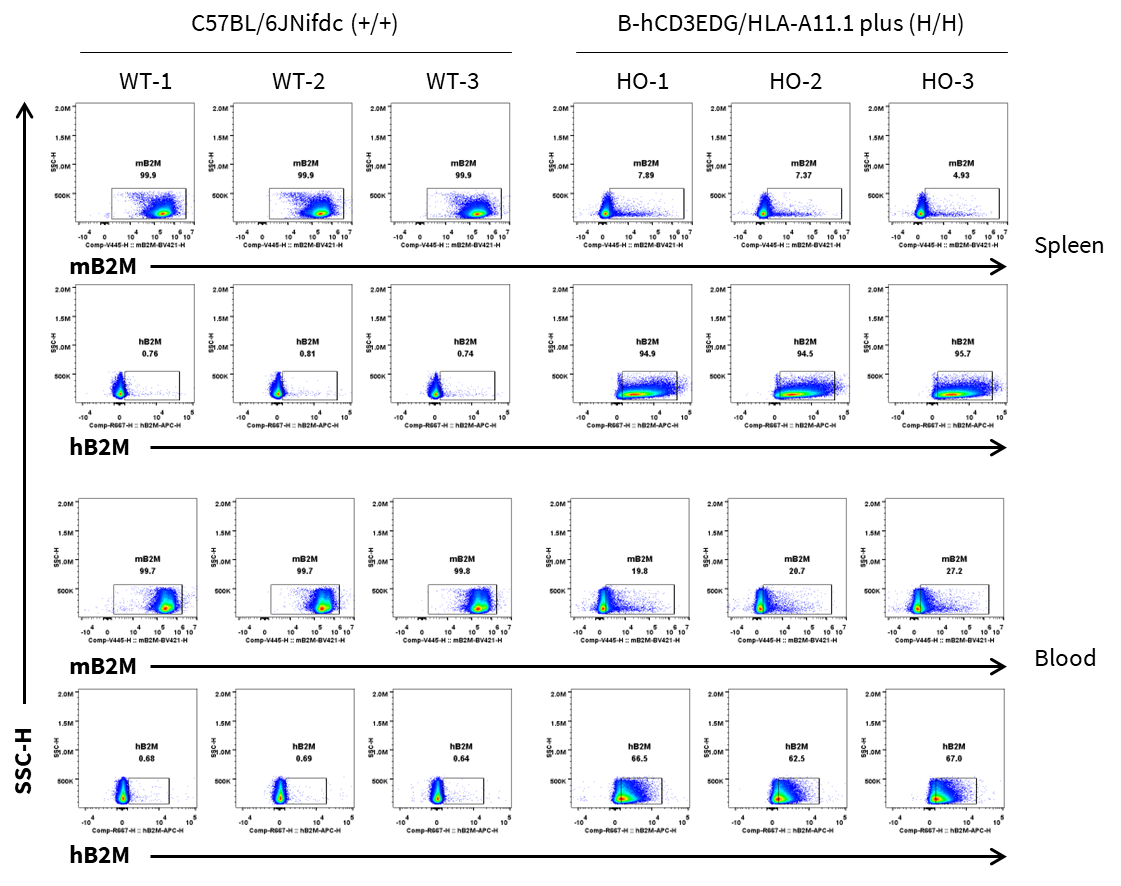
      • Mouse  B2M was detected in wild-type (WT) C57BL/6JNifdc mice and B-hCD3EDG/HLA-A11.1 plus mice because the mouse B2M gene is knocked into exon 2 of the mouse Fcgrt gene and is fused via a linker to the remaining portion of exon 2, a strategy that enables the co-expression of mouse B2M and Fcgrt in B-hCD3EDG/HLA-A11.1 plus mice.
      • Human B2M was exclusively detected in homozygous (HO) B-hCD3EDG/HLA-A11.1 plus mice.

      Mouse and human B2M expression analysis in splenocytes and blood. Splenocytes and blood were collected from wild-type (WT) C57BL/6JNifdc mice, homozygous (HO) B-hCD3EDG/HLA-A11.1 plus mice. B2M expression was analyzed by flow cytometry using species-specific anti-mouse B2M antibody (BD Biosciences, 744802) and anti-human TNFR2 antibody (Biolegend, 395712).

      HLA-A Protein Expression Analysis
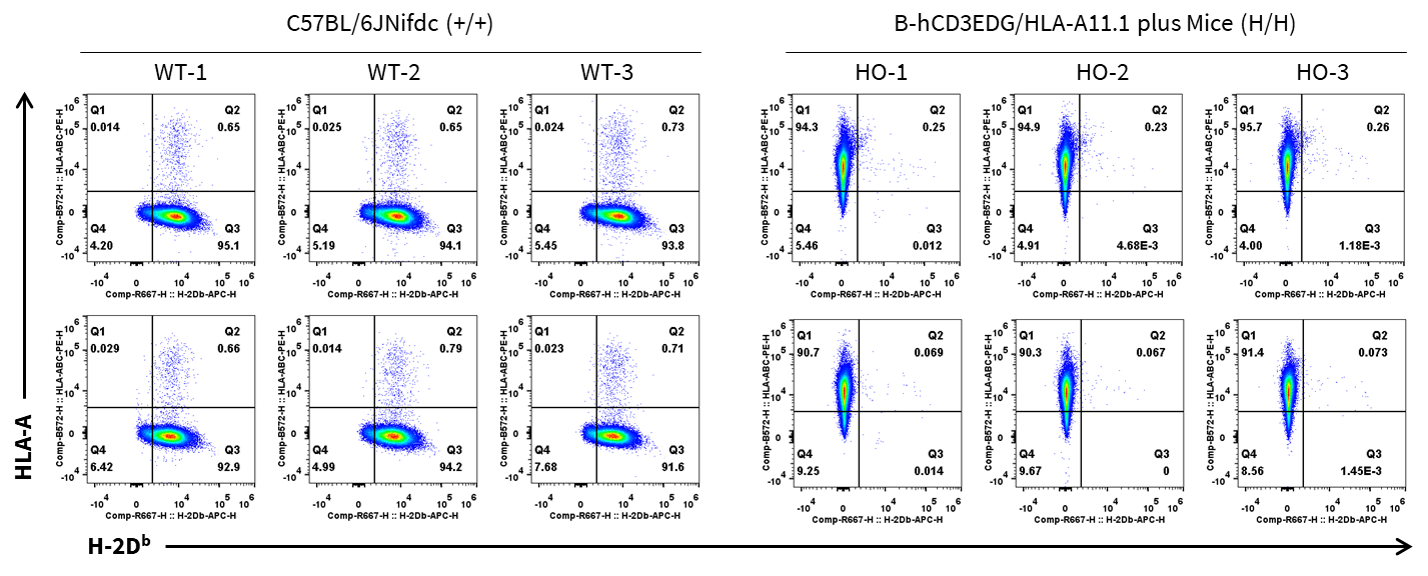
      • Mouse H-2Db was detected in wild-type (WT) C57BL/6JNifdc mice, but not in B-hCD3EDG/HLA-A11.1 plus mice.
      • Human HLA-A was exclusively detected in homozygous (HO) B-hCD3EDG/HLA-A11.1 plus Mice.

      Mouse and human HLA-A expression analysis in splenocytes. Splenocytes and blood were collected from wild-type (WT) C57BL/6JNifdc mice, homozygous (HO) B-hCD3EDG/HLA-A11.1 plus Mice. HLA-A expression was analyzed by flow cytometry using species-specific anti-H-2Db antibody (Biolegend, 111513) and anti-HLA antibody (Biolegend, 311406).

      Analysis of Leukocyte Subpopulations
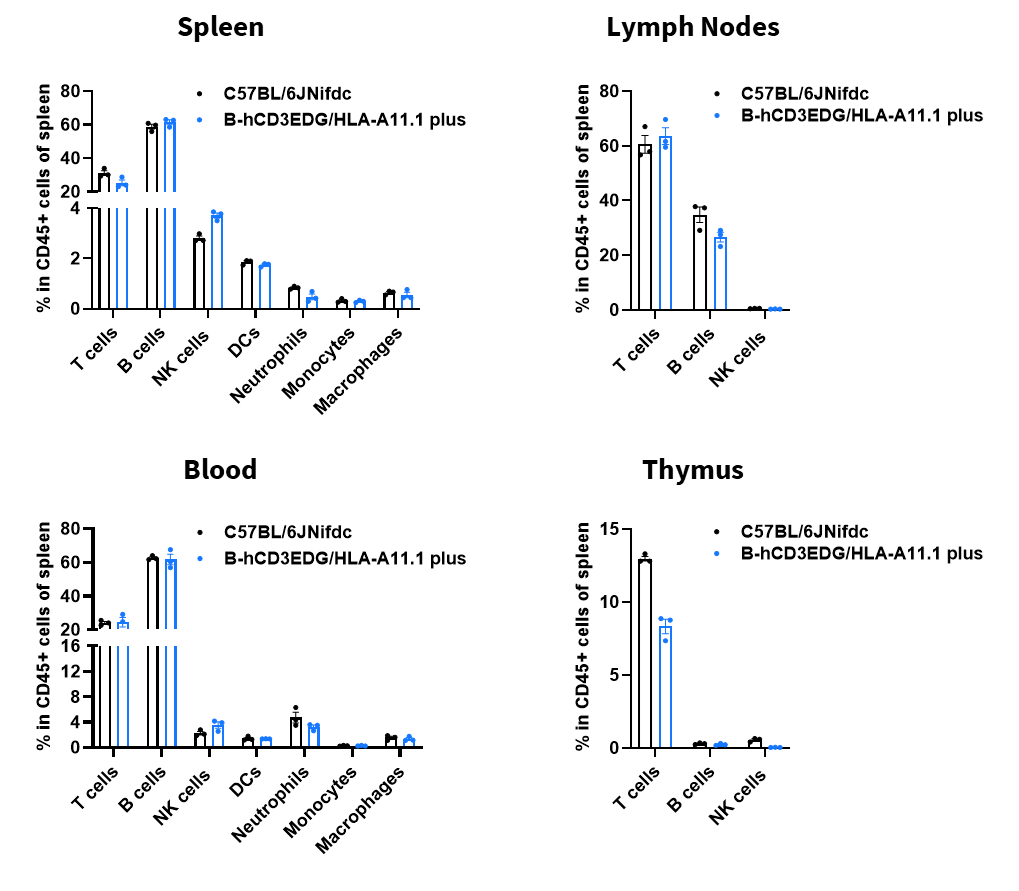
      • The percentages of T cells, B cells, NK cells, DCs, neutrophils, monocytes, and macrophages in homozygous B-hCD3EDG/HLA-A11.1 plus mice were similar to those in C57BL/6JNifdc mice.
      • Humanization of CD3EDG, and HLA-A does not affect normal immune cell development or splenic distribution.

      Analysis of leukocyte subpopulations by flow cytometry in immune organs and blood. Splenocytes, peripheral blood, lymph nodes, and thymus were isolated from C57BL/6JNifdc mice and B-hCD3EDG/HLA-A11.1 plus mice female, 9-week-old, n = 3). Single live cells were gated on the CD45⁺ population and analyzed by flow cytometry as indicated. Values are expressed as mean ± SEM.

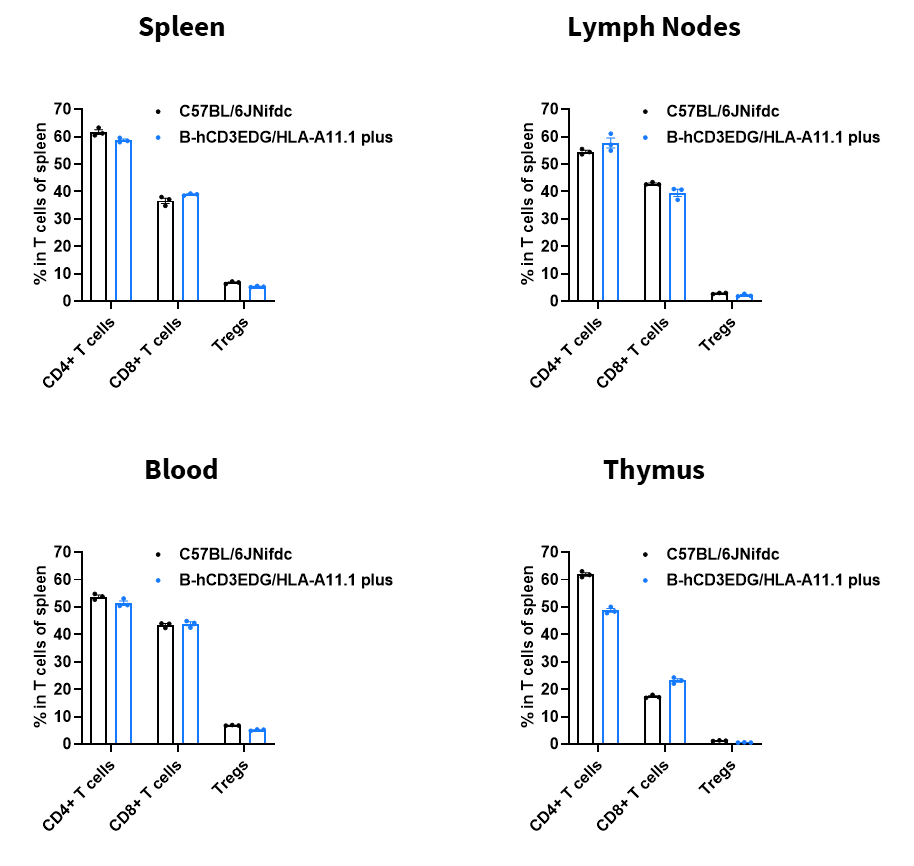
      Analysis of T Cell Subpopulations
      • The proportions of CD4⁺ T cells, CD8⁺ T cells, and Tregs in homozygous B-hCD3EDG/HLA-A11.1 plus mice were comparable to those in C57BL/6JNifdc  mice.
      • Humanization of CD3EDG, and HLA-A does not affect normal T cell development, differentiation, or splenic distribution.

      Analysis of T-cell subpopulations by flow cytometry in immune organs and blood. Splenocytes, peripheral blood, lymph nodes, and thymus were isolated from C57BL/6JNifdc mice and B-hCD3EDG/HLA-A11.1 plus mice (female, 9-week-old, n = 3). Single live cells were gated on the CD3⁺ T-cell population and analyzed by flow cytometry as indicated. Values are expressed as mean ± SEM.

      * When publishing results obtained using this animal model, please acknowledge the source as follows: The animal model [B-hCD3EDG/HLA-A11.1 plus mice] (Cat# 114543) was purchased from Biocytogen.