Description
CXCL9/CXCL10/CXCL11:
- Gene Information: CXCL9, CXCL10 & CXCL11 are both chemokines, located on chromosome 4,
- Protein Expression: CXCL9 is primarily secreted by antigen-presenting cells like macrophages. CXCL10 is widely produced by both immune and structural cells, including endothelial cells. CXCL11 is mainly secreted by endothelial cells and macrophages, typically requiring synergistic stimulation from IFN-γ and other pro-inflammatory cytokines.
- Signaling Pathway: CXCL9, CXCL10, and CXCL11 bind the GPCR CXCR3, triggering Gαi (lowering cAMP), PLC/calcium, PI3K/Akt, and MAPK/ERK pathways. These signaling cascades collectively drive immune cell chemotaxis, activation, and survival.
- Therapeutic Inhibition: Drug development targets this axis via two opposite strategies: blocking CXCR3 signaling (using antagonists or antibodies) to halt harmful T-cell infiltration in autoimmune diseases, and inducing CXCL9/10/11 expression (e.g., via STING agonists) to recruit CD8+ T cells and turn "cold" tumors "hot" for cancer immunotherapy.
Targeting strategy
CXCL9
- Exons 1–4 of the mouse Cxcl9 gene, which encode the entire protein (from ATG to stop codon), are replaced with the corresponding human sequences.
- The endogenous mouse promoter, 5′ UTR, and 3′ UTR regions are retained, allowing human CXCL9 expression to be driven by the native mouse Cxcl9 promoter, while endogenous mouse Cxcl9 transcription and translation are abolished.
CXCL10
- Exons 1–4 of the mouse Cxcl10 gene, which encode the entire protein (from ATG to stop codon), are replaced with the corresponding human sequences.
- The endogenous mouse promoter, 5′ UTR, and 3′ UTR regions are retained, allowing human CXCL10 expression to be driven by the native mouse Cxcl10 promoter, while endogenous mouse Cxcl10 transcription and translation are abolished.
CXCL11
- Exons 1–4 of the mouse Cxcl11 gene, which encode the entire protein (from ATG to 3′ UTR ), are replaced with the corresponding human sequences.
- The endogenous mouse promoter, 5′ UTR, are retained, allowing human CXCL11 expression to be driven by the native mouse Cxcl11 promoter, while endogenous mouse Cxcl11 transcription and translation are abolished.
Protein Expression Analysis
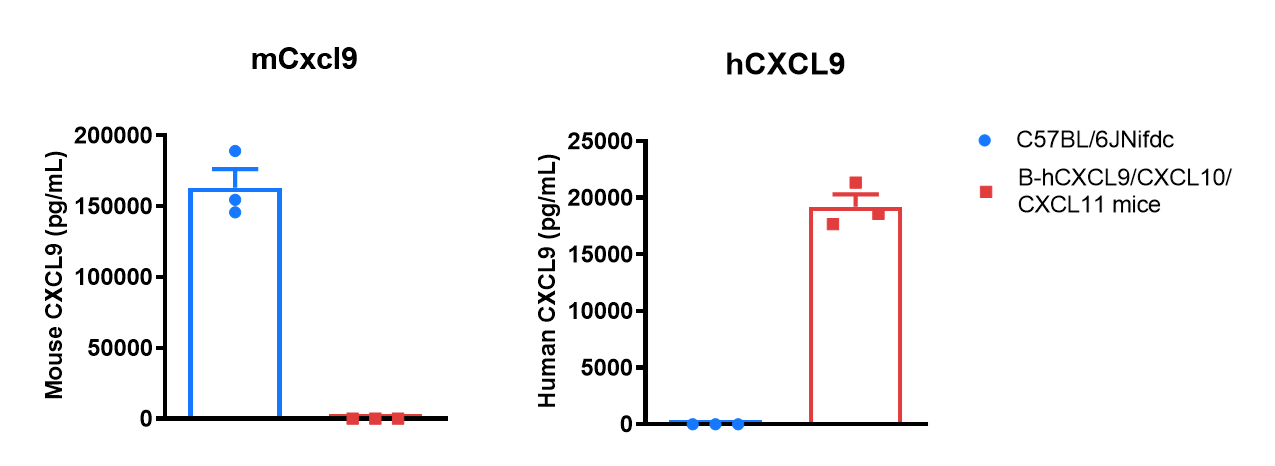
- Mouse Cxcl9 was detected exclusively in wild-type C57BL/6JNifdc mice.
- Human CXCL9 was detected in homozygous B-hCXCL9/hCXCL10/hCXCL11 mice, but not in wild-type mice.
Strain specific CXCL9 expression analysis in wild-type C57BL/6JNifdc mice and homozygous B-hCXCL9/CXCL10/CXCL11 mice by ELISA. Serum was collected from wild-type C57BL/6JNifdc mice (+/+) (female, n=3, 6-week-old) and homozygous B-hCXCL9/CXCL10/CXCL11 mice (H/H; H/H; H/H) (female, n=3, 6-week-old) stimulated with IFN-γ (8μg/mice, i.p.) for 4hrs. Expression level of mouse and human CXCL9 were analyzed by ELISA (anti-mouse CXCL9 ELISA kit: abcam, ab203364; anti-human CXCL9 ELISA kit: abcam, ab219047). Values are expressed as mean ± SEM.
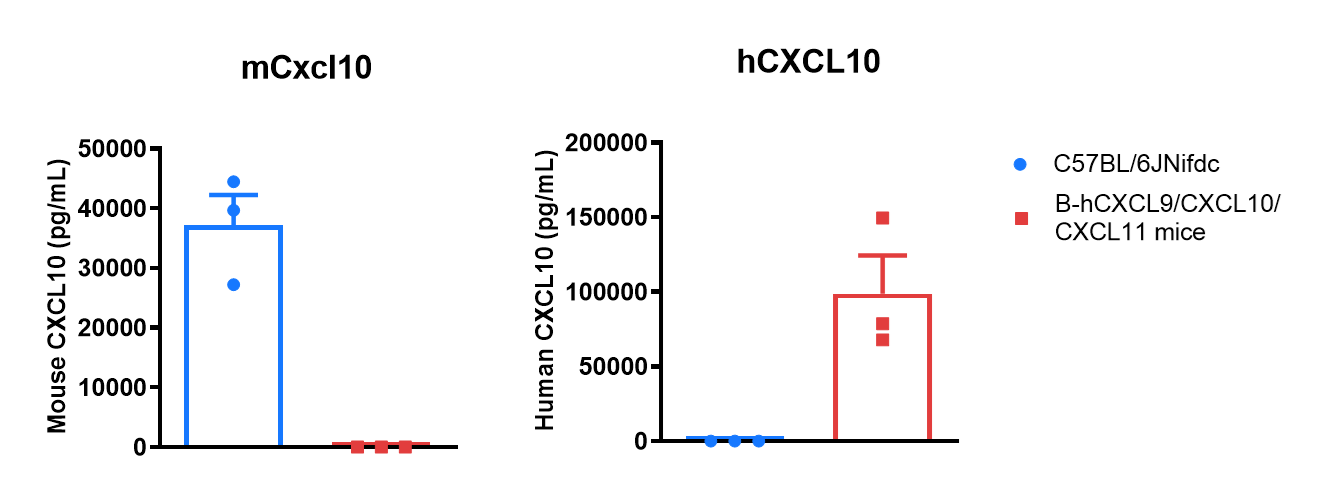
- Mouse Cxcl10 was detected exclusively in wild-type C57BL/6JNifdc mice.
- Human CXCL10 was detected in homozygous B-hCXCL9/hCXCL10/hCXCL11 mice, but not in wild-type mice.
Strain specific CXCL10 expression analysis in wild-type C57BL/6JNifdc mice and homozygous B-hCXCL9/CXCL10/CXCL11 mice by ELISA. Serum was collected from wild-type C57BL/6JNifdc mice (+/+) (female, n=3, 6-week-old) and homozygous B-hCXCL9/CXCL10/CXCL11 mice (H/H; H/H; H/H) (female, n=3, 6-week-old) stimulated with IFN-γ (8μg/mice, i.p.) for 4hrs. Expression level of mouse and human CXCL10 were analyzed by ELISA (anti-mouse CXCL10 ELISA kit: Abcam, ab260067; anti-human CXCL10 ELISA kit: Abcam, ab83700). Values are expressed as mean ± SEM.
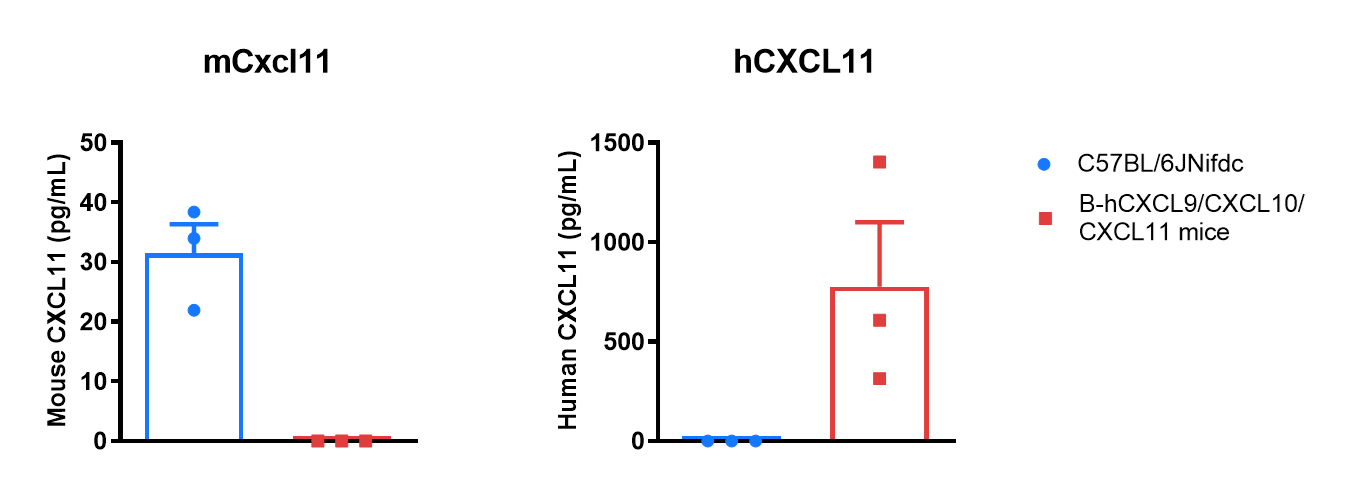
- Mouse Cxcl11 was detected exclusively in wild-type C57BL/6JNifdc mice.
- Human CXCL11 was detected in homozygous B-hCXCL9/hCXCL10/hCXCL11 mice, but not in wild-type mice.
Strain specific CXCL11 expression analysis in wild-type C57BL/6JNifdc mice and homozygous B-hCXCL9/CXCL10/CXCL11 mice by ELISA. Serum was collected from wild-type C57BL/6JNifdc mice (+/+) (female, n=3, 6-week-old) and homozygous B-hCXCL9/CXCL10/CXCL11 mice (H/H; H/H; H/H) (female, n=3, 6-week-old) stimulated with IFN-γ (8μg/mice, i.p.) for 4hrs. Expression level of mouse and human CXCL11 were analyzed by ELISA (anti-mouse CXCL11 ELISA Kit: Abcam, ab204519; anti-human CXCL11 ELISA kit: Abcam, ab289695). Values are expressed as mean ± SEM.
* When publishing results obtained using this animal model, please acknowledge the source as follows: The animal model [B-hCXCL9/hCXCL10/hCXCL11 mice] (Cat# 113851) was purchased from Biocytogen.