Description
SLC6A19: Biological Roles and Therapeutics Strategies
- Gene Information: Solute carrier family 6 member 19 (SLC6A19) is a membrane amino acid transporter encoded by the SLC6A19 gene. It belongs to the SLC6 neurotransmitter/amino acid transporter superfamily, mediating the uptake of neutral amino acids across epithelial apical membranes.
- Protein Expression: SLC6A19 exhibits tissue-restricted expression, predominantly localized to the apical membrane of villus enterocytes in the small intestine and proximal tubular epithelial cells in kidney.
- Signaling Pathway: In small intestine, SLC6A19 mediates dietary neutral amino acid absorption from gut lumen into bloodstream, and in kidney, SLC6A19 is responsible for reabsorption of filtered amino acids from primary urine back into renal fluid to avoid excessive amino acid wasting via urine.
- Therapeutic Inhibition: SLC6A19 is a validated drug target, mainly developed for phenylketonuria (PKU) and chronic kidney disease (CKD). In PKU field, inhibition of SLC6A19 in intestine could reduce Phe input into circulation and boosts urinary Phe excretion. For CKD, suppressing SLC6A19 alleviates tubular amino acid overload to slow progressive renal function decline.
Targeting strategy
SLC6A19
- The exons 1 8 of the mouse Slc6a19, including promoter and 5’UTR were replaced by the exons 1 12 of the human counterparts, including human promoter,5’UTR and 3’UTR in B hSLC6A19 mice.
- The human SLC6A19 expression is driven by human SLC6A19 promoter, while mouse Slc6a19 gene transcription and translation will be disrupted.
mRNA Expression by RT-PCR
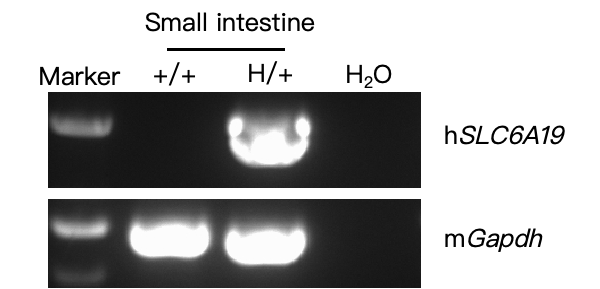
- Human SLC6A19 mRNA was exclusively detectable in heterozygous B-hSLC6A19 mice, but not in wild-type mice.
Strain specific analysis of SLC6A19 mRNA expression in wild-type C57BL/6JNifdc and heterozygous B-hSLC6A19 mice by RT-PCR. Small intestine RNA were isolated from wild-type C57BL/6JNifdc (+/+) and heterozygous B-hSLC6A19 mice (H/+), then cDNA libraries were synthesized by reverse transcription, followed by PCR with human SLC6A19 primers. Human SLC6A19 mRNA was exclusively detectable in heterozygous B-hSLC6A19 mice, but not in wild-type mice. And the human sequences were confirmed via Sanger sequencing.
mRNA Expression by RT-qPCR
- The expression level of human SLC6A19 in heterozygous B-hSLC6A19 mice was comparable with that in wild-type mice.
SLC6A19 mRNA expression in wild-type C57BL/6JNifdc and heterozygous B-hSLC6A19 mice by RT-PCR. Small intestine, kidney and liver RNA were isolated from wild-type C57BL/6JNifdc (+/+) and heterozygous B-hSLC6A19 mice (H/+) (male, n=3, 6-week-old), then cDNA libraries were synthesized by reverse transcription, followed by RT-qPCR with mouse or human SLC6A19 primers. Values are expressed as mean ± SEM.
* When publishing results obtained using this animal model, please acknowledge the source as follows: The animal model [B-hSLC6A19 mice] (Cat# 114327) was purchased from Biocytogen.