

B-hTNFA/hOX40/hOX40L mice

C57BL/6-Tnftm1(TNF)Bcgen Tnfrsf4tm1(TNFRSF4)Bcgen Tnfsf4tm1(TNFSF4)Bcgen/Bcgen • 113897


B-hTNFA/hOX40/hOX40L mice

Product nameB-hTNFA/hOX40/hOX40L mice
Catalog number113897
Strain nameC57BL/6-Tnftm1(TNF)Bcgen Tnfrsf4tm1(TNFRSF4)Bcgen Tnfsf4tm1(TNFSF4)Bcgen/Bcgen
Strain backgroundC57BL/6
NCBI gene ID7124,7293,7292 (Human)
AliasesDIF; TNFA; IMD127; TNFSF2; TNLG1F; TNF-alpha; OX40; ACT35; CD134; IMD16; TXGP1L; GP34; CD252; OX4OL; TXGP1; CD134L; OX-40L; TNLG2B

在此页面上

  • Description
  • Targeting strategy
  • Phenotypic analysis

海报

查看全部

    发表文章

      Description
      • TNF-a is secreted by macrophages, monocytes, neutrophils, T-cells (principally CD4+), and NK-cells, and its binding to surface receptors elicits a wide array of biologic activities including: increased fibroblast proliferation, and enhanced chemotaxis and phagocytosis in neutrophils.
      • CD134, also known as OX40 and TNFRSF4, is a 50 kD type I transmembrane protein, which is a member of the TNF receptor family.
      • OX40 is expressed on activated T lymphocytes including Th1, Th2, Th17, and Treg cells and the interaction of OX40 with OX40L results in B cell proliferation and antibody secretion, regulation of primary T cell expansion, and T cell survival.
      • CD252 is a 35 kD member of the TNF superfamily and is also known as OX40 ligand, OX40L, and CD134L. The OX40L is expressed on activated B cells and antigen presenting cells.
      • The targeted mouse Tnfa whole genomic sequences including 5'UTR, 3'UTR and coding region were replaced by human TNFA whole genomic sequences in B-hTNFA/hOX40/hOX40L mice.
      • The exons 1-5 of mouse OX40 gene that  encode the extracellular domain were replaced by human OX40 exons 1-5 in B-hTNFA/hOX40/hOX40L mice.
      • The exons 2-3 of mouse Ox40l gene that  encode the extracellular region were replaced by human OX40L exons 2-3 in B-hTNFA/hOX40/hOX40L mice.
      • Human TNFA was exclusively detectable in serum of the homozygous B-hTNFA/hOX40/hOX40L mice but not in wild-type mice.
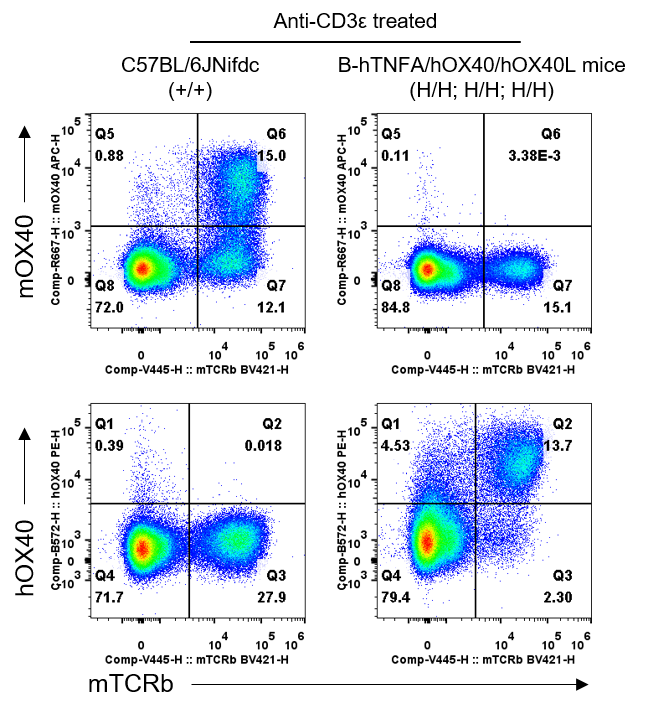
      • Human OX40 was exclusively detectable in T cells of the homozygous B-hTNFA/hOX40/hOX40L mice but not in wild-type mice.
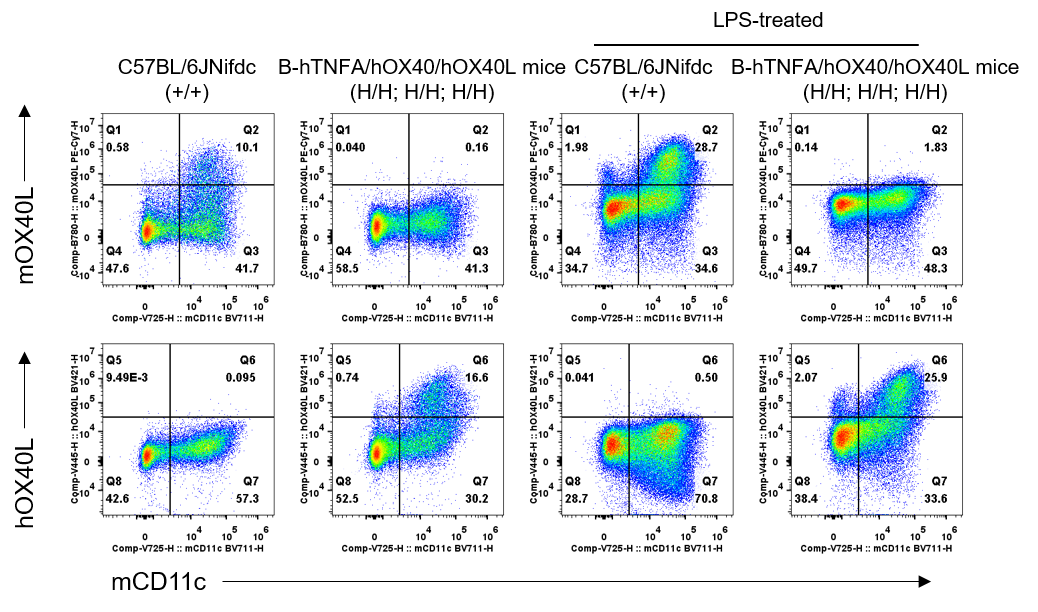
      • Human OX40L was exclusively detectable in DCs of the homozygous B-hTNFA/hOX40/hOX40L mice but  not in wild-type mice.
      • Application: This product is used for pharmacodynamics and safety evaluation of  drugs.
      Targeting strategy

      Gene targeting strategy for B-hTNFA/hOX40/hOX40L mice.

      The targeted mouse Tnfa whole genomic sequences including 5'UTR, 3'UTR and coding region were replaced by human TNFA whole genomic sequences in B-hTNFA/hOX40/hOX40L mice.

      The exons 1-5 of mouse OX40 gene that  encode the extracellular domain were replaced by human OX40 exons 1-5 in B-hTNFA/hOX40/hOX40L mice.

      The exons 2-3 of mouse Ox40l gene that  encode the extracellular region were replaced by human OX40L exons 2-3 in B-hTNFA/hOX40/hOX40L mice.

      B-hTNFA/hOX40/hOX40L mice were obtained by breeding B-hTNFA mice(110002) with B-hOX40/hOX40L mice(120543).


      Protein expression analysis in serum

      Strain specific TNFA expression analysis in wild-type C57BL/6JNifdc mice and homozygous B-hTNFA/hOX40/hOX40L mice by ELISA. Serum was collected from wild-type C57BL/6JNifdc mice (+/+) (female, n=3, 6-week-old) and homozygous B-hTNFA/hOX40/hOX40L mice (H/H; H/H; H/H) (female, n=3, 6-week-old) stimulated with LPS (Sigma-Aldrich, L4391) in vivo for 1 hrs. Expression level of TNFA was analyzed by ELISA (Mouse TNFa ELISA Kit: Biolegend, 430907; Human TNFa ELISA Kit: Biolegend, 430207). Mouse TNFA was only detectable in wild-type C57BL/6JNifdc mice. Human TNFA was exclusively detectable in homozygous B-hTNFA/hOX40/hOX40L mice. Values are expressed as mean ± SEM. ND: not detectable.
      Protein expression analysis-Spleen

      Strain specific OX40 expression analysis in homozygous B-hTNFA/hOX40/hOX40L mice by flow cytometry. Splenocytes were collected from wild-type C57BL/6JNifdc (+/+) and homozygous B-hTNFA/hOX40/hOX40L mice (H/H; H/H; H/H) stimulated with anti-mCD3ε (BioXcell, BE0001) in vivo for 24 hrs, and protein expression was analyzed with anti-mouse OX40 antibody (Biolegend, 119414)  and anti-human OX40 antibody (Biolegend, 350004) by flow cytometry. mOX40 was only detectable in T cells of wild-type C57BL/6JNifdc mice. hOX40 was only detectable in T cells of homozygous B-hTNFA/hOX40/hOX40L mice, but not in wild-type C57BL/6JNifdc mice.
      Protein expression analysis-BMDCs

      Strain specific OX40L expression analysis in homozygous B-hTNFA/hOX40/hOX40L mice by flow cytometry. Bone marrow cells were collected from wild-type C57BL/6JNifdc (+/+) and homozygous B-hTNFA/hOX40/hOX40L mice (H/H; H/H; H/H). BMDCs were induced from bone marrow cells and stimulated with LPS (Sigma Aldrich, L4391) for 24 hrs. Then BMDCs were analyzed with anti-mouse OX40L antibody (Biolegend, 108814)  and anti-human OX40L antibody (BD Horizon™, 563766) by flow cytometry. mOX40L was only detectable in BMDCs of wild-type C57BL/6JNifdc mice. hOX40L was only detectable in BMDCs of homozygous B-hTNFA/hOX40/hOX40L mice, but not in wild-type mice.

      * When publishing results obtained using this animal model, please acknowledge the source as follows: The animal model [B-hTNFA/hOX40/hOX40L mice] (Cat# 113897) was purchased from Biocytogen.