Description
CD8: A pivotal co-receptor target for engaging and activating cytotoxic T cells.
- Gene Information: CD8 is a transmembrane glycoprotein composed of alpha and beta chains. It functions as a critical co-receptor for the T cell receptor, essential for MHC class I-restricted antigen recognition and activation.
- Protein Expression: CD8 is predominantly and stably expressed on the surface of cytotoxic T lymphocytes. This highly specific expression makes it an ideal cellular marker and therapeutic anchor for directing immune responses.
- Signaling Pathway: Upon interacting with MHC class I molecules, CD8 recruits the tyrosine kinase Lck to the TCR complex. This initiates essential downstream phosphorylation cascades, ultimately driving robust T cell activation, clonal expansion, cytokine production, and potent anti-tumor cytotoxicity.
- Therapeutic Targeting: CD8 is widely used in T-cell engagers to redirect cytotoxicity. Crucially, it has emerged as a premier target for cutting-edge in vivo CAR-T therapies, where CD8-targeted vectors (like LNPs or viral vectors) are utilized for direct in vivo delivery of CAR genes to specifically engineer patient T cells internally.
Targeting the TRBC1/TRBC2: Biological Roles and Therapeutic Strategies
- Gene Information: TRBC1 and TRBC2 encode the constant regions of the T-cell receptor (TCR) alpha and beta chains, where mutually exclusive TRBC1 or TRBC2 selection establishes a distinct genetic marker for clonal T-cell populations.
- Protein Expression: These proteins form the structural backbone of the surface αβTCR-CD3 complex, which is universally present on healthy T cells but exhibits strict monotypic restriction (either TRBC1 or TRBC2) on malignant T-cell clones.
- Signaling Pathway: Antigen engagement shifts the TCR constant domain to trigger downstream CD3 phosphorylation cascades, activating essential transcription factors for T-cell proliferation and survival.
- Therapeutic Inhibition: Targeting the specific TRBC subunit expressed by the lymphoma allows CAR-T cells or antibodies to selectively eradicate the malignancy while preserving the reciprocal, healthy T-cell compartment to maintain immunity.
Targeting strategy
TRBC1/TRBC2
- The exons 1-2, partial exon 3 and introns 1-2 of mouse Trbc1 and Trbc2 were replaced by human exons 1-2, partial exon 3 and introns 1-2 of human TRBC1 and TRBC2 in B-hTRBC1/hTRBC2/hCD8 mice.
CD8
- The exons 1-3 and partial exon 4 of mouse Cd8a gene that encode signal peptide and extracellular domain are replaced by human counterparts in B-hTRBC1/hTRBC2/hCD8 mice. The genomic region of mouse Cd8a gene that encodes transmembrane domain and cytoplasmic portion is retained. The promoter, 5′ UTR and 3′ UTR region of the mouse gene are also retained. The chimeric CD8A expression is driven by endogenous mouse Cd8a promoter, while mouse Cd8a gene transcription and translation will be disrupted.
- The exons 1-3 and partial exon 4 of mouse Cd8b1 gene that encode signal peptide and extracellular domain are replaced by human counterparts in B-hTRBC1/hTRBC2/hCD8 mice. The genomic region of mouse Cd8b1 gene that encodes transmembrane domain and cytoplasmic portion is retained. The promoter, 5′ UTR and 3′ UTR region of the mouse gene are also retained. The chimeric CD8B1 expression is driven by endogenous mouse Cd8b1 promoter, while mouse Cd8b1 gene transcription and translation will be disrupted.
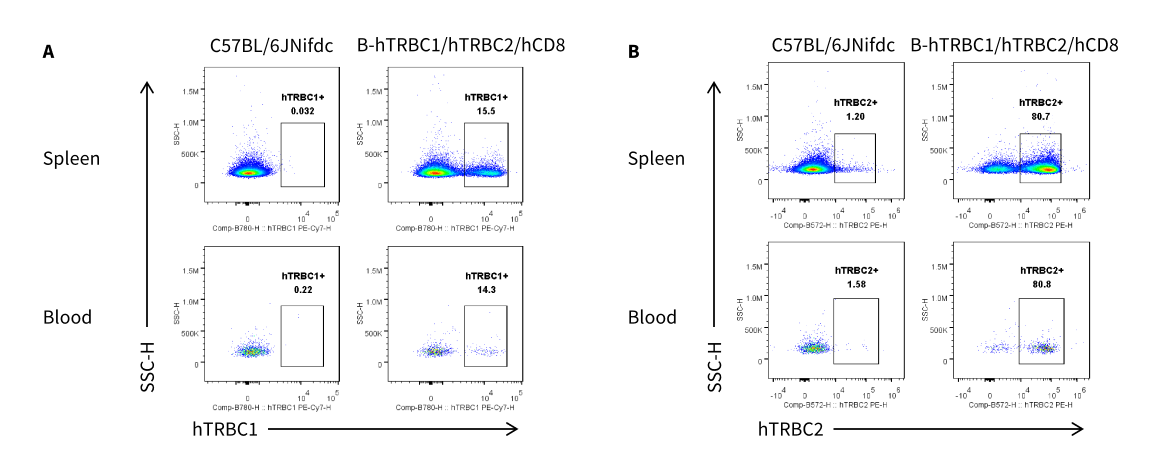
TRBC1 and TRBC2 Protein Expression Analysis
Strain-specific TRBC1 and TRBC2 expression analysis in homozygous B-hTRBC1/hTRBC2/hCD8 mice by flow cytometry. Splenocytes and blood cells were collected from wild-type (WT) C57BL/6JNifdc mice and homozygous (HO) B-hTRBC1/hTRBC2/hCD8 mice (male, 8-week-old, n = 3). TRBC1 and TRBC2 expression were analyzed by flow cytometry using anti-human TRBC1 antibody (BioLegend, 383515) and anti-TRBC2 antibody (BD, 571190).
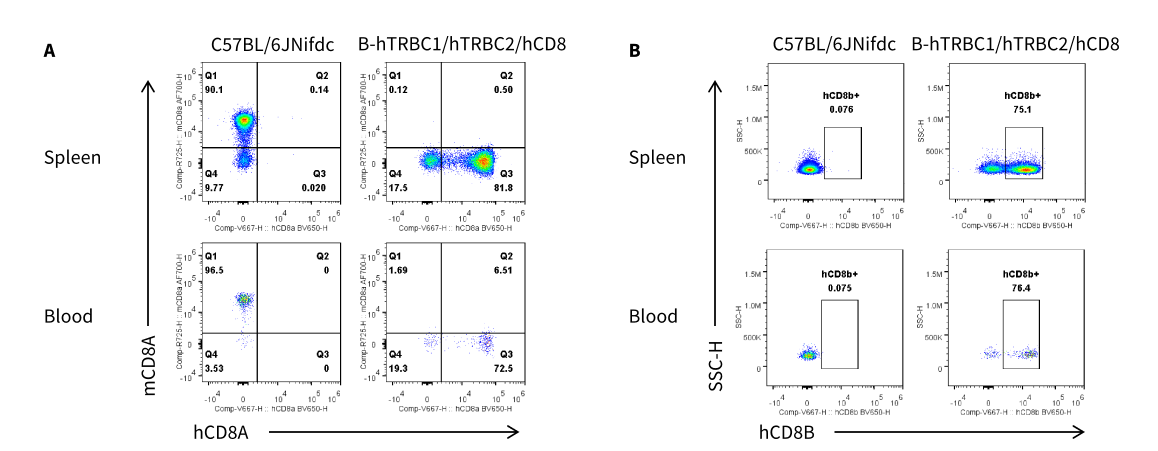
CD8 Expression in Spleen T Cells
Strain-specific CD8 expression analysis in homozygous B-hTRBC1/hTRBC2/hCD8 mice by flow cytometry. Splenocytes and blood cells were collected from wild-type (WT) C57BL/6JNifdc mice and homozygous (HO) B-hTRBC1/hTRBC2/hCD8 mice (male, 8-week-old, n = 3). CD8 expression was analyzed by flow cytometry using anti-mouse CD8 antibody (BioLegend, 100730), anti-human CD8A antibody (BioLegend, 300908) and anti-human CD8B antibody (BD, 742392).
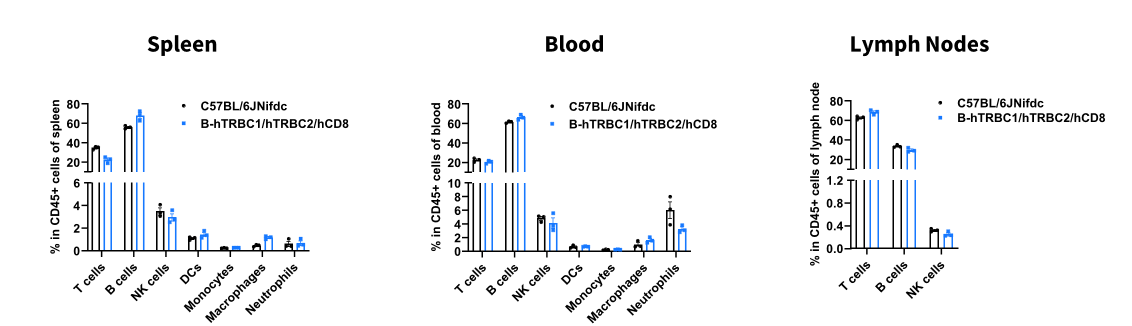
Analysis of Leukocyte Subpopulations
Analysis of leukocyte subpopulations by flow cytometry in immune organs and blood. Splenocytes, peripheral blood, lymph nodes and thymus were isolated from male C57BL/6JNifdc and B-hTRBC1/hTRBC2/hCD8 mice (male, 8-week-old, n = 3). Single live cells were gated on the CD45⁺ population and analyzed by flow cytometry as indicated. Values are expressed as mean ± SEM.
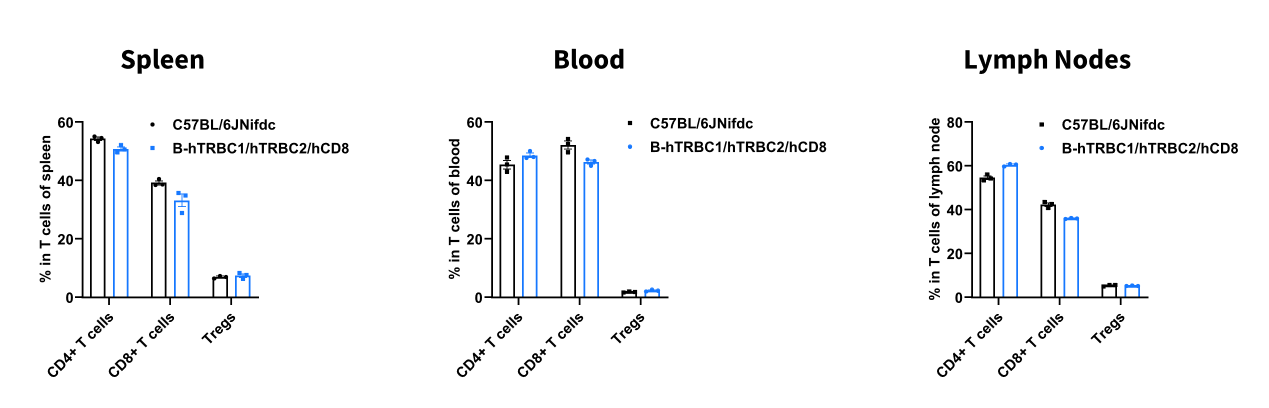
Analysis of T Cell Subpopulations
Analysis of T-cell subpopulations by flow cytometry in immune organs and blood. Splenocytes, peripheral blood, lymph nodes and thymus were isolated from male C57BL/6JNifdc and B-hTRBC1/hTRBC2/hCD8 mice (male, 8-week-old, n = 3). Single live cells were gated on the CD3⁺ T-cell population and analyzed by flow cytometry as indicated. Values are expressed as mean ± SEM.
* When publishing results obtained using this animal model, please acknowledge the source as follows: The animal model [B-hTRBC1/hTRBC2/hCD8 mice] (Cat# 114476) was purchased from Biocytogen.