Description
ALB/FcRn: Key mechanism in albumin homeostasis and half-life extension
- Cellular Uptake: Native and altered (e.g., oxidized) albumin molecules in the blood are internalized into the cell via fluid-phase endocytosis into endocytic vesicles, which then fuse to form acidified endosomes.
- pH-Dependent Binding: Within the acidic lumen of the endosome (pH < 6.5), FcRn receptors selectively bind to intact albumin molecules, whereas altered or damaged albumin fails to bind and remains free in the lumen.
- Recycling Pathway: FcRn-bound intact albumin is routed into recycling endosomes, transported back to the cell surface, and released back into the blood upon exposure to physiological pH (~7.4), thereby extending its serum half-life.
- Lysosomal Degradation: Unbound, altered albumin molecules are transferred from the endosomes directly to lysosomes, where they undergo enzymatic degradation to maintain systemic protein quality control.
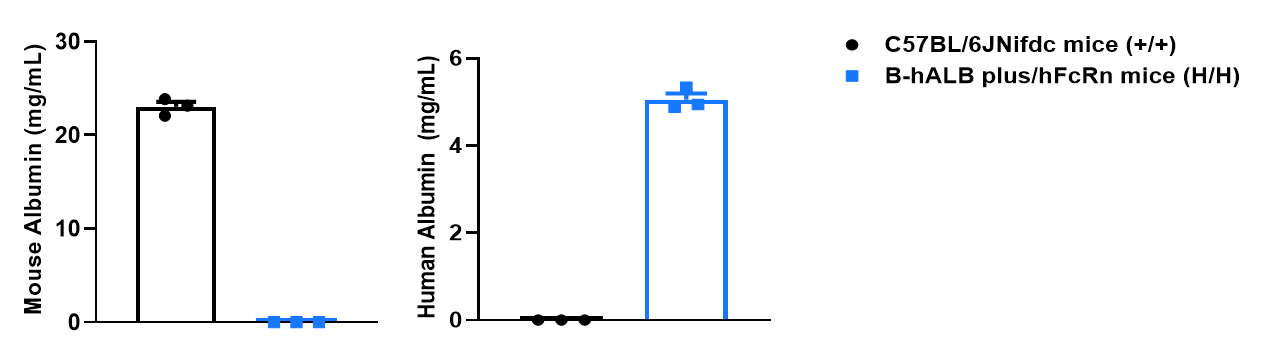
Albumin Protein Expression Analysis of ALB/FcRn Humanized Mice (B-hALB plus/hFcRn)
- Mouse Albumin was detected in wild-type mice.
- Human Albumin was detected in homozygous ALB/FcRn humanized mice, but not in wild-type mice.
Strain-specific ALB expression was evaluated by ELISA in wild-type C57BL/6 mice and ALB/FcRn humanized mice. Serum was collected from wild-type C57BL/6JNifdc (+/+) and B-hALB plus/hFcRn mice(H/H). Expression levels of human ALB were analyzed by ELISA (mouse ALB ELISA kit: Abcam, ab207620; human ALB ELISA kit: Abcam, ab179887). Values are expressed as mean ± SEM.
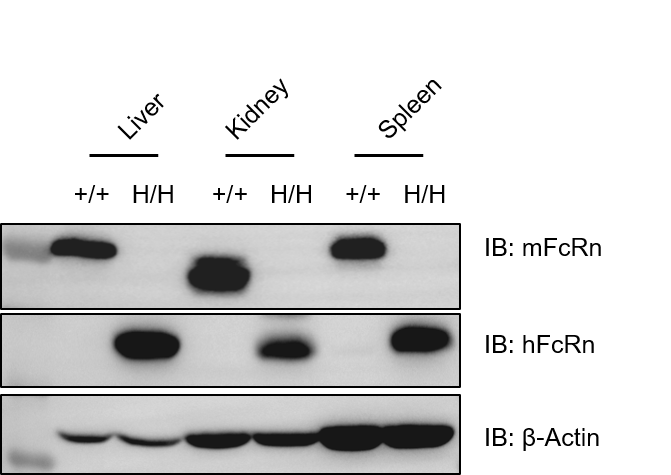
FcRn Protein Expression Analysis of ALB/FcRn Humanized Mice (B-hALB plus/hFcRn)
- Mouse FcRn was detected in wild-type mice.
- Human FcRn was detected in homozygous ALB/FcRn humanized mice, but not in wild-type mice.
Strain-specific FcRn expression was evaluated by Western blot in wild-type C57BL/6 mice and ALB/FcRn humanized mice. Various tissue lysates were collected from wild-type C57BL/6JNifdc (+/+) and B-hALB plus/hFcRn mice (H/H), and then analyzed by western blot with anti-mouse FcRn antibody (R&D, AF6775) and anti-human FcRn antibody (Novus Biologicals, NBP1-89128). 40 μg of total protein was loaded for Western blot analysis.
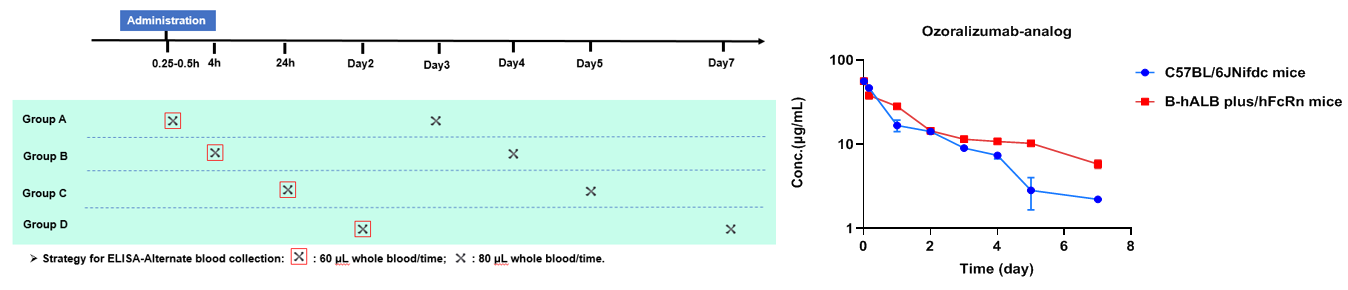
Nanobody PK Study in ALB/FcRn Humanized Mice (B-hALB plus/hFcRn)
- The in-house Ozoralizumab analog showed a markedly longer half-life in ALB/FcRn humanized mice versus C57BL/6 controls, indicating target engagement with human albumin and effective in vivo half-life extension.
Pharmacokinetic characteristics of wild-type C57BL/6JNifdc mice and homozygous ALB/FcRn humanized mice. C57BL/6JNifdc mice and homozygous B-hALB plus/hFcRn mice were injected intravenously with Ozoralizumab analog (in-house) at time 0 (n=12). Blood samples were collected at different time points for the PK assay. This antibody can recognize both MSA (mouse serum albumin) and HSA (human serum albumin), leading to the speculation that its affinity for HSA would be higher than for MSA.
* When publishing results obtained using this animal model, please acknowledge the source as follows: The animal model [B-hALB plus/hFcRn mice] (Cat# 113043) was purchased from Biocytogen.