
在此页面上

Biocytogen’s proprietary RenTCR™ platform utilizes genetically engineered mice carrying human TCRα/β gene loci and human HLA molecules to generate diverse human-sequence TCR candidates through in vivo T-cell development and antigen-driven immune responses. The platform enables discovery of antigen-specific TCRs across different HLS restrictions, supporting the development of TCR-T cell therapies and soluble TCR therapeutics.
For the PRAME program, RenTCR™ enabled the identification and functional selection of HLA-A*24:02-restricted TCR candidates. These candidates demonstrated enhanced functional peptide sensitivity compared with human donor-derived benchmarks, as well as potent cytotoxicity and antitumor activity in preclinical melanoma models.
The PRAME-specific TCR program is being developed for HLA-A*24:02-positive, PRAME-positive solid tumors, with melanoma supported by in vivo efficacy studies. PRAME expression across ovarian, uterine, breast, and lung cancers provides a rationale for further indication-specific evaluation.

The preclinical data package for HLA-A*24:02-restricted PRAME-specific TCRs includes nanomolar functional peptide sensitivity, selective antigen recognition supported by epitope mapping, alanine-scanning, proteome-wide X-scan profiling, and broad cell line panel screening. Functional validation includes in vitro tumor-cell cytotoxicity and IFN-γ production, alongside robust in vivo antitumor efficacy and survival assessment in melanoma xenograft models. Together, these findings support the further development of RenTCR™-derived candidates as potential TCR-based therapies for HLA-A*24:02-positive, PRAME-positive solid tumors.
(Representative data are shown below. The full data package is available upon request.)
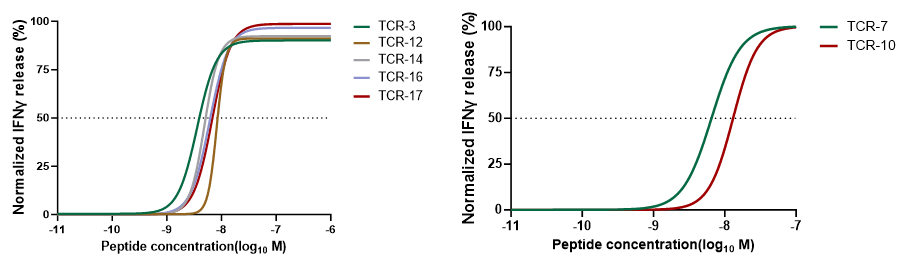
Figure 1. RenTCR™-derived PRAME-specific TCRs demonstrate nanomolar functional peptide sensitivity across two distinct PRAME epitopes. Human T cells expressing candidate TCRs were stimulated with T2 cells loaded with serial dilutions of PRAME 254–262 (PYLGQMINL; TCR-3, TCR-12, TCR-14, TCR-16, and TCR-17) or PRAME 301–309 (LYVDSLFFL; TCR-7 and TCR-10) peptides. All candidate TCRs elicited dose-dependent IFN-γ responses at nanomolar peptide concentrations (EC50 = 3.6 nM for TCR-3 and 13 nM for TCR-10). Data are normalized to maximum IFN-γ release and fitted using a four-parameter logistic model.
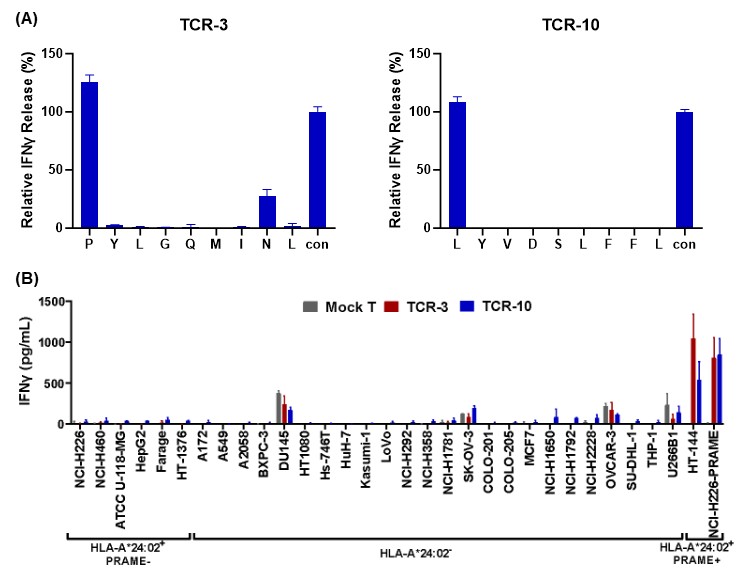
Figure 2. RenTCR™-derived PRAME-specific TCRs demonstrate selective peptide recognition and minimal off-target cell line reactivity. (A) Alanine scanning identified residues critical for recognition by TCR-3 (PYLGQMINL) and TCR-10 (LYVDSLFFL). IFN-γ release was measured by ELISA after TCR-transduced human T cells were exposed to variant peptide-loaded T2 cells. (B) Cell line screening showed generally low IFN-γ responses across PRAME-negative or HLA-A*24:02-negative cell lines, while TCR-3 and TCR-10 produced strong responses against HLA-A24:02⁺/PRAME⁺ tumor cells (HT-144 and NCI-H226-PRAME). TCR-transduced T cells were co-cultured with the indicated cell lines for 18 hours at an effector-to-target ratio of 1.5:1, and IFN-γ release was measured by ELISA.
(Additional data on X-scan recognition motif identification for TCR-10, limited reactivity to proteome-wide predicted off-target peptides, and dose-response validation demonstrating hundred-fold lower avidity for potential off-target versus target epitopes are available upon request.)
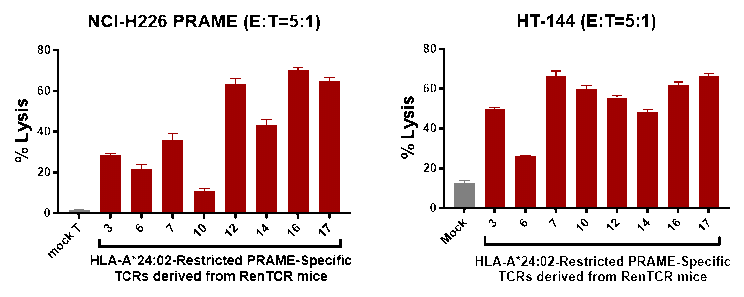
Figure 3. RenTCR™-derived PRAME-specific TCRs demonstrate potent in vitro tumor cell killing across PRAME-expressing tumor cell lines. Human T cells expressing candidate TCR-3 or TCR-10 were co-cultured with CFSE-labeled PRAME-overexpressing NCI-H226 and HT-144 target cells at an E:T ratio of 5:1 for 18 hours. Tumor cell lysis was quantified by flow cytometry. Both candidate TCRs mediated tumor cell killing compared with mock-transduced T cells, supporting functional recognition across tumor cell backgrounds.
(Additional data on IFN-γ production by T cells expressing PRAME-specific TCRs in response to tumor cell lines are available upon request.)
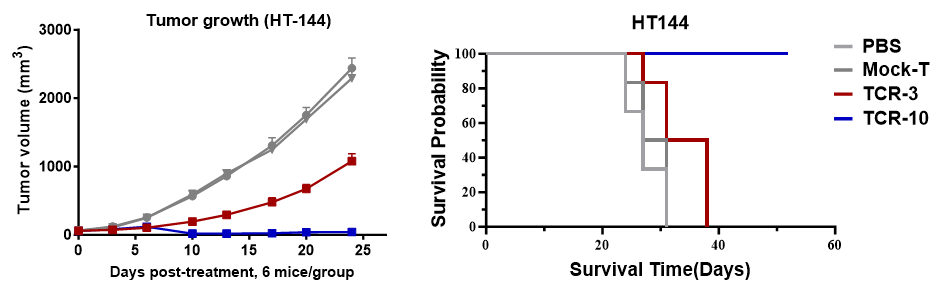
Figure 4. RenTCR™-derived PRAME-specific TCRs demonstrate robust in vivo antitumor activity and prolonged survival in melanoma xenograft model. NDG immunodeficient mice bearing established HLA-A*24:02-positive, PRAME-expressing HT-144 melanoma xenografts were treated with T cells expressing candidate TCR-3 or TCR-10. Both candidates inhibited tumor growth and extended survival compared with controls. Notably, TCR-10 induced complete tumor regression by day 10, with no tumor recurrence observed and 100% animal survival through the end of the study (>52 days).

Biocytogen welcomes partnership discussions to further evaluate this PRAME (HLA-A*24:02) TCR asset.

Biocytogen’s RenTCR™-derived PRAME-specific TCRs target the HLA-A*24:02-positive patient population, expanding therapeutic opportunity beyond the predominantly HLA-A*02:01-focused PRAME TCR landscape. Lead candidates recognize distinct PRAME epitopes with nanomolar sensitivity and demonstrate potent antitumor activity with no observed HLA cross-reactivity (~100-fold lower avidity for putative off-target peptide). Notably, TCR-10 achieved complete tumor regression and 100% animal survival in melanoma xenograft study. This profile supports their strong translational potential for PRAME-positive solid tumors.
PRAME (also known as CT130 or MAPE) is an intracellular cancer-testis antigen expressed across multiple epithelial and melanocytic malignancies, including melanoma, ovarian, uterine, breast, and lung cancers, while showing minimal expression in most normal tissues. As an intracellular antigen, PRAME is not directly accessible to conventional antibodies. TCR-based therapies overcome this limitation by recognizing PRAME-derived peptides presented by HLA-A*24:02 on the tumor cell surface, enabling selective T-cell-mediated tumor cell killing.
By combining in vivo immunization and T-cell selection in humanized TCR/HLA mice with high-throughput epitope validation and functional bioassays, the RenTCR™ platform enables the identification and prioritization of fully human TCR candidates prior to downstream engineering. This integrated workflow accelerates TCR discovery across diverse HLA restrictions and supports the generation of ready-to-use TCR libraries for therapeutic applications. For the PRAME program, this approach enabled the identification of multiple lead candidates with demonstrated recognition of endogenously processed PRAME antigen.
This preclinical asset is available for licensing and co-development. Qualified partners can access a comprehensive preclinical data package covering functional peptide sensitivity, alanine-scanning epitope mapping, cell line specificity profiling, in vitro tumor-cell cytotoxicity and IFN-γ release, as well as in vivo efficacy and survival in melanoma xenograft models. Contact Biocytogen to request the complete data package or discuss potential licensing and co-development opportunities.