Description
CD20: A B-cell surface marker modulating calcium influx and activation.
- Gene Information: Located on chromosome 11q12, the MS4A1 gene encodes CD20, a highly conserved hydrophobic transmembrane protein belonging to the membrane-spanning 4-domain family A member 1.
- Protein Expression: CD20 is expressed exclusively on the surface of B cells, spanning from the late pro-B stage through mature cells, but is notably absent on pluripotential stem cells and mature plasma cells.
- Signaling Pathway: Upon activation, CD20 functions as or regulates a store-operated calcium channel, altering intracellular calcium concentrations to modulate B-cell activation, differentiation, and cell-cycle progression.
- Therapeutic Inhibition: Monoclonal antibodies like rituximab target CD20 to deplete pathogenic B cells via antibody-dependent cellular cytotoxicity (ADCC), complement-dependent cytotoxicity (CDC), and direct induction of apoptosis.
CD22: CD22 negatively regulates B cell receptor activation via inhibitory signaling.
- Gene Information: Located on human chromosome 19q13.12, the CD22 gene encodes a transmembrane glycoprotein belonging to the Siglec family that recognizes sialic acid-containing glycans on immune cells.
- Protein Expression: CD22 is specifically expressed on mature B lymphocytes, appearing during late pre-B cell development and lost upon differentiation into antibody-secreting plasma cells or lymphoblasts.
- Signaling Pathway: Upon ligand engagement, CD22 undergoes ITIM phosphorylation by Lyn kinase, recruiting SHP-1 phosphatase to dephosphorylate downstream signaling molecules, thereby dampening calcium influx and BCR activation.
- Therapeutic Inhibition: Targeting CD22 with antibody-drug conjugates or CAR-T cell therapies selectively eliminates malignant B cells in acute lymphoblastic leukemia and non-Hodgkin lymphoma treatments.
BCMA: BCMA drives plasma cell survival through NF-$\kappa$B pathway activation.
- Gene Information: Located on human chromosome 16p13.13, the TNFRSF17 gene encodes B-cell maturation antigen (BCMA), a type I transmembrane glycoprotein belonging to the tumor necrosis factor receptor superfamily.
- Protein Expression: BCMA is selectively expressed on mature B lymphocytes, preferentially upregulated in plasmablasts and terminally differentiated plasma cells, while absent on naive B cells and non-hematopoietic tissues.
- Signaling Pathway: Binding of APRIL or BAFF triggers BCMA trimerization, recruiting TRAF complexes to activate NF-kappa B, AKT, and MAPK cascades, upregulated anti-apoptotic proteins to promote plasma cell survival.
- Therapeutic Inhibition: Targeting BCMA via CAR-T cells, bispecific antibodies, or antibody-drug conjugates induces selective clearance of malignant plasma cells in relapsed or refractory multiple myeloma.
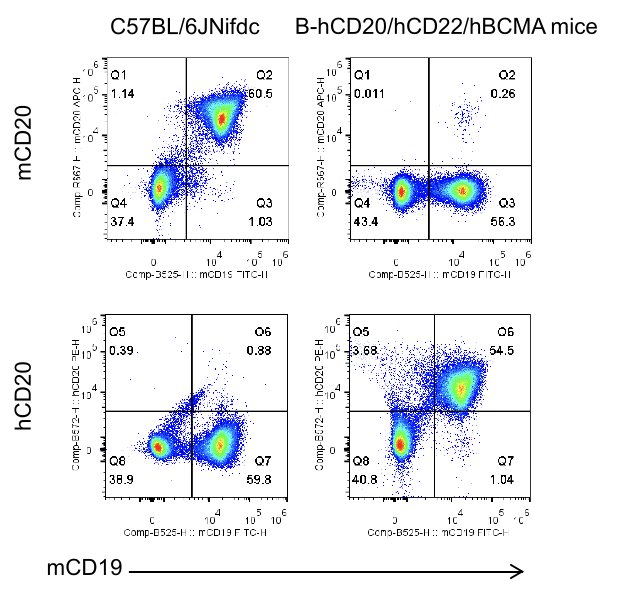
Human CD20 Protein Expression Analysis in Spleen of CD20/CD22/BCMA Humanized Mice
- Mouse CD20 was detectable in wild-type C57BL/6JNifdc mice.
- Human CD20 was detectable in homozygous CD20/CD22/BCMA humanized mice, but not in wild-type C57BL/6JNifdc mice.
Strain specific CD20 expression analysis in wild-type C57BL/6JNifdc mice and homozygous CD20/CD22/BCMA humanized mice by flow cytometry. Splenocytes were collected from wild-type C57BL/6JNifdc mice and homozygous B-hCD20/hCD22/hBCMA mice. Protein expression was analyzed with anti-mouse CD20 antibody (Biolegend, 152108) and anti-human CD20 antibody (Biolegend, 302305) by flow cytometry.
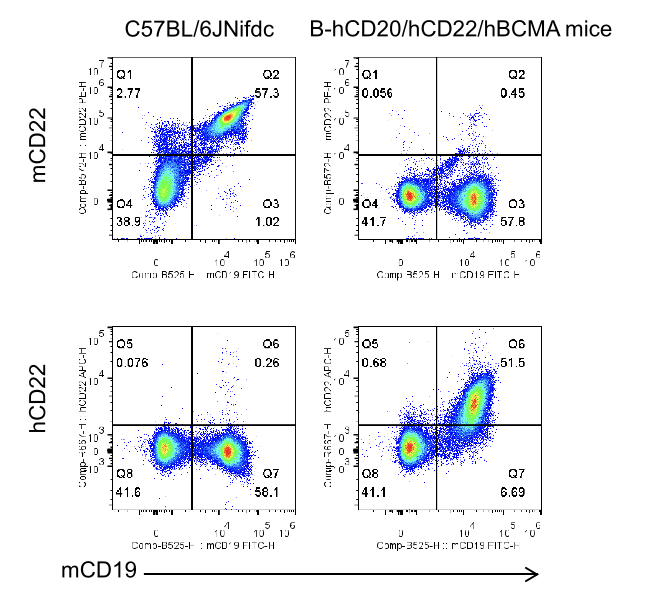
Human CD22 Protein Expression Analysis in Spleen of CD20/CD22/BCMA Humanized Mice
- Mouse CD22 was detectable in wild-type C57BL/6JNifdc mice.
- Human CD22 was detectable in homozygous CD20/CD22/BCMA humanized mice, but not in wild-type C57BL/6JNifdc mice.
Strain specific CD22 expression analysis in wild-type C57BL/6JNifdc mice and homozygous CD20/CD22/BCMA humanized mice by flow cytometry. Splenocytes were collected from wild-type C57BL/6JNifdc mice and homozygous B-hCD20/hCD22/hBCMA mice. Protein expression was analyzed with anti-mouse CD22 antibody (Biolegend, 126111) and anti-human CD22 antibody (Biolegend, 363505) by flow cytometry.
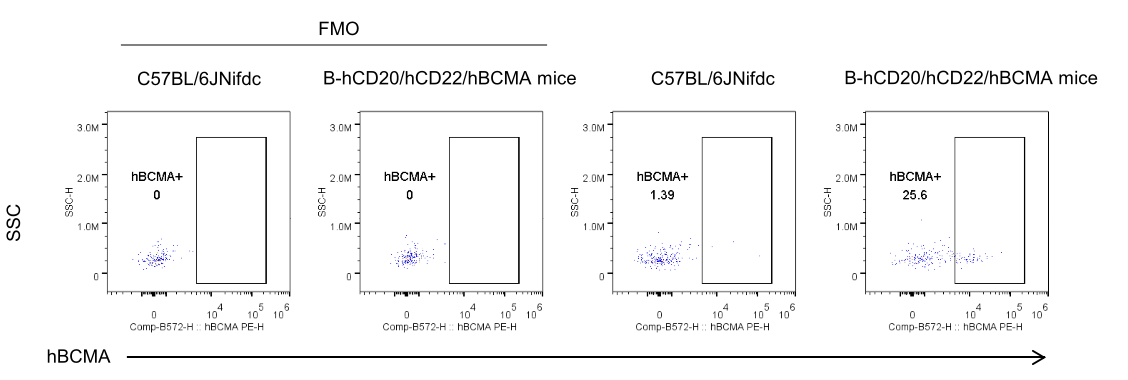
Human BCMA Protein Expression Analysis in Spleen of CD20/CD22/BCMA Humanized Mice
- Human BCMA was detectable in homozygous CD20/CD22/BCMA humanized mice, but not in wild-type C57BL/6JNifdc mice.
Strain specific BCMA expression analysis in wild-type C57BL/6JNifdc mice and homozygous CD20/CD22/BCMA humanized mice by flow cytometry. Splenocytes were collected from wild-type C57BL/6JNifdc mice and homozygous B-hCD20/hCD22/hBCMA mice. BCMA expression on plasma cells was analyzed with anti-human BCMA antibody (Biolegend, 357504) by flow cytometry.
* When publishing results obtained using this animal model, please acknowledge the source as follows: The animal model [B-hCD20/hCD22/hBCMA mice] (Cat# 114462) was purchased from Biocytogen.