Description
- Gene Information: CD98HC, encoded by the SLC3A2 gene, is a critical type II transmembrane glycoprotein. It functions primarily as a heavy chain that covalently associates via a disulfide bond with various light chains, such as LAT1 or LAT2.
- Protein Expression: Under normal physiological conditions, CD98HC is expressed moderately across various tissues, including the kidneys, intestinal epithelium, and placenta, where it maintains regular metabolic and transport functions. However, its expression is markedly upregulated in proliferating cells, activated lymphocytes, and a wide array of human malignancies, including carcinomas and melanomas.
- Signaling Pathway: CD98HC actively participates in intricate intracellular signaling networks by interacting directly with β1 and β3 integrins. This interaction modulates integrin-mediated signal transduction, promoting cell adhesion, migration, spreading, and survival.
- Application: Given its prominent role in cancer cell metabolism and immune activation, CD98HC has emerged as a promising therapeutic target in oncology and immunology. CD98HC-targeting antibodies or ligands enable receptor-mediated transcytosis across the blood-brain barrier, serving as an efficient shuttle to transport therapeutic drugs, proteins, and nanoparticles directly into the central nervous system.
Human CD98HC mRNA Expression Analysis in CD98HC Humanized Rats
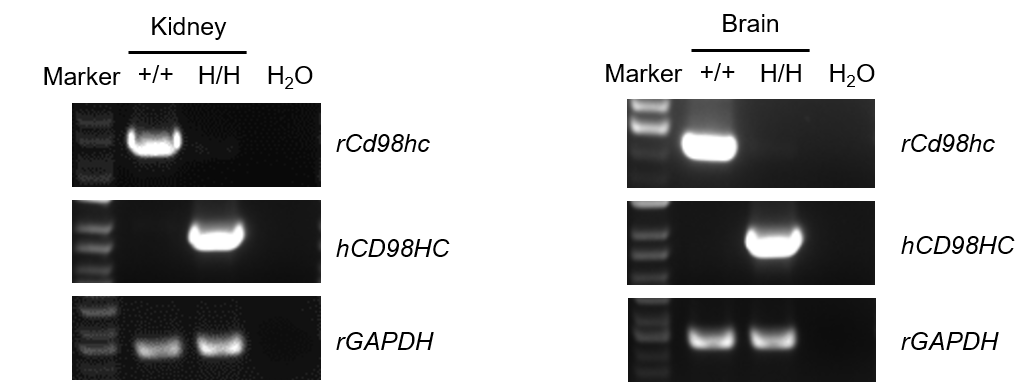
- Rat Cd98hc mRNA was detectable only in wild-type SD rats.
- Human CD98HC mRNA was detectable only in homozygous CD98HC humanized rats, but not in wild-type SD rats.
Species-specific CD98HC gene expression in wild-type SD rats and homozygous CD98HC humanized rats by RT-PCR. Kidney and brain tissues were collected from wild-type SD rats (+/+) and homozygous B-hCD98HC rats (H/H), and cDNA was synthesized by reverse transcription, followed by PCR with rat or human CD98HC primers.
Human CD98HC Protein Expression Analysis in Spleen of CD98HC Humanized Rats
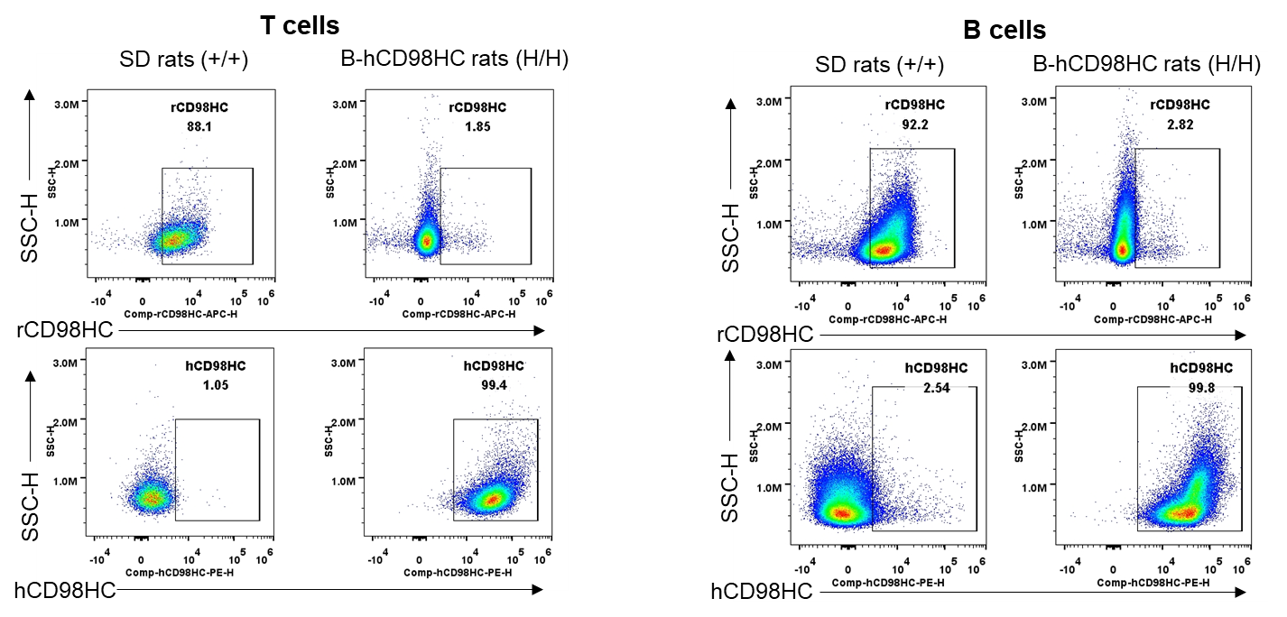
- Rat CD98hc is detectable only in wild-type SD rats.
- Human CD98HC is exclusively detectable in homozygous CD98HC humanized rats, but not in wild-type SD rats.
Strain specific CD98HC expression analysis in wild-type SD rats and homozygous CD98HC humanized rats. Splenocytes were collected from wild-type SD rats (+/+) and homozygous B-hCD98HC rats (H/H) (female, 7-week-old, n=1). Protein expression was analyzed with anti-mouse CD98HC antibody (Biolegend, 128211) and anti-human CD98HC antibody (Biolegend, 315603) by flow cytometry.
Human CD98HC Protein Expression Analysis Across Tissues of CD98HC Humanized Rats
- Human CD98HC was detected in the liver, spleen, lung, kidney, spinal cord, cortex, hippocampus, cerebellum, midbrain, thalamus and striatum of homozygous CD98HC humanized rats, and is absent in wild-type rats.
Western blot analysis of hCD98HC protein expression in homozygous CD98HC humanized rats. Various tissue lysates were collected from wild-type SD and homozygous B-hCD98HC rats (H/H), and then analyzed by western blot with species-specific anti-human CD98 antibody (Abcam, ab307587). 40 μg of total proteins were loaded for western blot analysis.
Functional Assay-Hematology Analysis of CD98HC Humanized Rats
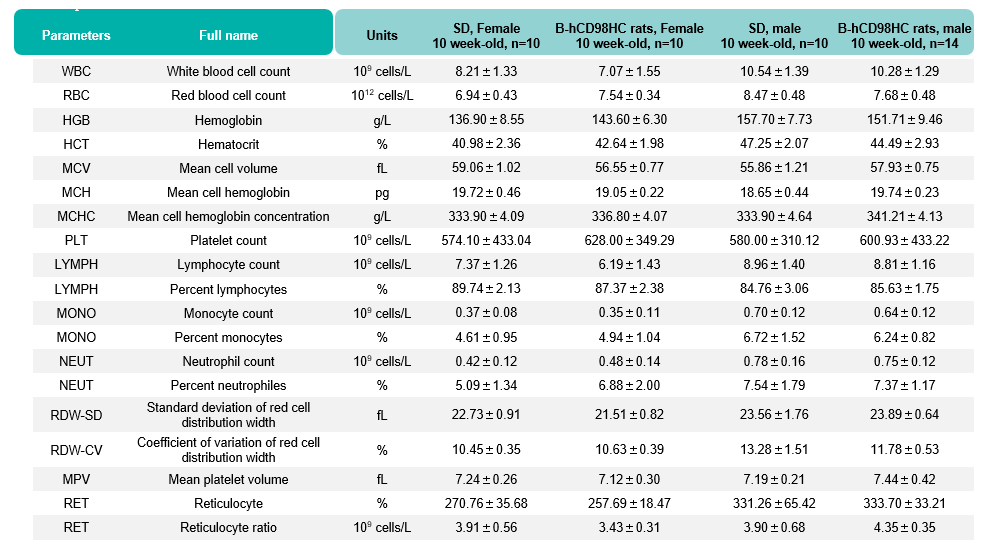
- Humanization of CD98HC does not alter hematological parameters
Values are expressed as mean ± SD.
Functional Assay-Biochemistry Analysis of CD98HC Humanized Rats
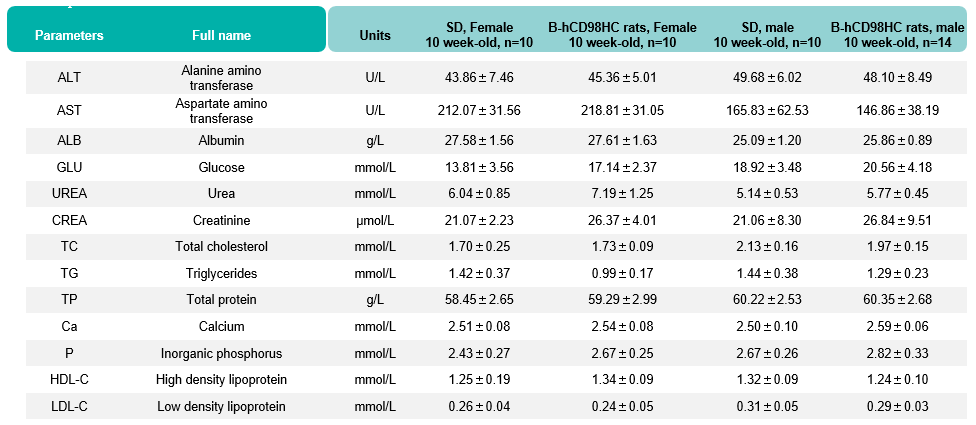
- Humanization of CD98HC does not alter various blood biochemical parameters
Values are expressed as mean ± SD.
Assessment of Brain Penetration of CD98HC Antibody in CD98HC Humanized Rats
- Antibody concentrations in brain parenchyma and whole brain were substantially elevated in the CD98HC humanized rats, demonstrating that CD98HC facilitates brain penetration of the anti-CD98HC antibody.
Brain pharmacokinetic (PK) analysis of anti-CD98HC antibody in CD98HC humanized rats. (A) Experimental design. B-hCD98HC rats were divided into two groups (female, n=12 per group) and received a single intravenous (i.v.) dose of 10 mg/kg anti-human CD98HC antibody (monovalent) or isotype. Brain tissues were collected at 15 min and on days 1, 5, and 10 post-administration after cardiac perfusion. (B) Serum, brain parenchyma and whole brain concentrations of anti-CD98HC antibody were measured by ELISA. Data are shown as mean ± SEM.
* When publishing results obtained using this animal model, please acknowledge the source as follows: The animal model [B-hCD98HC rats] (Cat# 113123) was purchased from Biocytogen.