
C57BL/6N-Gdf8tm1(GDF8)Bcgen/Bcgen • 112413

GDF8: A New Era in Muscle Growth Therapies.

GDF8
The exons 1-3 of the mouse Gdf8 gene that encode the full-length protein and 3’UTR are replaced by human counterparts in B-hGDF8 mice. The promoter and 5’UTR region of the mouse gene are retained. The human GDF8 expression is driven by the endogenous mouse Gdf8 promoter, while mouse Gdf8 gene transcription and translation will be disrupted.

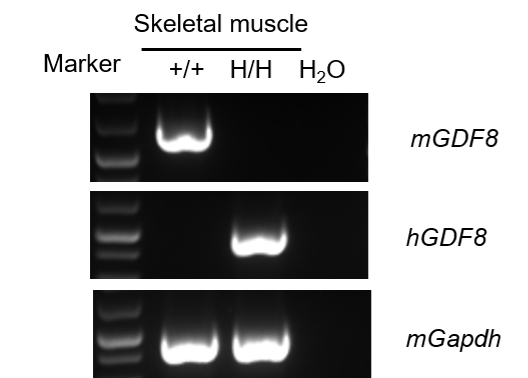
Strain specific analysis of GDF8 mRNA expression in wild-type C57BL/6 mice and B-hGDF8 mice by RT-PCR. Skeletal muscle RNA was isolated from wild-type C57BL/6 mice (+/+) and homozygous B-hGDF8 mice (H/H), then cDNA libraries were synthesized by reverse transcription, followed by PCR with mouse or human GDF8 primers. Mouse Gdf8 mRNA was detectable only in wild-type C57BL/6 mice. Human GDF8 mRNA was detectable only in homozygous B-hGDF8 mice but not in wild-type mice.

Human GDF8 mRNA expression in B-hGDF8 mice by RT-qPCR. Gastrocnemius, quadriceps, tibialis anterior, and soleus were collected from homozygous B-hGDF8 mice (H/H) (male, 10-week-old, n=5), then cDNA libraries were synthesized by reverse transcription, followed by RT-qPCR with human GDF8 primers. Human GDF8 mRNA was detectable in the muscle of homozygous B-hGDF8 mice. The expression of human GDF8 mRNA was normalized to the gastrocnemius tissue. Values are expressed as mean ± SEM.

Strain specific GDF8 expression analysis in homozygous B-hGDF8 mice by ELISA. Plasma was collected from wild-type C57BL/6 mice (+/+) and homozygous B-hGDF8 mice (H/H) (male, 6-week-old), and analyzed by ELISA (GDF-8/Myostatin Quantikine ELISA Kit: R&D, DGDF80). Human and mouse GDF8 proteins were both detectable in wild-type C57BL/6JNifdc and B-hGDF8 mice. The ELISA kit cross-recognized human and mouse GDF8. Values are expressed as mean ± SEM.

GDF8 expression analysis in homozygous B-hGDF8 mice by ELISA. Serum was collected from homozygous B-hGDF8 mice (H/H) (male and female, 6-week-old, n=5), and analyzed by ELISA (GDF-8/Myostatin Quantikine ELISA Kit: R&D, DGDF80). Human GDF8 protein was detectable in male and female B-hGDF8 mice. Values are expressed as mean ± SEM.


In Vivo Efficacy Study in HFD-Induced B-hGDF8 mice. B-hGDF8 mice were fed a high-fat diet for 14 weeks to induce obesity. After the induction, B-hGDF8 mice were treated with PBS, semaglutide, or GDF8 antibody. Body weight was monitored during the treatment. Lean tissue and fat tissue changes from Day-1 were analyzed by the body composition analyzer.
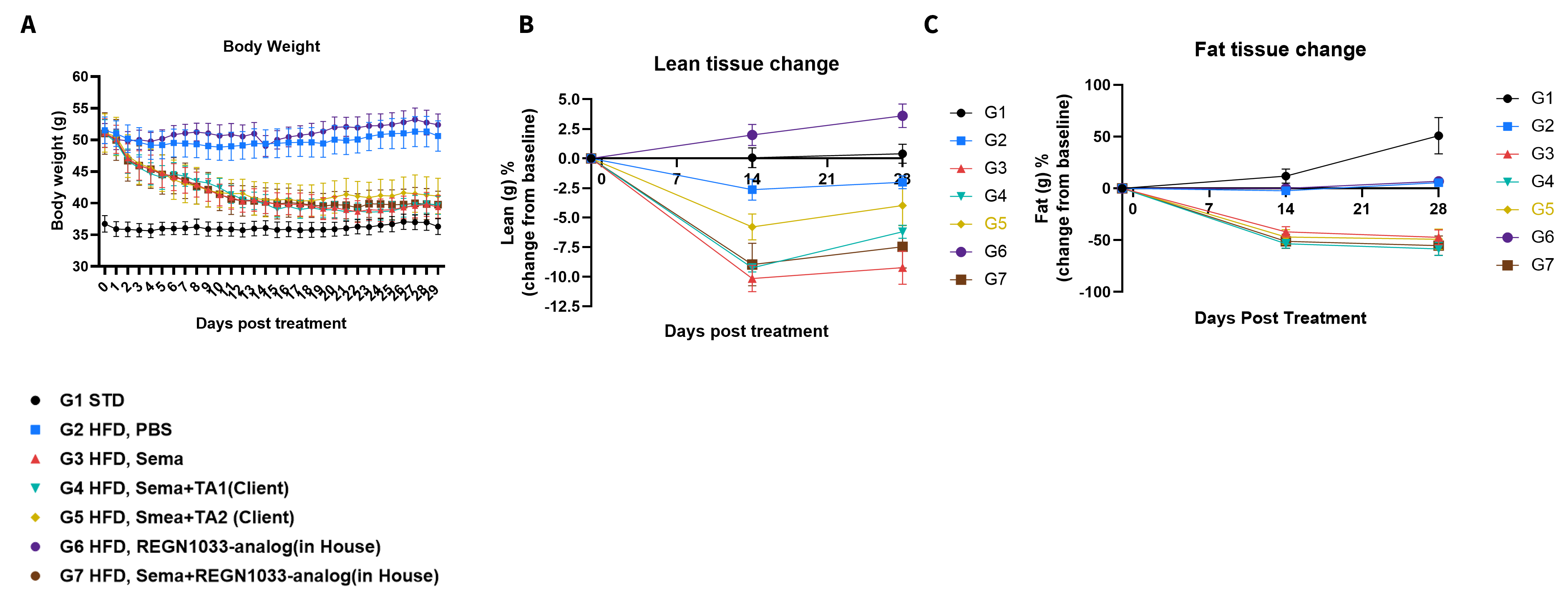
In Vivo Efficacy Study in HFD-Induced B-hGDF8 mice. B-hGDF8 mice were fed with a high-fat diet for 14 weeks to induce obesity. (A) Body weight change after treatment. (B) Lean tissue changes from Day-1 analyzed by the body composition analyzer. (C) Fat tissue changes from Day-1 analyzed by the body composition analyzer. Note: Data are shared upon the client's approval.
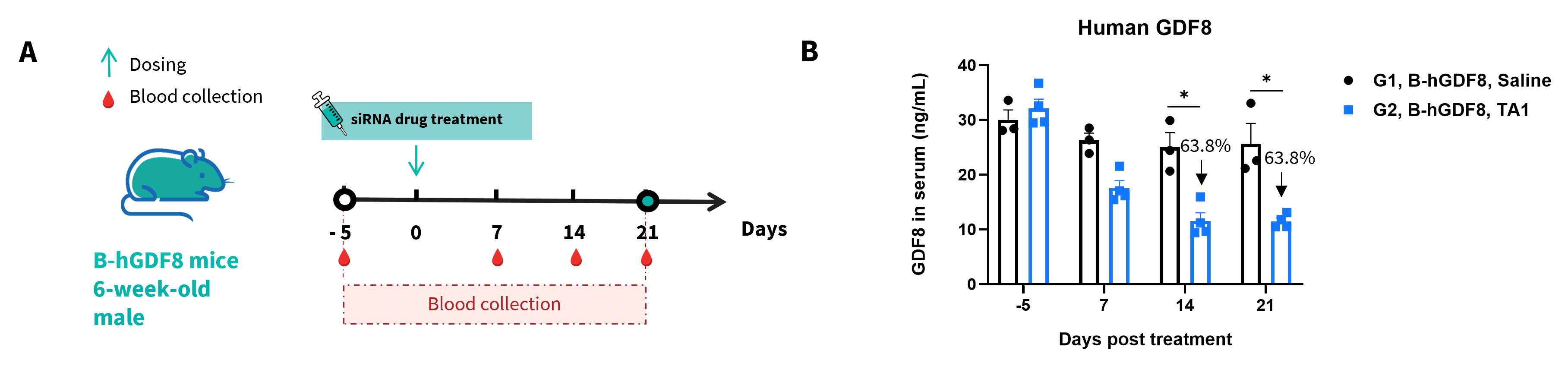
The inhibitory efficiency of the GDF8-targeted nucleic acid drugs in homozygous B-hGDF8 mice. B-hGDF8 mice were randomly divided into two groups (6-week-old, n=3-4). The human GDF8-targeted nucleic acid drug (provided by a client) and saline were administered to the mice individually. The nucleic acid drug was administered in the form of a saline aqueous solution. (A) The schematic diagram of experimental processing. (B) The changes in GDF8 protein expression levels in serum on days -5, 7, 14, and 21 after administration, compared to the levels before administration. Significance was determined by two-way ANOVA, *P<0.05. Values are expressed as mean ± SEM. Note: Data are shared upon the client's approval.