Description
RAGE: A key pattern recognition receptor in tissue injury and its therapeutic intervention
- Gene Information: Receptor for Advanced Glycation End-products (RAGE), also known as AGER, is a protein-coding gene located on chromosome 6p21.32. It encodes a multi-ligand transmembrane receptor belonging to the immunoglobulin superfamily.
- Protein Expression: RAGE is constitutively expressed at exceptionally high levels on lung alveolar type I epithelial cells. Its expression is dramatically upregulated across endothelial cells, vascular smooth muscle cells, and infiltrating leukocytes (macrophages, neutrophils) during inflammation and cellular stress.
- Signaling Pathway: RAGE exerts its biological effects by recognizing and binding a diverse array of damage-associated molecular patterns (DAMPs)—including advanced glycation end-products (AGEs), HMGB1, and S100 protein family members. Upon ligand binding, it triggers robust downstream activation of the canonical NF-κB, MAPK, and JAK/STAT pathways, setting off a chronic, self-sustaining inflammatory loop.
- Therapeutic Inhibition: By blocking RAGE or neutralizing its interactions with extracellular DAMPs, candidate therapeutics (such as azeliragon or sRAGE decoy analogs) inhibit downstream inflammatory amplification, tissue remodeling, and endothelial dysfunction, aiming to improve clinical outcomes in diabetic complications, acute lung injury, and chronic inflammatory diseases.
Targeting strategy
RAGE
- The exons 1~11 of mouse Rage gene that encode the full-length protein were replaced by human RAGE exons 1~11 in B-hRAGE mice.
- The endogenous mouse promoter, 5′ UTR, and 3′ UTR regions are retained, allowing human RAGE expression to be driven by the native mouse Rage promoter, while endogenous mouse Rage transcription and translation are abolished.
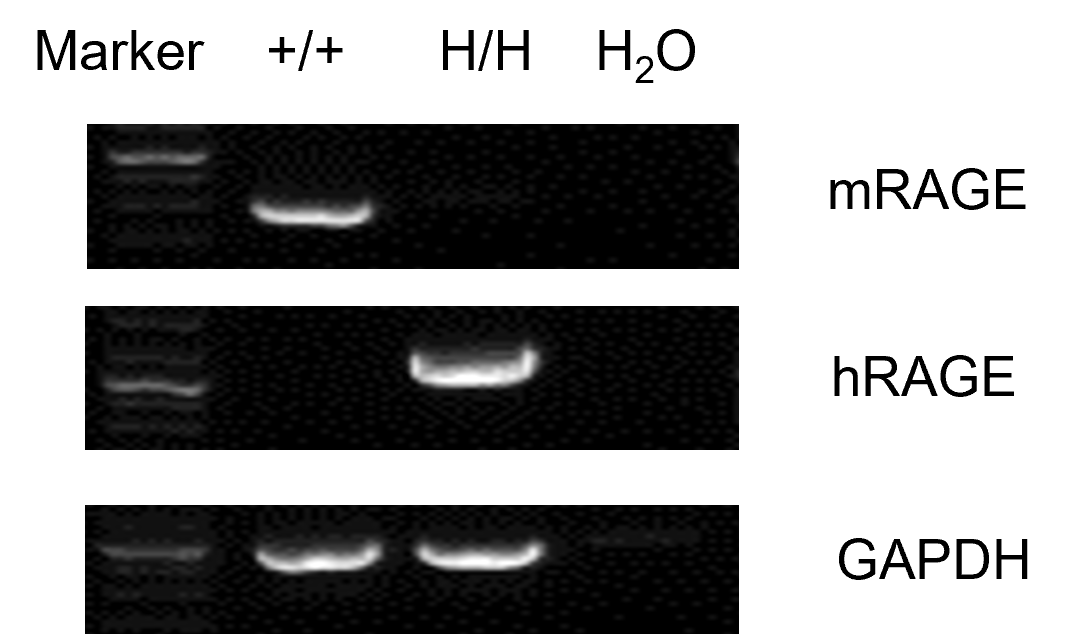
RAGE mRNA Expression by RT-PCR in Lung
- Human RAGE mRNA was exclusively detectable in B-hRAGE mice.
Strain specific analysis of RAGE gene expression in wild-type C57BL/6 and B-hRAGE mice by RT-PCR. Mouse Rage mRNA was detectable in splenocytes of wild-type mice. Human RAGE mRNA was detectable only in B-hRAGE mice, but not in wild-type mice.
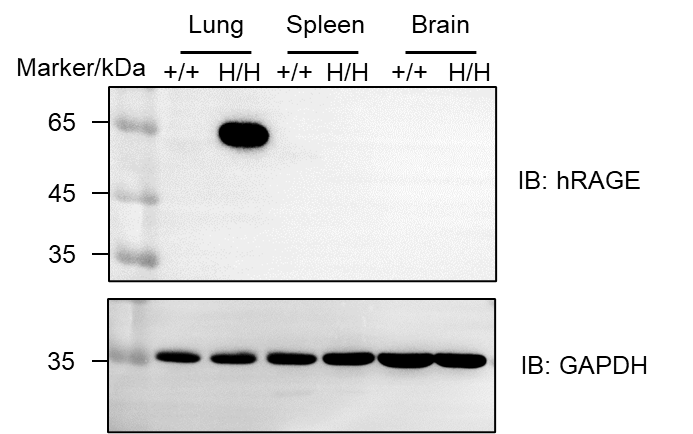
RAGE Protein Expression in Lung
- Human RAGE protein was exclusively detectable in B-hRAGE mice.
Western blot analysis of RAGE protein expression in homozygous B-hRAGE mice. Lung, spleen, and brain tissue lysates were collected from wild-type C57BL/6N mice (+/+), homozygous B-hRAGE mice (H/H), and then analyzed by western blot with species-specific anti-RAGE antibody(R&D, MAB11451). 40 μg total proteins were loaded for western blotting analysis. RAGE was detectable in lung of homozygous B-hRAGE mice.
Soluble RAGE Protein Expression in Serum
- Human RAGE protein was exclusively detectable in B-hRAGE mice.
Strain specific RAGE expression analysis in wild-type C57BL/6N mice and homozygous humanized B-hRAGE mice by ELISA. Serum was collected from wild-type C57BL/6N mice (+/+) (male, n=3, 7-week-old) and homozygous B-hRAGE mice (H/H) (male, n=3, 7-week-old). Expression level of mouse and human RAGE were analyzed by ELISA (Human RAGE Quantikine ELISA Kit: R&D, DRG00). Human RAGE was exclusively detectable in homozygous B-hRAGE mice(n=3). Values are expressed as mean ± SEM.
Soluble RAGE Protein Expression in Lung
- Human RAGE protein was exclusively detectable in B-hRAGE mice.
Strain specific RAGE expression analysis in wild-type C57BL/6N mice and homozygous humanized B-hRAGE mice by ELISA. Lung homogenates were collected from wild-type C57BL/6N mice (+/+) (male, n=3, 7-week-old) and heterozygous B-hRAGE mice (H/H) (male, n=3, 7-week-old). Expression level of mouse and human RAGE were analyzed by ELISA (Human RAGE Quantikine ELISA Kit: R&D, DRG00). Human RAGE was exclusively detectable in homozygous B-hRAGE mice(n=3). Values are expressed as mean ± SEM.
* When publishing results obtained using this animal model, please acknowledge the source as follows: The animal model [B-hRAGE mice] (Cat# 111107) was purchased from Biocytogen.