Description
Background:
- CD161, also known as NKRP1A or KLRB1, is primarily an inhibitory receptor expressed on natural killer (NK) cells. It suppresses NK cell cytotoxicity and inhibits IFN-γ release upon binding to LLT1, which is expressed on the surface of other cells such as cancer cells. Beyond this, the interaction between NKRP1A and LLT1 in T and B lymphocytes appears to be involved in their activation and may play a role in inflammatory responses and the pathogenesis of autoimmune diseases. Therefore, NKRP1A/LLT1 can serve as a potential therapeutic target for treating tumors, autoimmune disorders, inflammation, and bone disorders.
Targeting strategy:
- The exons 1-6 of mouse Klrb1 gene that encode the whole molecule including 5’UTR and 3’UTR were replaced by human counterparts in B-hCD161 mice.
Validation:
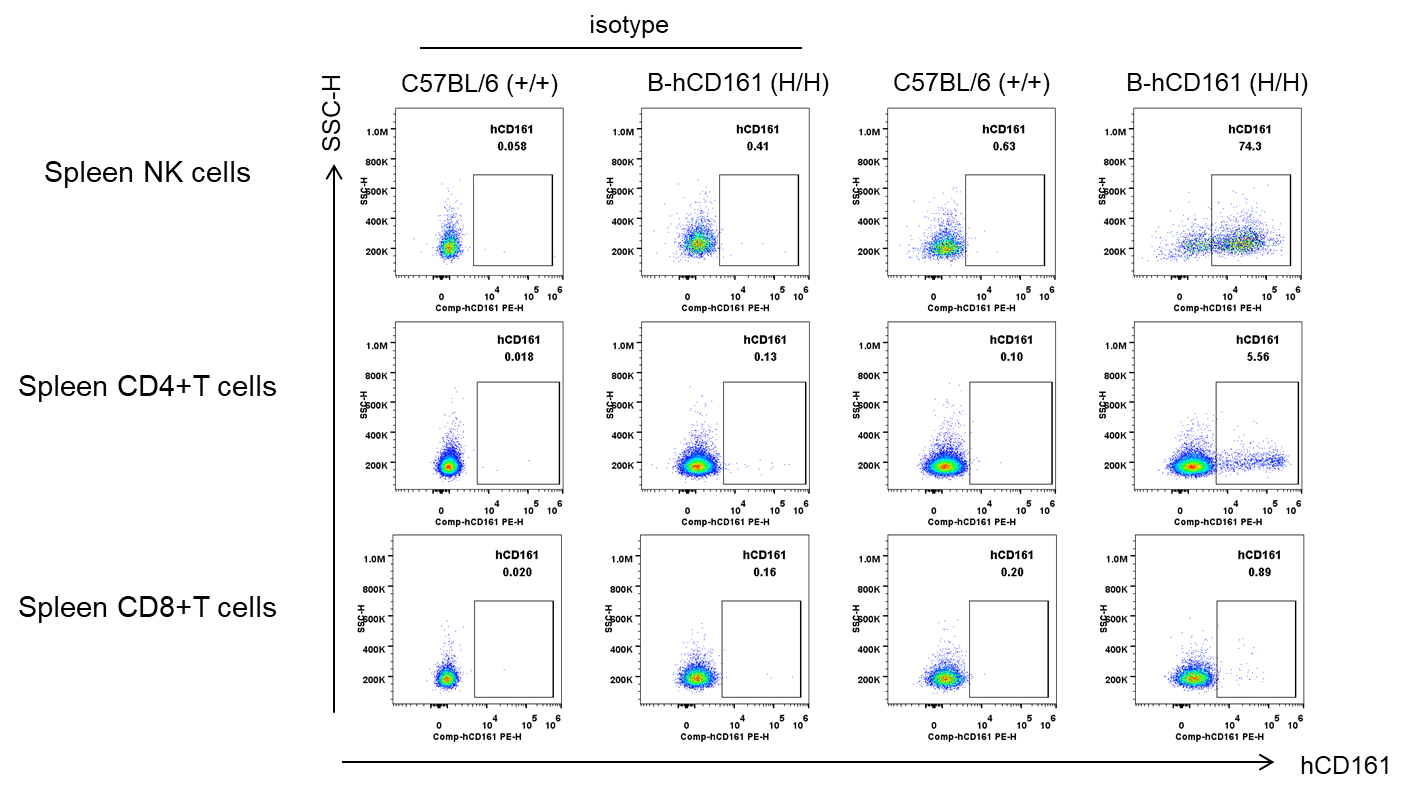
- Human CD161 protein was exclusively detectable on NK cells and CD4+ T cells from spleen of B-hCD161 mice, but not wild-type C57BL/6 mice.
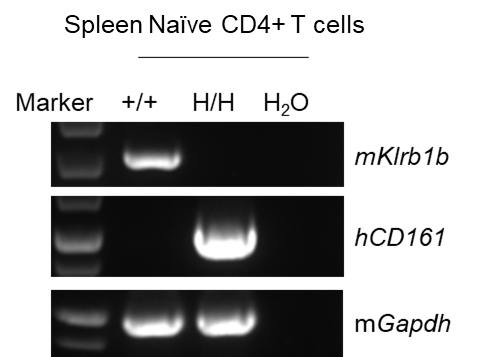
- Human CD161 mRNA was exclusively detectable on naïve CD4+ T cells from spleen of B-hCD161 mice, but not wild-type C57BL/6 mice.
Application:
- This product is used for the pharmacological and safety evaluation of specific anti-CD161 antibodies.
Targeting Strategy
Gene targeting strategy for B-hCD161 mice. The exons 1-6 of mouse Klrb1 gene that encode the whole molecule including 5’UTR and 3’UTR were replaced by human counterparts in B-hCD161 mice.
mRNA expression analysis
Strain specific analysis of CD161 mRNA expression in wild-type C57BL/6 mice and B-hCD161 mice by RT-PCR. Naïve CD4+ T cells RNA from spleen were isolated from wild-type C57BL/6 mice (+/+) and homozygous B-hCD161 mice (H/H), then cDNA libraries were synthesized by reverse transcription, followed by PCR with mouse Klrb1b or human CD161 primers. Mouse Klrb1b mRNA was detectable only in wild-type C57BL/6 mice. Human CD161 mRNA was detectable only in homozygous B-hCD161 mice but not in wild-type mice.
Protein expression analysis
Strain specific CD161 expression analysis in wild-type C57BL/6 mice and homozygous humanized B-hCD161 mice by flow cytometry. Splenocytes were collected from wild-type C57BL/6 mice (+/+) and homozygous B-hCD161 mice (H/H). Protein expression was analyzed with anti-human CD161 antibody (Biolegend, 339904) by flow cytometry. Human CD161 was exclusively detectable on NK cells and CD4+ T cells from spleen of homozygous B-hCD161 mice, but not wild-type C57BL/6 mice.
* When publishing results obtained using this animal model, please acknowledge the source as follows: The animal model [B-hCD161 mice] (Cat# 112794) was purchased from Biocytogen.